


The EU Reset is bad for British taxpayers, British youths, and British businesses. This report by economist Catherine McBride OBE, published by the Great British Business Council, sets out what the UK gives up under the EU Reset and what it will cost.
By Catherine McBride OBE

Contents
- Executive Summary
- Introduction
- Section II. Security, defence and development cooperation
- Section III. Putting people at the centre of the EU-UK relationship
- How much are UK University fees
- The true cost of EU students
- UK youth unemployment is rising due to wage and employment tax increases
- How many EU nationals could come to the UK under the Reset scheme?
- Grants for Strategic Partnerships and Jean Monnet funding
- What else could the UK do with £810 million?
- Massive UK student debt for a real degree, but taxpayer subsidies for EU short course jollies
- Section IV. Strengthening our economies while protecting our planet and its resources
- Part 1. Joining the EU’s Internal Electricity Market and its Emission Trading System
- A. Joining the EU’s Internal Electricity Market
- What is the EU Internal Electricity Market?
- What would be the benefits to the UK of joining the EU’s electricity market?
- How would IEM differ from EU UK electricity trading now?
- How much would the UK have to pay?
- Loss of sovereignty, State Aid, and control of UK environmental regulations.
- What if a Member State is persistently under‑contributing? (Asking for a friend)
- The UK will have to comply with EU State Aid Rules
- Rule taking
- EU Internal Electricity Market Conclusion
- B. Joining the EU’s Emission Trading System
- Background
- Differences in EU and UK ETS schemes
- Costs to the UK of joining the EU’s ETS
- What is causing the price differential between the EU and UK ETS
- C. Aligning with the EU’s Carbon Border Adjustment Mechanism
- EU CBAM charges on UK exports could be minimal
- EU CBAM calculations
- Emissions default values – according to the EU
- Comparative advantage without joining the EU’s ETS and CBAM
- The EU’s CBAM coverage does not help the UK
- Joining the EU’s CBAM will make UK exports less competitive
- What is the purpose of the UK-EU Reset and ETS alignment?
- UK deindustrialisation and fertiliser production.
- Steel exports benefit if the UK doesn’t join the EU ETS and CBAM
- Part 2. Joining the EU’s SPS Area and following its food and agricultural regulations
- Department for Food, Agriculture and Rural Affairs response to EU SPS Agreement
- Why is the government imposing this upheaval and expense on British businesses?
- Why won’t the Reset increase UK agrifood exports to the EU?
- Who will be hurt the most by these changes?
- Potential Benefits from alignment
- Cui Bono – who stands to gain?
- Logistics and border control
- UK’s agricultural technology industry – in danger from EU SPS alignment.
- Biosecurity – the real risk from certificate-free borders
- Current DEFRA restrictions on EU agrifood
- Other costs from the SPS agreements product scope
- The Costs of dynamic alignment with the EU’s food and farming regulations
- Section V. Internal security and judicial cooperation
- Conclusion and total Reset cost estimates
Executive Summary
- In every single part of the Reset, the UK would be giving up its sovereignty and agreeing to blindly follow EU regulations.
- The UK would become a rule-taker with an obligation to adopt EU laws immediately and exactly. Even when the rules do not suit the UK economy, do not apply to it, or lower UK standards.
- Dynamic alignment means identical rules, on the EU’s timetable and on their agenda, with no British involvement or right of veto.
- All future UK laws in the areas covered by the EU Reset will be EU laws and, therefore, under the exclusive jurisdiction of the European Court of Justice. The UK’s government and courts will have no ability to alter them.
- Britain would pay for the privilege of obeying. The Reset will cost British taxpayers, businesses, and universities an estimated £17.6 billion in 2027, rising to £20.5 billion per annum by the 2030s, with an additional £12 billion in one-off compliance costs. This does not include other potential costs, such as the loss of the UK’s Agtech industry if the government cannot secure a regulatory carve-out.
- In addition, the UK is committing to a PERMANENT contribution to the EU Cohesion Fund, which levels up poorer parts of the EU. The UK will not be eligible to receive funds from the Cohesion Fund. The UK would be borrowing more to send money to the EU.
- The UK would also be expected to subsidise EU youths up to the age of 30 to freely move to the UK and benefit from subsidised university fees, free NHS access, and the ability to apply to bring their family members with them.
- The cost would be£2.7 billion in lost fee income for UK universities, lost Immigration Health Surcharge payments, and lost opportunities for UK youth.
- British 18- to 24-year-olds — already facing 16% unemployment with a million NEETs for the first time ever – would have to compete with nearly 3 million unemployed EU youths for jobs and with 19 million EU students for university places.
- Erasmus+ is sold as a bargain. It is not. The UK would pay £570 million from 1 January 2027, rising to £810 million from 2028. On pre-Brexit outgoing numbers, that is £42,100 per UK participant –almost three times the £14,850 it cost before we left the EU!
- The supposed benefits were made up: the Reset will not let UK nationals to use the EU passport lanes in EU airports because this is a national competency and out of the hands of the European Commission.
- Despite UK Government claims and European Commission assurances, the Reset will not stop illegal immigrant crossings, as again this is controlled by the French and Belgian governments.
- Providing accommodation and sustenance to illegal immigrants cost the UK £4.36 billion in 2025/6, but in France immigrants are left to live on the streets despite the European Court of Human Rights finding that France has breached asylum seekers’ rights under the European Convention on Human Rights. The Reset wouldn’t change this.
- The Reset will not increase UK agrifood exports either. The UK doesn’t export much food now, and it didn’t before Brexit. In fact, UK exports of Food and live animals to the EU make up just 1.3% of total UK exports. The UK is a food importer. The Reset will just push some export companies’ costs onto UK taxpayers and make it harder to import food from non-EU countries.
- Every UK farm and food business will have to comply with EU regulations (regardless of whether they trade with the EU), even if this means incurring massive costs to change their internal processes and existing supply chains.
- Packaging changes alone are a multi-billion pound cost. By mid-2027, manufacturers must meet EU recycling, labelling and nutrition rules, ban PFAS and oxo-degradable plastics in food contact packaging, and tether bottle lids. Estimated cost: £2–3 billion once, then £400–700 million a year by 2030.
- Farmers take a direct hit. A mid-2027 cliff-edge alignment with EU maximum residue limits would cut horticultural profits by £500–800 million and Total Income from Farming by 7–11%, hitting potatoes, apples, brassicas, carrots, onions and sugar beet.
- Certificate-free borders are not a free lunch. They will not magically increase farm exports. They can, however, walk Foot and Mouth, African Swine Fever, Lumpy Skin Disease, and Peste des Petits Ruminants, as well as several plant diseases, onto British farms. The EU has these diseases now. Britain does not.
- Agtech is the industry the Reset would damage the most. It only took off after Brexit and is already worth £28 billion — more than double the UK’s £12 billion of food and live-animal exports to the EU in 2025. Dynamic alignment with EU GMO rules would put that growth back under the precautionary principle.
- Cheaper electricity transfer costs are a rounding error. Joining the EU’s internal market trims a sliver off of import-trading cost. It does nothing about the taxes, levies and policy charges that actually make British power the most expensive in the World.
- Joining the EU’s ETS system will push up emission taxes by about 20% for the few manufacturing industries still operating in Britain. The government is keeping the Carbon Price Support tax until 2028, so UK industry will be even less competitive than EU manufacturers, who only pay the ETS.
- Jining the EU’s CBAM will not help UK exporters, as the EU’s CBAM default values for the UK are generally low for the high value products that the UK exports, such as aluminium gas cylinders, while for low value homogenous products, UK goods will be more competitive in EU markets than their Chinese and Indian competitors whose EU CBAM default values are considerably higher than the UK’s (Yes, seriously — read the chapter explaining this).
- CBAM will push up prices for UK imports from non-EU countries. These imports are often key materials used to make more valuable finished goods, such as cars and aircraft parts.
- Adding CBAM to ammonia, the key ingredient in fertilisers, is insane. The UK no longer makes ammonia, and the EU doesn’t either. The US is the UK’s main supplier, but the EU’s CBAM would increase US ammonia prices by 34% in 2027, rising to 60% in 2034.
- Joining the EU’s defence schemes will help EU manufacturers, as 65% of all spending must take place in the EU, EEA, or Ukraine. UK defence companies would be forced to enter into a partnership with an EU company and cede their intellectual property to the EU partner. The UK should spend the money on UK-made equipment for the UK Armed Forces.
- Despite UK Government claims, signing the EU’s £90 billion Ukraine Support Loan (USL) ties the UK to an EU process of financial obligation and hampers its ability to set independent foreign policy. The USL obliges the UK to pay interest on the funding from the international market, managed by the EU, with no end date. The UK is legally responsible for interest payments, and possibly 16% (€14 billion) of the €90 billion loan, as Ukraine relies on reparations from Russia if it loses the war. No public documentation of this scheme exists.
- Leaving the Hague Convention was a major benefit of Brexit; under the Hague 2019, UK courts will have to recognise foreign judgments, even from small, unreliable EU Member State courts.
Introduction
This paper reviews the UK-EU Reset negotiated by Nick Thomas-Symonds, the former European Relationship Minister, in May 2025. The paper uses the European Commission’s recommendation publications because the UK publications appear to be PR documents by comparison, and because the UK’s negotiators appear to have no interest in pushing back against any of the European Commission’s demands. With such weak negotiators, the UK population should expect the Government to have capitulated to all of the EU’s demands, regardless of how outrageous and one-sided they are or how much they cost.
The EU’s Reset documents contain five parts, and this paper will follow that division rather than the UK government’s publication, which divides the Reset into 12 areas and reorders them—burying, downplaying, or omitting the worst parts.
In addressing each of the Reset’s five parts, this paper reviews the European Commission’s offer, scrutinises the Labour government’s claims about why the Reset is necessary, explains the costs of accepting the EU’s offer, and offers a variety of alternatives that would better suit Britain.
The sections of the UK EU Reset
I. Introduction. This section explains that the Reset is in addition to the Withdrawal Agreement, including the Windsor Framework, the Trade and Cooperation Agreement, the political agreements leading to full reciprocal access to each area’s fishing waters until July 2038, and the agreement extending energy cooperation on a continuous basis.
II. Security, defence and development cooperation. This section builds on the Security and Defence Partnership and intends to boost cooperation in supporting Ukraine, security and defence initiatives, military logistics, security in space, strategic consultations, peacebuilding and crisis management, cyber issues, countering hybrid threats, and resilience of critical infrastructure. It was also meant to cover the UK’s payment towards the EU’s SAFE fund, maritime security, international disaster and humanitarian responses, and health security.
III. Putting people at the centre of the EU-UK relationship. The section covers youth mobility schemes, work visas, discounted student fees, and the UK paying to join the EU’s Erasmus+ programme. This chapter also proposes the use of e-gates by UK citizens when travelling to the EU; however, shortly after the agreement was announced, it became apparent that e-gate use is a national competency and outside the EU’s control.
IV. Strengthening our economies while protecting our planet and its resources. This section includes two large areas, so we have divided it into two parts in line with the European Commission’s legal publications, explaining their intentions for the Reset.
The first part will cover the UK joining the EU’s Internal Electricity Market, linking its Emissions Trading System with the EU’s, State Aid as it relates to the electricity market, and the promotion of renewables and new energy technologies. The second part covers the UK’s accession to the EU’s Sanitary and Phytosanitary Area and its agreement to comply with the EU’s food production, food marketing, and agricultural regulations.
Both sections require the UK to dynamically align with EU laws and accept arbitration by the EU Court of Justice. Both sections also require the UK to make payments to the EU.
V. Internal security and judicial cooperation. This section covers the UK and EU law enforcement authorities under Title VII of Part Three of the Trade and Cooperation Agreement. This concerns the cooperation and exchange of data, fingerprints, DNA, criminal records, vehicle registration data, and facial images to combat terrorism and serious crime. The UK and the European Commission will also examine how to obtain data from electronic communication service providers. The agreement also noted that the Hague Convention on Recognition and Enforcement of Foreign Judgments in Civil or Commercial Matters will enter into force for the United Kingdom on 1 July 2025. This part of the Reset is already operational, although it has received little mention in the UK press.
VI. Irregular migration. The final section of the Common Understanding Agreement covered people smuggling and illegal immigration. The UK would be allowed to work with the European Union’s Global Alliance to Counter Migrant Smuggling, the European Migration Network, the European Union Agency for Asylum, Frontex, and participate in the EU’s Khartoum and Rabat Processes. The agreement stated that the UK and the EU should work together to prevent irregular Channel crossings.
Most people have forgotten that this was even part of the Reset agreement, especially in light of recent videos by a UK Member of Parliament showing French police beach patrols passively watching rubber dinghies carrying up to 160 people as they crossed the Channel. When questioned about this, the police told the MP that they were ordered not to intervene. (link) The most recent crossings were carried out in mega dinghies carrying over 250 people.

Section II. Security, defence and development cooperation
The Council of the European Union published the Security and Defence Partnership between the European Union and the United Kingdom of Great Britain and Northern Ireland on 19 May 2025. The publicly available version of the agreement is about the Security and Defence Partnership, which is simply an agreement to talk to each other, exchange information, and attend each other’s ‘high-level’ meetings.
The EU and UK have also agreed to cooperate in areas of: Regional security; Maritime Security; Security and Defence initiatives, policies and instruments; Space security; Emerging Disruptive Technologies; Cyber Issues; Countering hybrid threats and resilience of critical infrastructure; Countering foreign information manipulation and interference; Counter terrorism, preventing/countering violent extremism; Non-proliferation, disarmament and conventional arms, including small arms and light weapons; Capacity building for partners in security and defence; Training, education in security and defence; Situational Awareness; Cooperation in third countries an multi fora and institutional exchanges; External aspects of economic security; External aspects of the fight against corruption and illicit finance; Women, Peace and Security; External dimension of irregular migration; Climate – security nexus; and Global Health Security. This long list of topics is covered in varying lengths; for example, Maritime Security gets three paragraphs, covering everything from protecting undersea communication lines to sharing information on the operations of the ‘shadow fleet’ and the integrity of international trade – even though the UK could not get a naval ship to its base in Cyprus to protect the base from Iranian missiles just a year after this agreement was signed. Space security gets two paragraphs, which is slightly surprising as neither the UK nor the EU has extensive space programmes, but apparently, they have agreed to work together to ’promote norms, rules and principles of responsible behaviour in outer space. It will be interesting to see whether China or the US are interested in following the EU’s space rules.
Meanwhile, real threats to the UK and EU, such as counter terrorism and preventing violent extremism, get one sentence – about EU-UK dialogue. Similarly, irregular migration, a problem in both the EU and the UK, also only gets one sentence – they intend to explore opportunities for cooperation to fight human trafficking. Fighting corruption gets an even shorter sentence: they intend to cooperate to tackle corruption in third countries, but they don’t mention EU officials caught with suitcases of cash. The section on Women, Peace and Security commits to ensuring that gender equality is a guiding principle in their areas of cooperation on conflict, security, and defence. However, both the EU and the UK have encouraged enormous gender inequality within their own borders through their immigration programmes. Matthew Syed reports in The Sunday Times that in 2024/5 police in England and Wales recorded 2,949 ‘honour-based crimes’, including 125 forced marriages and 109 female genital mutilation offences.1 Both the UK and the EU also have problems with rape and murder of women and children, because they have failed to address their illegal migrant problems.
An especially odd part of the agreement refers to a shared commitment to non-proliferation and disarmament. In addition, both the EU and the UK have committed to increasing their defence spending, not reducing it. The EU also wants the UK to participate in its Security Action for Europe programme to spend €150 billion on EU rearmament. We discuss this in detail below.
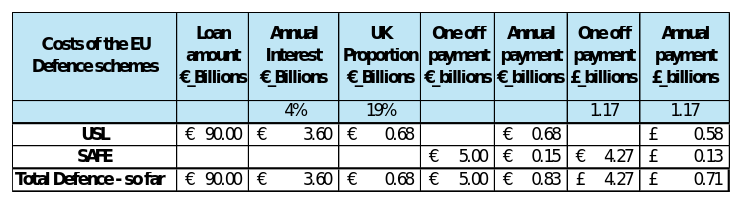
The UK has also agreed to participate in the EU’s €90 billion Ukraine Support Loan (USL), providing financing for Ukraine for budget support (€30 billion) and defence procurement (€ 60 billion). This is not sovereign debt, but EU-issued supranational debt, backed by the EU budget, with Ukraine as the loan recipient. The UK was approved as a third country participant in July 2026.2 The funds can be used to purchase defence products, provided that 65% of the content is sourced from the EU, Norway, Iceland, or Ukraine. The final legal wording of the agreement has yet to be released, so it is unclear whether UK defence equipment can also count toward the 65%. However, Ukraine has no legal obligation under the agreement to buy any defence equipment from the UK. And in order to participate, the UK has to provide a ‘fair and proportionate’ financial contribution to the EU’s/Ukraine’s borrowing costs.
The amount of the UK’s ‘fair and proportionate’ contribution has not been announced, but UK taxpayers will pay it, while any benefits from weapons sales will go to private companies. The EU generally bases third-country contributions on their GDP relative to the EU’s GDP. The UK’s GDP was about 19% of EU GDP in 2025/6. This effectively means the UK could be asked to pay 19% of the USL’s interest and administrative costs. Hopefully, UK negotiators have only agreed to pay the costs for the defence part of the loan, and have asked that this be discounted to take into account the UK’s own Extraordinary Revenue Acceleration Loan (ERA) to Ukraine worth £2.26 billion, where the UK is the sole lender, and Ukraine can only use the money for defence procurement. The ERA loan has financed 150,000 Ukrainian-produced drones, as well as over 350 air defence missiles and radars.
On a positive note, Ukraine’s President, Prime Minister and its Finance Ministry have publicly argued that Russian reparations should repay any defence loans. The only catch is that Ukraine needs to defeat Russia.
The EU’s Security Action for Europe programme
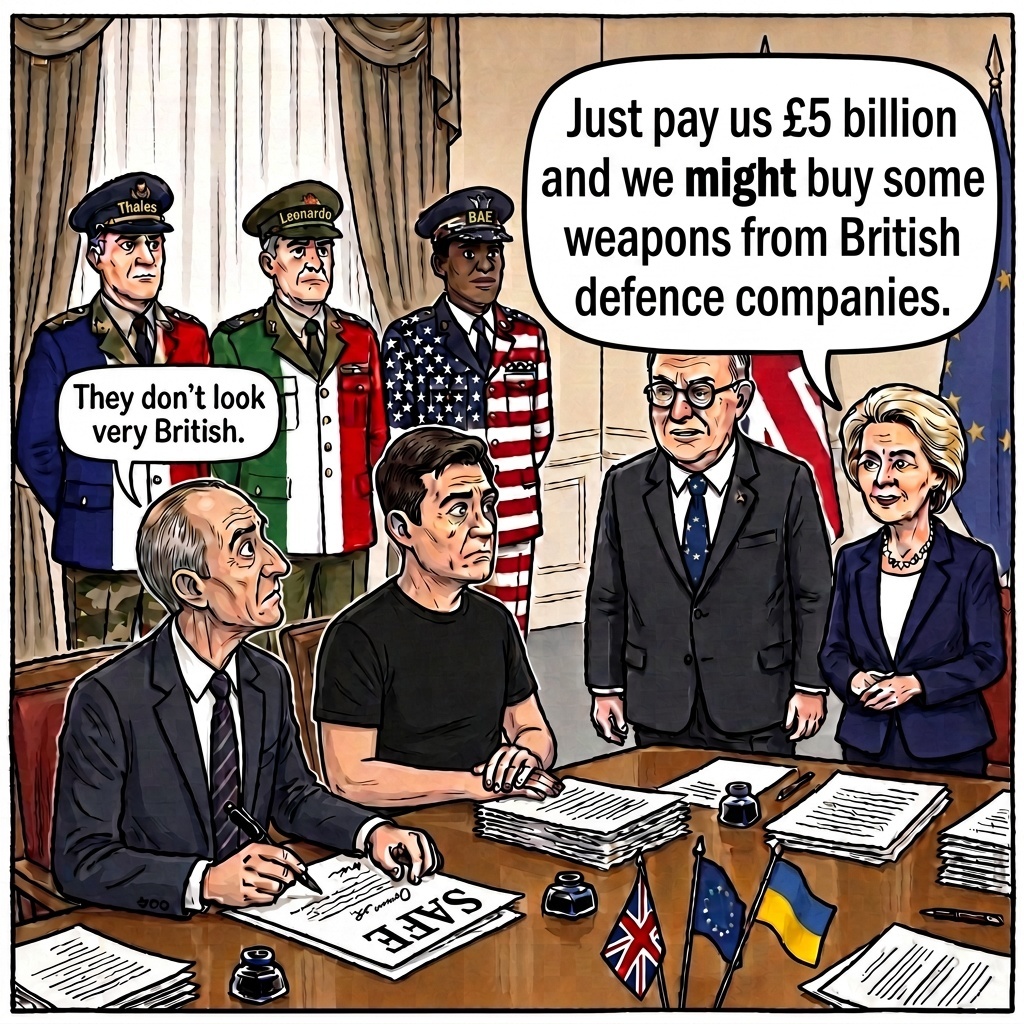
Despite what you may have heard about the UK’s financial crisis and the ever-expanding Government debt, the UK Government is currently contemplating paying the EU between €4 billion and €6.5 billion to be able to participate in the EU’s Security Action for Europe (SAFE) programme, plus an annual €150 million fee for administration.3 The SAFE programme is a €150 billion EU loan scheme designed to reduce the EU’s reliance on the US for defence supplies and boost EU arms production.
Participation in the programme would enable UK defence companies to bid for up to 50% of SAFE-funded contracts, provided they meet the required content requirements. SAFE requires that 65% of any defence equipment purchased be manufactured within the EU, the EEA, the EFTA, or Ukraine. The 65% covers manufacturing, component sourcing, assembly and integration, and software and systems engineering. If UK products do not meet the 65% rules, they would be ineligible for SAFE funding, regardless of whether the UK had paid to join. There is also no refund if UK defence firms fail to win any bids for defence equipment. So, joining SAFE could well be money spent for nothing in return.
In addition to the 65% content requirement, the EU or an EU-based partner firm must also retain control over the design and critical components. For example, if the UK pays to join SAFE, and BAE Systems (a British company) develops a radar system in the UK but wants to retain design control, this would not meet the SAFE conditions and the radar would not be eligible for SAFE-funded projects. However, if BAE built the radar system in Poland and allowed its EU partner to hold the design authority, the radar could potentially be purchased with SAFE funding.
The UK would also not be eligible for EU-issued loans to purchase defence equipment; however, it would be able to participate in joint procurements with two other EU member states. The three countries would have to buy together to qualify for the SAFE programme.
Effectively, UK taxpayers would be borrowing money to join the EU’s SAFE programme, where benefits depend on competitive success and with no guarantee that UK firms would win contracts worth more than the value of the UK taxpayers’ contribution.
But who really benefits from this programme?
Unsurprisingly, UK defence firms are eager for the government to pay up so that they can begin bidding for contracts. BAE Systems, Babcock, and MBDA are apparently already preparing bids.
Like all EU schemes, the EU collects funds from general taxpayers and redistributes them to selected companies, groups, or, in the case of CAP payments, landowners. The EU also, as usual, reserves harsh treatment for the UK, despite the UK-EU Security and Defence Partnership signed in May 2025, which appears to have no value whatsoever.4 In contrast, Norway, Iceland, and Ukraine have all been allowed to join SAFE for free, and their territories are included in the mandatory 65% manufacturing footprint — unlike the UK.5
Show me the money
The UK does not have surplus revenue; any increase in government spending, whether for EU defence programmes or UK welfare payments, must be covered by increased borrowing, and UK government debt is currently more expensive than that of any other G7 country.
So, why would the UK agree to borrow up to £5.7 billion at 4.98% (10-year Gilt) so that a group of UK-based defence companies could potentially secure a contract to manufacture 65% of their equipment in the EU, EEA, EFTA, or Ukraine? With no guarantee that UK defence companies will win any SAFE contracts, let alone win SAFE contracts worth more than the UK taxpayers’ ridiculously generous donation to the EU.
Who are these UK defence companies, and exactly how do they qualify as British?
The UK’s major defence companies are based in the UK, but several are actually subsidiaries of EU companies. The leading UK defence companies include:
- BAE Systems plc, an LSE publicly listed company that is almost 73% owned by non-UK interests, including 39.6% by US-based shareholders, including Capital Group, BlackRock, and Vanguard, among many others.6
- Babcock, also publicly listed on the LSE, is 63.9% owned by non-UK shareholders and is also 42.3% owned by various US shareholders.7
- Thales UK, which is a subsidiary of Thales SA (France), is 26.6% owned by the French government and 26.6% owned by Dassault Systèmes, a French aerospace and defence company. The French government and Dassault effectively control this company.8
- Leonardo UK, a subsidiary of Leonardo SpA (Italy), which is 30% owned by the Italian government, as well as major US and French shareholders.9
- MBDA UK, a subsidiary of MBDA SAS (France), which is owned by BAE Systems (UK) (37.5%), Airbus (EU) (37.5%) and Leonardo (Italy) (25%).10
- QinetiQ, an LSE publicly listed company that is about 68.5% owned by shareholders outside of the UK.11
However, despite their not-very-British ownership, UK taxpayers should expect to benefit from increased employment in the defence sector. Unfortunately, even if UK taxpayers pay up so that these not-very-British companies can bid for SAFE contracts, at best only 35% of the contract production could take place in the UK. Worse still, UK defence manufacturers would likely need to import materials, as the UK’s high energy costs have caused many UK steel, aluminium, and plastics manufacturers to close or relocate offshore. This would be made worse if the UK joins the EU’s Emissions Trading System and Carbon Border Adjustment Mechanism, also part of the Reset (discussed in section IV, part one of this paper). This will make imported materials even more expensive and further reduce the UK domestic content of any defence manufacturer’s bid.
But is paying the EU really necessary for these companies to sell their products?
The most ridiculous part about the UK government borrowing money that UK taxpayers will have to repay in 5, 10, or 30 years’ time, only for the government to then give the borrowed funds to the EU in the dubious hope that the EU may loan some of the funds to EU Member States so that they could possibly buy defence equipment from UK based companies, is that these UK companies make exceptional defence equipment that they sell internationally without the UK government paying to join a club that limits the amount of UK-made content in their products. Why would anyone, other than the EU, think this carousel-like trade is a good idea?
BAE Systems is one of the world’s top five defence contractors and sells equipment to Saudi Arabia, Qatar, Australia, the US, and Oman. MBDA UK is already part of the pan-European missile consortium, and also sells equipment to Saudi Arabia, India, and Qatar. Meanwhile, Leonardo UK has sold defence equipment to the US, Qatar, and Brazil, whereas QinetiQ has sold equipment to the US, Australia, Canada, and Nato allies. Babcock has sold equipment to Australia, Canada, New Zealand, and Indonesia, and in January 2026, Babcock signed a £4 billion contract to supply naval equipment to Indonesia – without UK taxpayers having to pay Indonesia to buy Babcock equipment. Thales UK has sold defence equipment to Australia, the UAE, and Singapore.
If these private and foreign-government-owned companies can meet unsubsidised international demand for defence equipment, why are UK taxpayers being asked to subsidise their possible, but not certain, equipment sales to the EU?
The Government’s EU Reset is an exercise in doing the same thing again and expecting a different result. The EU is desperate for money; it is not interested in playing fairly or buying the best available defence equipment. The EU is only interested in preserving itself, which it hopes to do with UK taxpayer-subsidised employment in the EU defence industry. The UK must maintain and improve its defence capability, and this will require borrowing to invest in UK defence equipment for the UK Armed Forces. However, if UK taxpayers are going to borrow to buy more defence equipment, they should either choose the best available equipment or, if the Chancellor wants to boost the UK economy, spend the money with UK-based companies that produce as much of the equipment as possible in the UK. This would also qualify as investment spending and so remain within the government’s budgetary ‘Red-lines’, which exclude borrowing for day-to-day spending.
But for the UK to borrow money in order to support EU manufacturers and EU defence makes no sense, either economically or politically.
The Table below estimates the costs of the schemes that have been made public.
Section III. Putting people at the centre of the EU-UK relationship
This section covers youth mobility schemes, work visas, discounted student fees, and the UK paying to join the EU’s Erasmus+ programme. It was sold to the UK population as a way for UK citizens to glide through EU airports using e-gates when travelling to the EU, but shortly after the agreement was announced, it became apparent that e-gate use is a national competency and outside the EU’s control. Middle-class parents in the UK imagine that the youth mobility scheme will allow their children to work as chalet girls and ski instructors, but in the past, the reality of youth mobility and Erasmus+ schemes has been a large number of EU youth coming to the UK to work as baristas and labourers.
The European Commission hasn’t published an official negotiating Document since the Common Understanding was agreed to in May 2025, but this may be because they published one in April 2024, when the Sunak Government was in power. Who knew?
The European Commission document, COM(2024) 169 final, was published on 18 April 2024. According to this document:
However, despite the 2019 European Union-United Kingdom Joint Political Declaration (which addressed youth mobility), the United Kingdom declined to enter into negotiations on mobility during the 2020 negotiations.12,13 Consequently, the Trade and Cooperation Agreement does not address the question of mobility of persons between the Parties to the Agreement. The Trade and Cooperation Agreement includes, however, provisions on social security coordination that support the possibility for mobility of persons under the domestic law of either Party and is therefore an enabler of mobility.14
At the time, the UK was negotiating youth mobility schemes with individual EU Member States, based on the UK’s youth mobility visa schemes it had agreed with other non-EU countries. The European Commission was not happy about this (even though temporary visas are a national competency of member states), as they claimed it would have resulted in different treatment of European Union members and because the EU believed individual country visa schemes would not address the ‘main barriers to mobility’. So, what did the EU think were the main barriers to youth mobility? They weren’t concerned that EU citizens could visit the UK without a visa for a period of up to six months, even though the EU only allows UK nationals to spend 90 days in a 180-day period in the EU without a visa. Instead, they were concerned that the UK has no specific visa path for au pairs (young adult foreigners employed by a host family), which seemed trivial. But the EU’s major concern was that EU students now had to pay the same fees as ‘foreign students’. The relevant passage is below (emphasis added):
Furthermore, students from the Union are now subject to very high tuition fees applicable to foreign students when seeking to undertake studies (in particular higher education and doctoral studies) in the United Kingdom compared to the fees paid by domestic students. They also have more difficult access, or no access, to related benefits (e.g. scholarships, student loans).
They were also concerned that traineeships, internships, or apprenticeships are considered ‘work’ in the UK and therefore subject to UK minimum wage rules.15 It is unclear why they thought this was a problem. The document goes on to claim that the EU is interested in its young people acquiring skills and developing talent, including across borders and beyond the EU, provided, of course, that those foreign countries’ taxpayers are willing to subsidise EU students. The subject of student fees comes up again; the EU admits that many of its member states have working holiday visas, these programmes ‘do not address issues such as university tuition fees or equal treatment to nationals’.
In every part of the UK-EU Reset agreement, the EU is demanding payments from the UK, and in this section, it wants payments in kind: subsidised university fees, access to UK student loans, and access to UK scholarships. They also wanted EU youths to have free access to the NHS without paying the Immigration Health Surcharge.
How much are UK University fees
UK university fees are capped for UK students but not for international students. All international students pay the same fees whether they are from China or Czechia, India or Italy, or Australia or Austria. Fees from international students help subsidise UK students’ fees, but there is no reason they should also subsidise EU students’ fees. Especially as the EU has seven times as many youths aged 18 to 25. Allowing them to have subsidised places would force up prices for all other international students.
The current standard full-time undergraduate fees in England in 2025/6 were £9,535 per year. From August 2026, fees increased to £9,790 and will increase to £10,050 from 2027. The UK Government caps these fees for UK nationals. International students can pay between £15,000 and £25,000 for a humanities subject at a standard university, and between £23,000 and £33,000 to attend Oxbridge or University College London (UCL). Engineering and other laboratory-based subjects charge between £18,000 and £33,000 at standard universities, and between £28,000 and £40,000 for UCL, Imperial, Oxbridge, etc. Medical schools are even more expensive, with most charging £30,000 to £55,000 a year, and Oxbridge and Imperial charging £40,000 to £55,000 a year for a minimum 5-year degree
The House of Lords European Affairs Committee (2024) heard submissions from Universities UK and the Russell Group of Universities, who substantially agree that international fee income is critical to UK university finances, and that reintroducing home fee status to EU students would create significant financial pressures for universities. Similarly, the Office for Students Financial Sustainability Report stated that: ‘Providers rely increasingly on income from international students to offset losses on teaching UK students.’ By capping UK student fees at £9,250 from 2017 to 2025, UK universities became more reliant on uncapped international student fees.
Because of this impasse over university fees, the 2024 youth mobility negotiations stalled.16 The UK Government refused to include fee parity in the youth mobility talks, according to Lord Davies of Gower and the Cabinet Office. On the other side, the EU was insistent that: ‘Equal treatment in access to education, including tuition fees, is a core element of the EU’s position.’
The Commission’s demands are breathtaking. Besides equal treatment for EU under 30 year olds with UK nationals, including no healthcare surcharge to use the NHS, they also want their youths to be accompanied by close family members and have the right to ‘family reunification’, with no quotas, no purpose-bound requirements, no time limits, and no discretionary visa application procedures. Their aim was to provide young EU citizens with a clear, simple, and cost-effective path for mobility to the UK, although they generously claimed that their proposal had ‘no budgetary implications’. Presumably, they meant for the EU.
The UK charges all adult immigrants £1,035 per year to access the NHS through the Immigration Health Surcharge, and this is already reduced to £776 for students, Youth Mobility Scheme applicants, and under-18s. Allowing the 150,000 or so EU students attending UK universities before Brexit to avoid paying even the lowest international student fee level of about £15,000 cost UK universities at least £863 million in lost revenue.
The EU tried again in June 2025: the results were set out in Council Decision (EU) 2025/1286 of 20 June 2025, published on 1 July 2025. Despite the previous impasse in negotiations, the EU again wanted other international students to subsidise EU students attending UK university courses. They used almost identical reasoning, that bilateral visa schemes between the UK and various EU members were not addressing the core barrier to youth mobility – university fees. The EU’s document reiterated that EU Member States determine the volumes of admissions of third-country nationals under Article 79(5) of the TFEU. However, despite this admission, the Commission wanted a ‘supplementing’ youth mobility agreement to be added to the Trade and Cooperation Agreement. This would presumably give them the power to threaten to withdraw from the trade agreement if the UK did not admit sufficient numbers of EU students to UK universities.

The true cost of EU students
There are many reasons why the UK should not allow EU students to attend UK universities, have their student fees subsidised by other international students, or borrow money from the UK Student Loan programme to pay those fees.
The most obvious reason for not reestablishing a youth mobility scheme is that, before Brexit, when there was free movement between the UK and other EU nations, far more young people came to the UK than went in the other direction. This was never an equal agreement.
In 2020/21, the last year before Brexit, 152,905 EU students were enrolled in UK higher education institutions, paying the same fees as UK students, of £9,250 per year.17 This was not an unusual number, although the trend was increasing; in 2019/20 there were 147,800 EU students, in 2018/19 there were 146,565, in 2017/18 there were 142,840, and in 2016/17 there were 138,040.
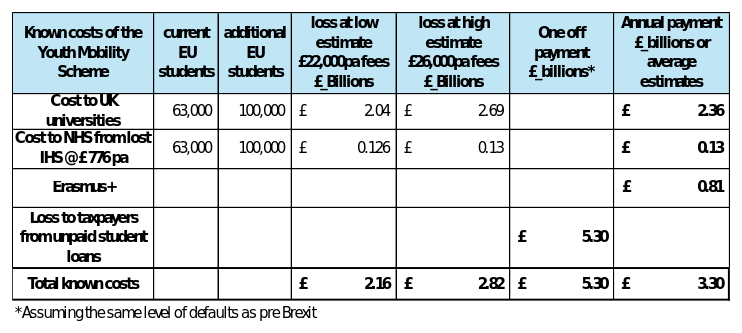
After Brexit, EU students could still study in UK universities if they were offered a place. However, an EU national studying at a UK university now pays the same amount as any other international student. In 2024/25, the number of EU students studying in UK universities had dropped to 63,600, while the number of non-EU students had increased to 621,970.18 This change had happened gradually, with EU student numbers falling as non-EU student numbers grew. But the increase in university revenues is enormous. The minimum difference in fees for UK students and non-EU students is £5,500 per year; the 100,000 more non-EU international students replacing EU students are increasing university revenues by at least £550 million, while the 63,600 EU students now paying full international fees are adding at least another £350 million. This totals £900 million, assuming the minimum fee level. Some publications have claimed the average tuition price paid by international students is between £22,000 and £26,000 per year. Using the higher price, the loss to UK universities would be £2.7 billion each year.19 Why would anyone want to stop UK universities earning this amount of money? Educating foreign students is a valuable UK export industry. Not only do these students pay for their education, but they also pay for their accommodation and living expenses. It is estimated that each student adds about £100,000 to the UK economy every year.
Besides the opportunity costs, the old system had another downside: EU students could obtain student loans. By 2020, around 120,000 EU students had taken out UK student loans. Unfortunately, EU student loan repayment rates have been much lower than those of UK students, because many EU graduates left the UK after graduating. In 2020, EU students owed £5.3 billion in student loans, and Student Loan Company data show that only about 20-25% of this amount was being actively repaid.20 This is not because EU students are less honest, but rather because HMRC can deduct repayments directly from UK student salaries once they start earning above the repayment threshold. It has been estimated that between 50% and 70% of EU student loans will be written off because enforcement outside the UK is limited, making them unrecoverable.
The UK is now in a very different economic climate than before Brexit: UK unemployment has increased from 3.8% in 2019 to 4.9% in the second quarter of 2026. There are 1.772 million people aged 16 and over who are unemployed in the UK.21
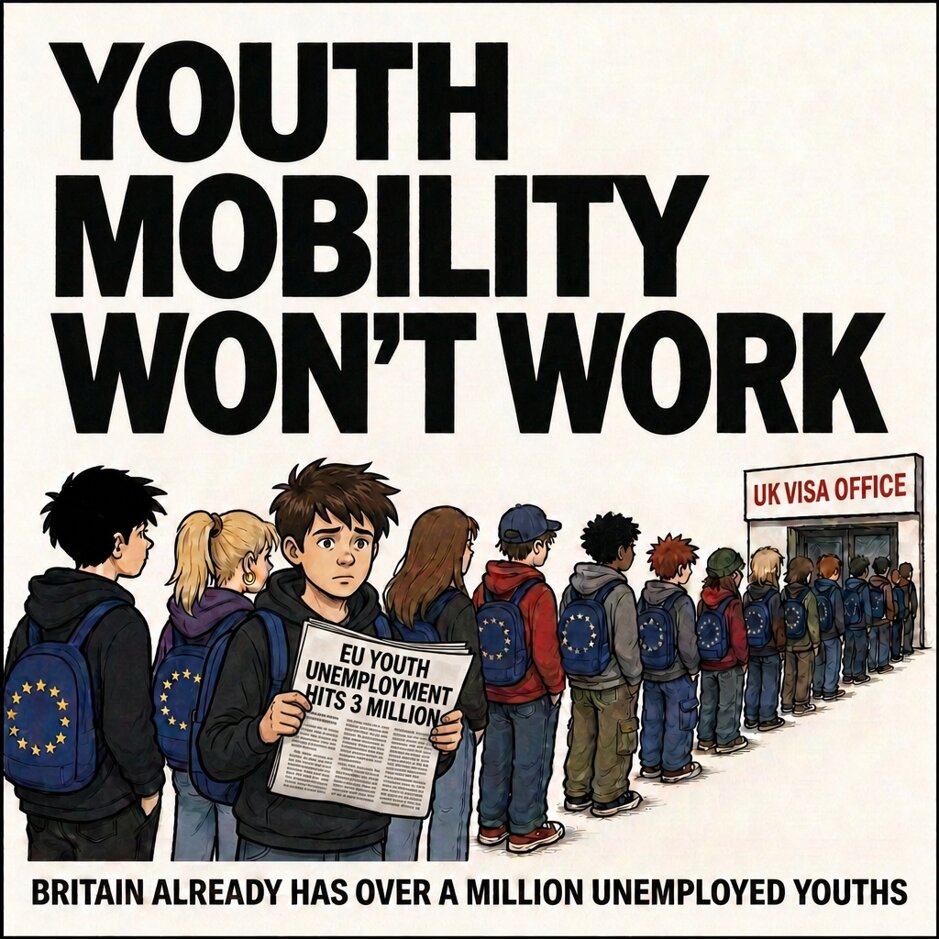
But there is a much bigger problem: UK youth (aged 16-24) unemployment hit 16.4% in the March-May quarter of 2026. This is about 743,000 people. The UK has 1.01 million young people who are Not in Education, Employment or Training (NEET). That is 13.5% of all young people. This is the first time there have been more than a million 16- to 24-year-olds who are neither employed nor in education or training.22 Allowing European youths, up to the age of 30, free access to the UK labour market will not improve this situation.
UK youth unemployment is rising due to wage and employment tax increases
The UK’s rising unemployment is due to a general economic slowdown driven by higher wages, energy costs, employment taxes, and business taxes. But the UK’s higher youth unemployment can be explicitly blamed on the massive increase in the minimum wage for under-21-year-olds in both 2025 and 2026, coupled with higher employer National Insurance Contributions.
In April 2025, the minimum wage (National Living Wage — NLW) for 18- to 20-year-olds increased by 16.3%, while the NLW for 16- to 17-year-olds and apprentices increased by 18%. In April 2026, the NLW increased again: the rate for 16- to 17-year-olds increased by 6% to £8 per hour; for 18- to 20-year-olds it increased by 8.5% to £10.85; and for workers over 21, it increased by 4.1% to £12.71 per hour,23 which equates to about £2,200 per month.
In contrast, most EU countries have minimum monthly wages which range from €620 (£530) per month in Bulgaria to €2,771 (£2,368) per month in Luxembourg.24 While EU member states Austria, Denmark, Finland, Italy, and Sweden do not have a statutory minimum wage. UK minimum wages for those over 21 are higher than in any EU country other than Luxembourg, but Luxembourg’s population is under 700,000, of whom 75,600 are 15- to 24-year-olds, and only 24,000 are in the workforce, so although Luxembourg’s youth unemployment rate is 20% to 21%, according to Eurostat, this equates to only 5,000 people.25 That said, for most unemployed EU youths, travelling to the UK in search of employment under the Reset’s Youth Mobility Scheme will look like an attractive option.
Last April, the UK Government also increased the Employer National Insurance Contribution (ENIC) from 13.8% to 15%, and reduced the employer NIC threshold from £9,100 per annum to £5,000 (or £96 per week). In addition, the UK’s Employees’ Rights Bill, currently being implemented in phases, is deterring employers from employing young workers without a history of employment. It is not surprising that the number of unemployed young people in Britain is rising.26
Youth unemployment is also hitting the graduate jobs market. According to High Flyers, graduate recruitment fell by 5.1% in 2025, following a 14.6% decline in graduate vacancies in 2024.27 40% of the UK’s largest employers recruited fewer graduates in 2025, and recruitment fell in 10 of the 15 largest industry sectors. Graduate recruitment is expected to be lower again in 2026. The largest industry declines in graduate recruitment in 2025 were in Oil & energy, down 56.4%, and Chemicals & pharmaceuticals, down 48.6%. Applications for the UK’s leading graduate employers have doubled since 2023, while the number of universities targeted by the country’s top graduate employers in 2025/6 has reduced to an average of just 23 universities. This is not a job market that needs an influx of EU graduates looking for work.
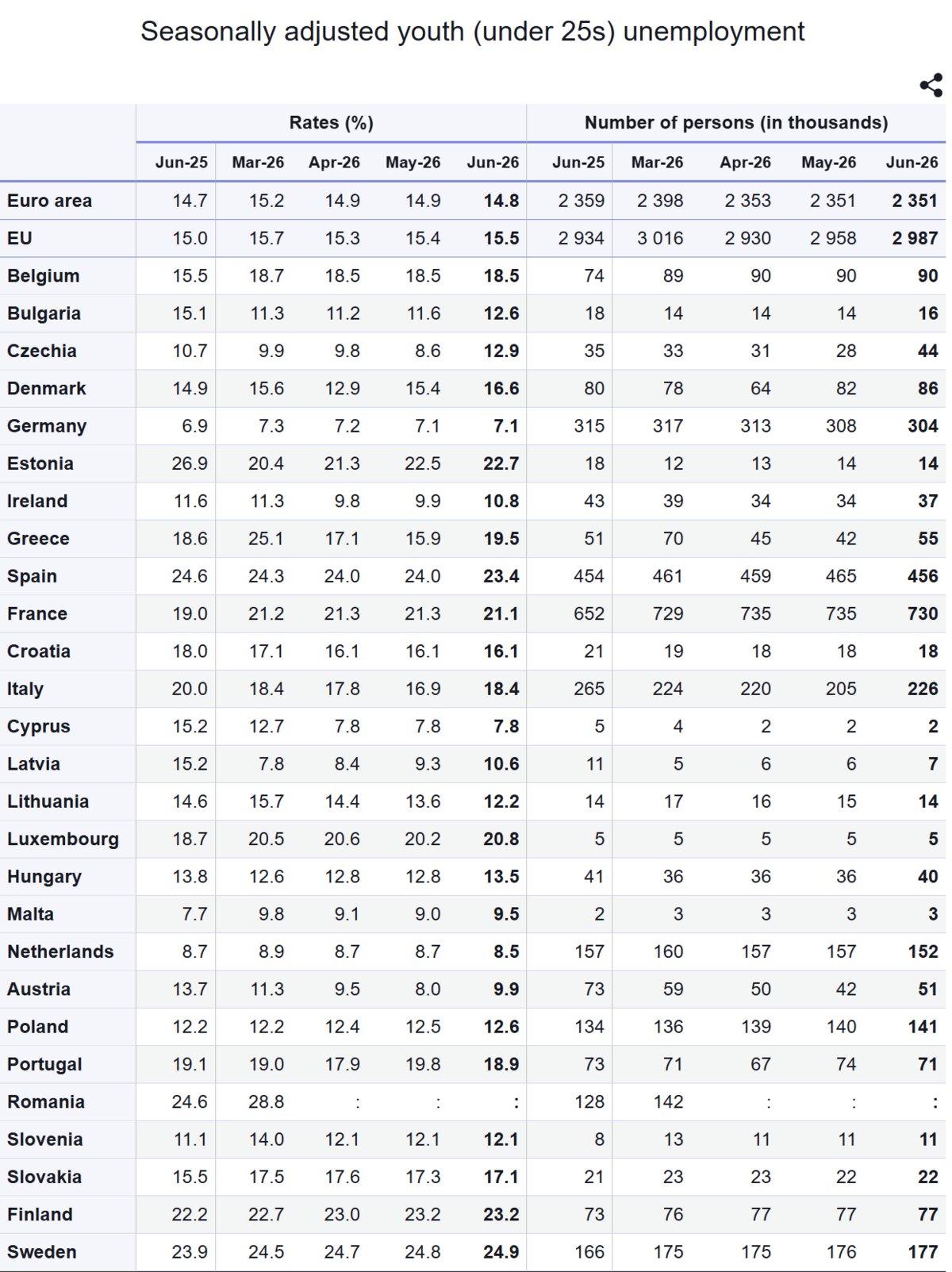
Britain isn’t the only country facing high youth unemployment. Many EU nations have similar or even worse problems. While some EU countries have such small populations that the high unemployment rate isn’t very significant, others have much higher absolute figures for youth unemployment. For instance, France’s 21.1% youth unemployment translates to approximately 730,000 unemployed young people, while Spain’s 23.4% youth unemployment translates to approximately 456,000 unemployed young people. In total, there were 2.987 million unemployed under-25s in the EU in June 2026, up from 2.934 million a year ago (see table below).28
Before Brexit, many young EU nationals worked in the UK’s catering, hospitality, and agricultural sectors, generally at minimum wage rates. At the time, employers welcomed them. But now, the UK catering and hospitality sector is employing fewer people as it suffers from high energy costs, higher wages, and a population with less disposable income to spend in pubs and restaurants, while UK agriculture is suffering from unusually hot and dry weather. Unsurprisingly, industries are cutting their workforce; inviting EU youths up to the age of 30 to the UK under the Youth Mobility Scheme will only exacerbate the UK’s own youth employment problem.
This will be made worse by the Government’s intention to reduce the number of hours staff can work on zero-hours contracts before employers must legally offer them a contract with guaranteed hours and pay compensation for cancelled shifts. The Department of Business and Trade estimates that this could cost employers up to £2.9 billion annually.29
How many EU nationals could come to the UK under the Reset scheme?
The UK government has yet to decide how many EU nationals will be able to come to the UK under the Youth Mobility Scheme. The UK currently has 3-year youth mobility schemes with Australia (35,000 places), New Zealand (13,000 places), Canada (8,000 places), Japan (1,500 places), South Korea (1,000 places), Hong Kong (1,000 places), and Taiwan (1,000 places), as well as schemes with San Marino, Monaco, and Iceland that total less than 1,000 places. These schemes do not entitle students to attend UK universities at reduced UK national fees; instead, their youth mobility visas require students to pay full international student fees and the NHS health surcharge.
The EU wants the UK to grant youth mobility visas to EU 18- to 30-year-olds in the same proportion of its population as the UK grants mobility visas to young Australians. This would amount to nearly 600,000 young people. The EU also wants the UK to extend Youth Mobility visas to four years instead of three, extend the definition of ‘youths’ to 18- to 30-year-olds, instead of the previous 18 to 24 age range, and grant EU youth free access to the National Health Service, allow them to ‘exercise the right to family reunification’, and be eligible for UK taxpayer-subsidised university tuition fees, as already discussed.
However, the main difference between UK youth mobility with the EU and with the Commonwealth countries listed above is that, as English-speaking countries, their reciprocal youth visas are much more popular with young Britons. For example, in the 2024-2025 financial year, Australia issued 79,000 visas to UK nationals under its youth mobility scheme; New Zealand issued several thousand and has an annual quota of 15,000 visas; and Canada’s quota is 9,000 to 10,000 visas. In total, in 2024, the UK granted just 24,437 Youth Mobility Visas in 2024 to nationals from 13 partner countries, including 9,754 to Australians, 4,304 to New Zealanders, and 3,060 to Canadians.30 In 2024, Australia, New Zealand, and Canada alone issued 68,495 visas to young people from the UK.31 So, almost three times as many UK youths went to Australia, New Zealand, or Canada as came to the UK. This is unlikely to be the case under the new UK-EU youth mobility scheme, where many more EU nationals speak English and will be able to work or study in the UK, whereas very few UK nationals speak European languages to a high enough standard to do either. Young Britons mainly learn only one of the EU’s 25 official languages, generally French, German, Spanish, or Italian, limiting the number of EU countries where they can work or study. In addition, there are fewer internationally recognised universities of the same calibre as Cambridge, Oxford, Imperial, or UCL. In addition, regardless of their language skills, young Britons are unlikely to find work in the EU countries with higher youth unemployment than the UK.
The estimated losses from subsidised student fees for existing EU students and, potentially, an additional 150,000 students who are exempt from the Immigration Health Surcharge will cost universities £3 billion a year in lost revenues, the NHS almost £170 million, and potentially hit taxpayers for another £5 billion in unpaid student loans. But the highest cost will be the loss of opportunities for British youth, who will have to compete with EU youth for student places and jobs.
Like other aspects of the Reset, the Youth Mobility Scheme will predominantly help the EU.
Erasmus+
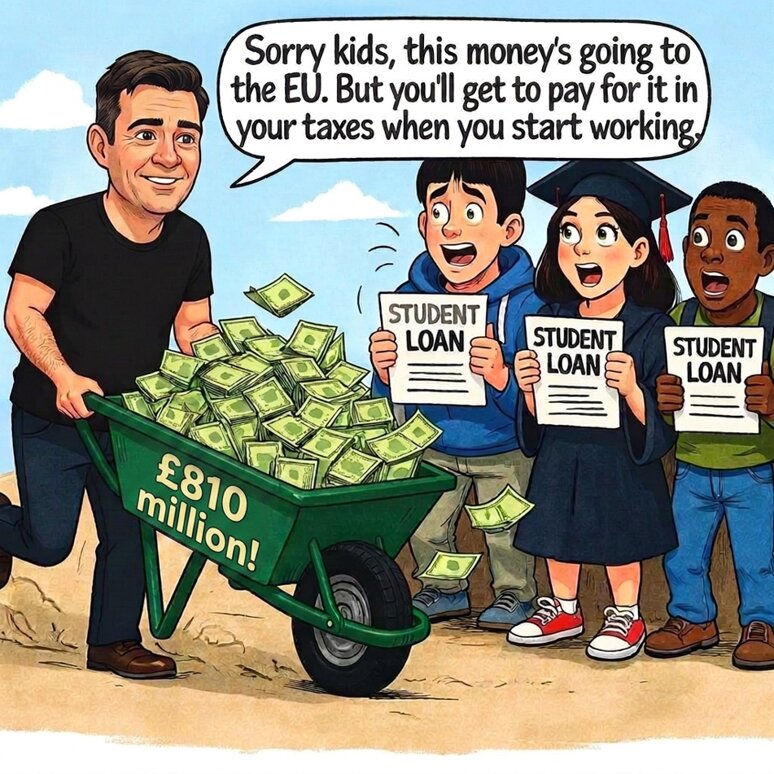
Despite the UK failing to agree to the EU’s terms for the Youth Mobility Scheme, that didn’t prevent the EU Relations Minister, Nick Thomas-Symonds MP, responsible for negotiating the Reset, from agreeing to join the EU’s Erasmus+ programme. This was announced on 17th December 2025, when most people were preparing for Christmas and Parliament was in Recess. Thomas-Symonds agreed that the UK would participate in the EU’s Erasmus+ scheme from January 1st1 January 2027, and that we, the nation, would pay £570 million in the 2027/28 academic year for this dubious privilege. This is a discounted rate, and the following year the UK will have to pay £810 million, even though very few UK students used the scheme when we were members.
Who can participate
Any public or private body may apply for Erasmus+ funding if they are active in the fields of education, training, youth, and sport from the EU, the EEA, and the EU candidate countries that have chosen to participate in the programme: Turkey, the Republic of North Macedonia, and the Republic of Serbia. In addition, groups of young people who are active in youth work, but not necessarily within a youth organisation, may also apply for funding for learning mobility for young people and youth workers, youth participation activities, and the DiscoverEU Inclusion Action. Some Erasmus+ programmes are open to third countries that are not associate Erasmus+ countries.
Payments into EU programmes are based on a country’s GDP. The amount is unrelated to how many students from that country use the scheme to travel to other EU countries. Nor does it reflect the number of EU participants who chose to study or train in another participating country.
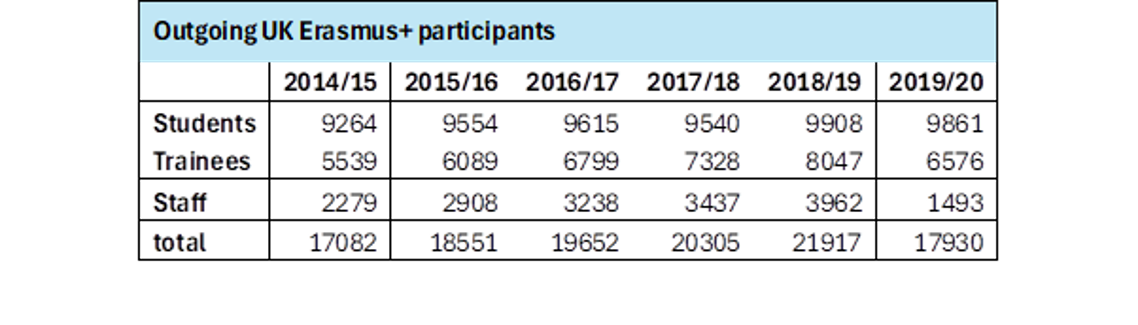
In 2020, the Erasmus programme budget was €3.37 billion, according to the European Commission.32 This was also the last year of the UK’s Erasmus membership; only 55,681 participants were enrolled in the various Learning Abroad schemes associated with the UK.33 This is broken down as follows: 28,334 Higher Education Students, 13,708 in Vocational Education and Training, 9,842 Youths, 2,550 School Education, and 1,247 Adult Education. But these weren’t all British participants. According to the same document, only 16,437 were ‘outgoing students and trainees’ and 1,493 were ‘outgoing staff’.34 The rest were ‘incoming’. So, at best, 17,930 British participants used the scheme in 2019/20. The amount we paid for this isn’t published, as it was part of our general contribution to the EU. However, 18,000 participants per year wasn’t unusual for the UK.35 In the chart below, UK ‘outgoing’ students were around 9,000 each year, while trainees and staff numbers were generally lower but increased as Brexit approached, suggesting they were aware that these jollies would be lost.36
The UK’s Brexit negotiators considered whether the UK should remain a participant in Erasmus+ after Brexit, as an associate member like the EEA countries, Serbia, North Macedonia, and Turkey. However, they rejected the option because it was considered to be ‘poor value for the money’. The Johnson Government was asked to pay £2 billion into Erasmus funding for the seven-year budget from 2021 to 2027. This would have amounted to £285.7 million per year. Now Thomas-Symonds has agreed that UK taxpayers should pay the EU £570 million for 2027 alone.
The Johnson Government was right to consider Erasmus poor value for money. Dividing the £285.7 million per year the EU was demanding by the average annual outgoing UK participants from 2014/15 to 2019/20, the UK was paying £14,850 per Erasmus+ participant. This was 60% higher than UK university fees at the time. But the Starmer Labour Government has agreed to pay twice that amount!
It is mind-boggling that Thomas Symonds would try to convince the UK population that his £570 million payment to the EU is a 30% discount. It is a 99.5% increase! And the so-called ‘discount’ is only for one year, after which the UK will be required to pay 16% of the total Erasmus+ budget, equal to £810 million annually, to the EU. If we assume a similar level of UK participation in the scheme, Erasmus will cost £42,100 per participant per year from 2028 onwards.
The proposed Erasmus+ budget for 2028 to 2034 is €40.8 billion, up from €26.2 billion in the current 2021-27 multiannual framework.37 If the UK agrees to pay £810 million per year, it would be paying about €6.5 billion – 16% of the total Erasmus+ budget. The £2 billion Johnson rejected was only 11% of the total Erasmus budget and only 0.01% of the UK’s GDP. If the OBR’s projections for UK GDP are correct, £570 million would be 0.02% of UK GDP in 2027, while £810 million would be 0.03% of UK GDP in 2028. This is not a good deal for the UK; this money could be better spent on UK students attending a full-time degree programme or an apprenticeship course.
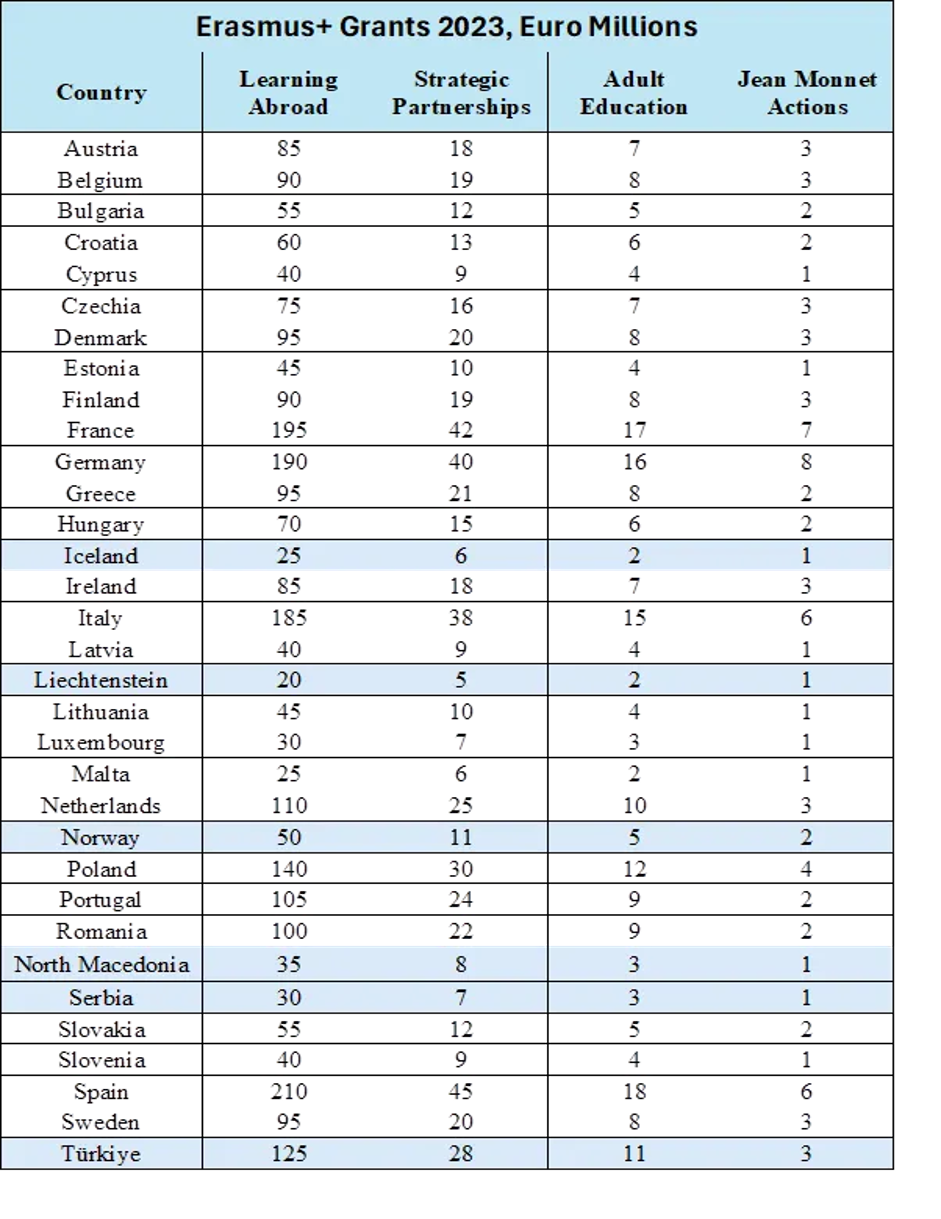
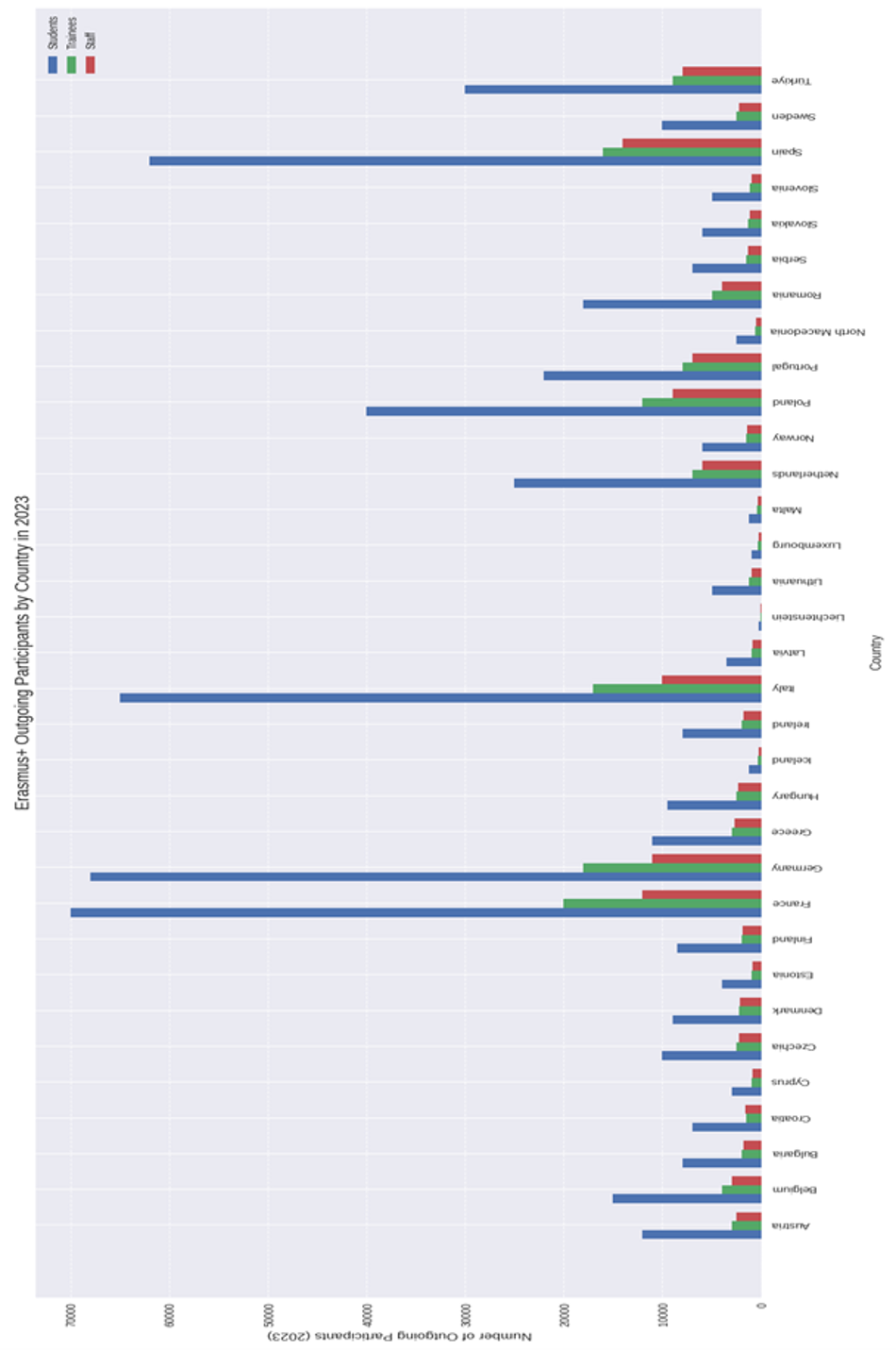
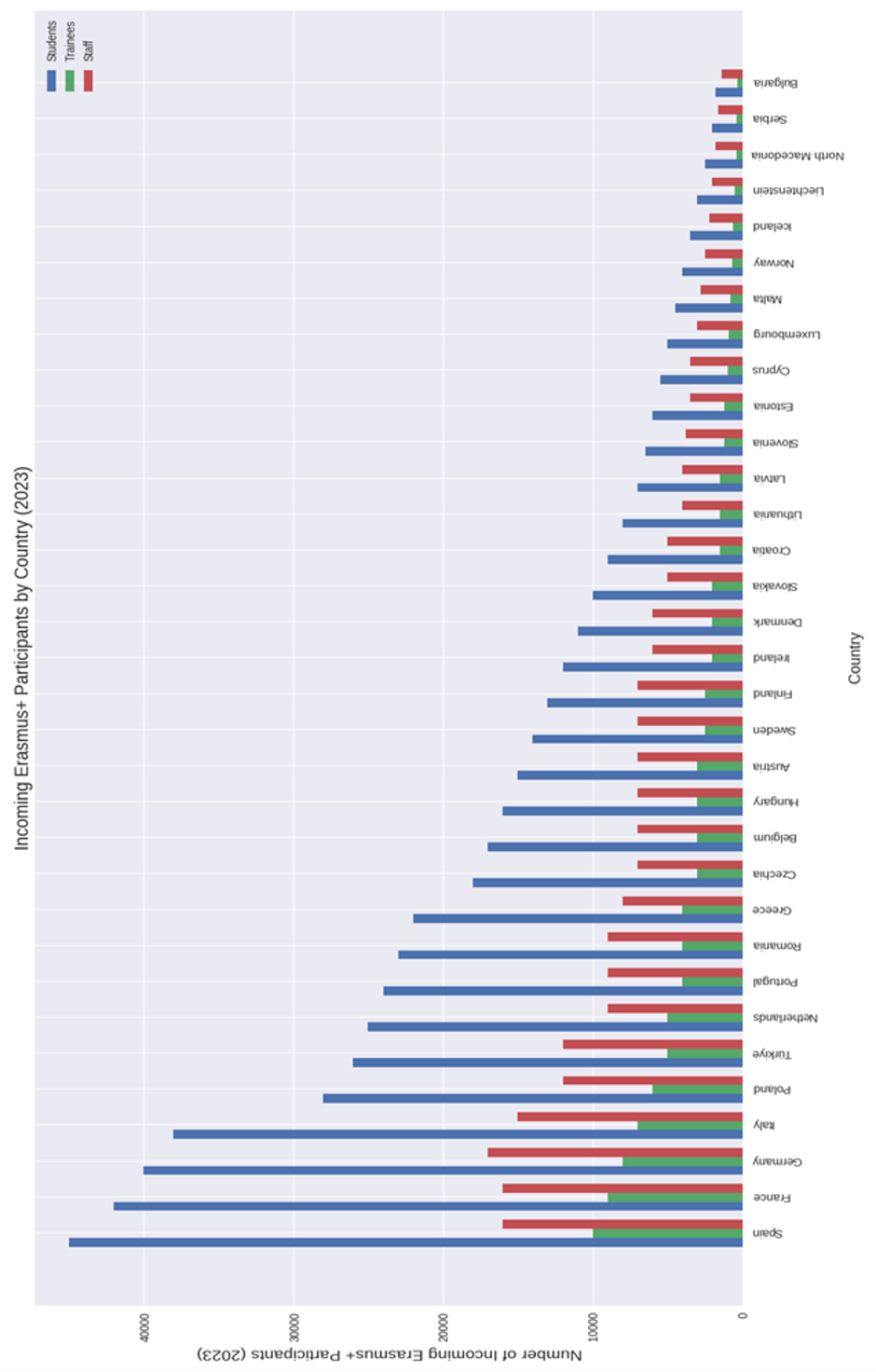
EU members pay for Erasmus through their EU budgetary contributions, while associate members, Norway, Iceland, Liechtenstein, Türkiye, North Macedonia, and Serbia, pay a negotiated amount that is not published but is likely to reflect the country’s relative GDP. However, the EU does publish the grants it gives to these countries (see the table below) and how many of their students used the scheme (see charts below).38 For example, in 2022, there were 77,552 outgoing Turkish students and staff, but in 2023, this number dropped to just under 60,000.39
Grants for Strategic Partnerships and Jean Monnet funding
Erasmus+ funding covers more than learning abroad; it also provides grants for Strategic Partnerships and Jean Monnet Actions.40
Jean Monnet Actions promote European Union integration, and even non-EU members, such as Turkey, Norway, Serbia, North Macedonia, Iceland, and Liechtenstein, receive contributions to these programmes.41 The programmes include teaching posts for professors specialising in EU studies; Jean Monnet Centres of Excellence to promote EU integration studies; Jean Monnet Networks and Projects; and EU-related teaching in schools and vocational education and training. Strategic Partnership grants support the integration and dissemination of teaching methods, student and staff exchanges, institutional cooperation, and the ‘strengthening of transnational capacity’ (whatever that means). Turkey, Serbia, and North Macedonia have all received substantial grants for Strategic Partnership programmes, despite not being members of the EU or the EEA.
The Chart below details the grants awarded to each participating country under Erasmus funding. Non-EU countries are highlighted in light blue.
The charts on Pages 24 and 25 are from the Erasmus+ 2023 Student, Trainee, and Staff Participant Data. The first chart shows outgoing participants by country, and the second shows incoming participants by country. The major difference is in the scale of the Y-axis. The first chart is in thousands, the second in tens of thousands. Unsurprisingly, the number of outgoing participants is generally proportional to the country’s total population. Though it isn’t always. Spain’s student population is only about 60% of Germany’s, but it sends almost as many students on Erasmus programs. At the same time, incoming participants appear to choose the largest country with the best weather; Spain, France and Italy are three of the top four destinations.
What else could the UK do with £810 million?
£810 million is a lot of money. The UK student fee cap will increase to £10,050 per year from 2027, so the £810 million could have funded tuition for 80,600 UK students to attend UK universities free of charge. Alternatively, it could fund tuition and accommodation for approximately 25,000 UK students.
Wouldn’t this be a more effective use of the funds? Especially if the Labour Government’s intention is to help disadvantaged students, as it claims. Many students from low-income families choose the nearest university so they can continue living at home; going away to university is financially out of reach. Unless, of course, they apply to study in the US.
Talented, disadvantaged British students may be offered a ‘full ride’ at a US college, covering tuition and fees, room and board, books and supplies, living expenses, and spending money for student activities. Some of the bursaries even include airfare back to the UK during the holidays. Full-ride scholarships are available at Duke, USC, Vanderbilt, Chicago, Yale, and Harvard, among others.42
Why did the UK agree to pay so much to join Erasmus+ when so few UK students use it? Imagine if the government used the £810 million to establish a similar full-scholarship scheme in the UK instead of giving it to the EU.
Massive UK student debt for a real degree, but taxpayer subsidies for EU short course jollies
It is absurd to expect bright and talented British children to take on massive debts to pay for their tuition and board, whether they attend a UK university or a drama school, but then pay into an EU scheme that subsidised only 55,681 participants a year when we were members of the EU. Of those participants, only 17,930 were UK students, trainees, and teachers travelling to other EU destinations for jaunts lasting between 2 days and 12 months.
The average outstanding debt of a UK graduate after a 3-year degree is around £47,730 in England, £44,830 in Wales, £29,180 in Northern Ireland, and £21,000 in Scotland.43 If these students continue to live and work in the UK, their student loan repayments will be deducted from their PAYE income. The minimum wage for full-time work is £26,437 before tax. Hopefully, most graduates will earn more than this, so they will repay their loans at 9% of their income above the repayment threshold.44,45 For English students who took out loans since 2023, the repayment threshold is £25,000 and will remain at this level until 2027; for Scottish students, the threshold is £33,795 and will increase with the Retail Price Index. For English and Welsh students who took out loans between 2012 and 2023, the threshold is £29,385, and it will be frozen at this level for the next three years.
And the debt keeps on growing. Someone who borrowed £27,000 in 2012 just to pay their tuition fees of £9,000 per year, but had not repaid any of the debt, would now owe between £44,000 and £57,000. The repayment threshold for Plan 2 (undergraduate loans taken in 2012) is £28,470, and the interest rate is capped at RPI plus 3% for annual incomes over £51,245.46 If the student doesn’t repay the loan after 30 years, the loan, plus interest, will be ‘written off’, meaning UK taxpayers will pay it. By which time it would be between £65,000 and £140,000. The current Plan 5 loans last 40 years and carry a lower interest rate equal to the March RPI. However, extending the loan term by 10 years will increase the total amount owed if the loan is written off, so taxpayers will still be stung. This is another reason why the massive unpaid EU student debt is such a problem, and why allowing EU students to access the UK’s student loan program again must be avoided.
If only our Paymaster General could find a big pile of money to help subsidise British disadvantaged students attending UK tertiary education, or to support students researching subjects that are important but unlikely to lead to high-paying careers. If only…
How much will this cost?
In total, the Youth Mobility and Erasmus+ program will cost at least £3 billion a year, and potentially at least another £5 billion in unpaid student loans. As interest rates are much higher now than they were before Brexit, unless the Government makes arrangements to recoup loan repayments from the EU Member States’ tax revenue collectors, we should expect this amount to be much higher in the future. In addition, British youths will lose student places and employment opportunities, but this is impossible to estimate.

Section IV. Strengthening our economies while protecting our planet and its resources
The European Commission published its recommendation for a Council Decision on 16 July 2025, COM(2025) 408 final, setting out its expectations regarding the UK’s accession to the EU’s SPS Area and Emissions Trading System (ETS). Then, in a second publication, COM(2025) 804 final, dated 22 December 2025, they published their recommendations for a Council Decision on the UK participating in the EU’s Internal Electricity Market (IEM). We have divided this section into two parts: the first covers joining the EU’s IEM and ETS, and the second covers joining the EU’s SPS Area.
Part 1. Joining the EU’s Internal Electricity Market and its Emission Trading System
A. Joining the EU’s Internal Electricity Market
The European Commission document on negotiations over the UK’s accession to the EU’s IEM, published on 22 December 2025, when most people were preparing for Christmas, also requires the UK to make a permanent financial contribution to the EU Cohesion Fund.
The Commission document stipulates that these two negotiations, joining the IEM and paying into the EU’s Social Cohesion Fund, must happen simultaneously. The section of the document covering the UK’s contributions to the EU Cohesion Fund states that the contributions must be permanent and legally binding, providing legal certainty and predictability (presumably for the EU). The payment amount will be based on the relative size of the UK and EU economies. The words “permanent” and “legally binding” are used to describe the EU cohesion payment every time it is mentioned in the document (a passage from the Commission publication is shown below, emphasis added).
20. The agreement should establish a permanent, legally binding mechanism for the appropriate financial contribution of the United Kingdom towards reducing economic and social disparities between the regions of the [European] Union
The EU Cohesion Fund is meant to reduce the economic and social disparities between the ‘regions of the [European] Union’. None of this money will be spent in the UK. The idea that there is also economic disparity between UK regions and that any spare cash available to the UK Treasury would be better used in UK regional development is obviously of no concern to the European Commission. It also appears to be of no concern to the Labour Minister who agreed to the Common Understanding without reading the fine print.
It is also important that the reader understands that payments to the EU Social Cohesion Fund are separate from, and additional to, the payments the UK will have to make to join the EU’s IEM. Point 4 of COM(2025)804, which covers both agreements, makes this distinction very clearly and is reproduced below (emphasis added):
4. BUDGETARY IMPLICATIONS
The agreement on the participation of the United Kingdom in the internal electricity market of the [European] Union should include provisions to ensure that the United Kingdom contributes financially to support the Union’s work in the policy area, including to the functioning of the relevant Union agencies, systems and databases to which the United Kingdom would gain appropriate access.
The agreement on the financial contribution of the United Kingdom towards reducing economic and social disparities between the regions of the [European] Union should include provisions to ensure that the United Kingdom financially contributes towards reducing economic and social disparities between the regions of the [European] Union, that would reflect the level of the United Kingdom’s participation in the [European] Union’s internal market.
There is unlikely to be any pushback from the UK about this, since in the UK Government’s response to COM(2025)804 + Annex (submitted by the Cabinet Office on 4 February 2026 and signed by Nick Thomas-Symonds, then the Minister for the Cabinet Office and His Majesty’s Paymaster General), there is general agreement to the EU document including this startling statement at the end, which is shown below (emphasis added):
FINANCIAL IMPLICATIONS
The UK has agreed that the UK’s participation in the internal electricity market of the [European] Union will require the UK to provide an appropriate financial contribution to the costs of relevant European Union agencies, systems and databases within the policy area.
Regarding the UK’s financial contribution towards ‘reducing economic and social disparities’ in the EU, Thomas-Symonds does admit that the EU’s proposal goes beyond the outcome of exploratory talks and that: ‘we will discuss in detail negotiations with the EU how to ensure any and all financial contributions are appropriate.’ It is doubtful that the EU thought the Thomas-Symonds ‘blank cheque’ agreement in May 2025 was just ‘exploratory talks’.
The detailed Reset negotiations were scheduled for July 2026 but have now been pushed back to the Autumn. If the negotiations are concluded before the Autumn Budget, 28 October 2026, any legally binding commitments to make payments to the EU would have to be included and scored by the OBR.
Besides the payment requirements, the European Commission document COM(2025)804 + Annex, also stipulates that:
- the agreement does not give the UK the right to participate in EU decision-making,
- the UK is obliged to dynamically align with all relevant EU regulations by implementing identical rules simultaneously,
- there should be uniform interpretation and application of EU law ‘at all times’ and this ‘cannot differ’,
- legal interpretation is in accordance with EU Court of Justice (ECJ) case law,
- dispute settlement should safeguard the exclusive competence of the ECJ to interpret EU law, and
- the agreement should allow cross-retaliation with the Trade and Cooperation Agreement (TCA).
These legal requirements are also included in the other Reset negotiation agreements published by the European Commission.
Most interestingly, point 14 of Annex A: Agreement on the participation of the UK in the EU’s internal electricity market, includes the requirement that the agreement contain provisions for termination and suspension by either party (shown below with added emphasis).
14. The agreement should contain provisions for termination and suspension. The process by which a Party may terminate or suspend the respective agreement, including their taking effect, should be specified in a clear and consistent manner. In particular, the provision on termination should specify an appropriate timeframe within which the agreement shall cease to exist.
Annex B, regarding payment to the EU’s Cohesion Fund, does not include a termination and suspension provision. It does, however, include point 32 (shown below with added emphasis): that the Cohesion Fund payment agreement should happen simultaneously with the UK joining the EU’s internal electricity market.
32. The agreement and the agreement on the participation of the United Kingdom in the internal electricity market of the Union should provide for their simultaneous entry into force.
It would appear that the EU believes that joining its IEM is so appealing to the UK that UK negotiators would agree to permanently contribute to the EU’s Cohesion Fund, even though the EU could terminate the electricity market agreement. So, what is in this agreement?
What is the EU Internal Electricity Market?
The EU’s Internal Electricity Market (IEM) establishes the rules that allow electricity to be traded freely across EU Member States. Effectively, the IEM links EU electricity markets, but grid constraints prevent full unification. The EU seems to have many of the same problems as the UK, so it is hard to see why joining their market would improve ours. Cities in the Netherlands limit electricity use for residents, businesses and public services, and have stopped new connections. There are 12,000 to 15,000 companies waiting for power connections in the Netherlands; Germany, like the UK, had to import about 10% of its electricity last year; and EU grid operators’ group ENTSO-E claims that Europe needs to modernise its energy infrastructure to prevent blackouts.47 But the EU thinks the UK will pay to join.
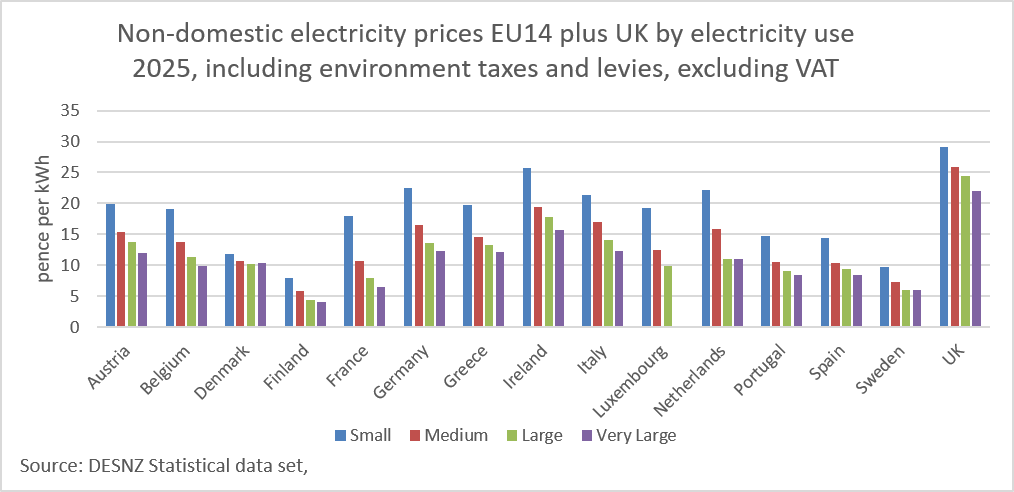
Each EU Member State has its own electricity industry, with a mix of state- and privately operated producers and fuel sources ranging from burning lignite and coal to nuclear, hydro, biomass, wind power, and other generation mixes. EU member states also have different tax rates, levies, and subsidies on their electricity. In 2025, prices before tax for non-domestic users varied from 3.95p per kWh in Finland for very large electricity users, to 24.92p per kWh for small users in Ireland. Including taxes, Finland again had the lowest rate for its very large users at 4p per kWh, while Ireland still topped the poll at 25.66p per kWh.48 However, had the UK still been a member of the EU, it would have had the highest prices across all but one category of non-domestic users, with or without tax.
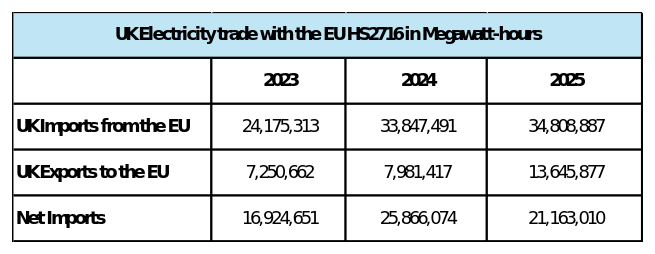
There is a perception that UK electricity prices will be lower if the UK joined the EU’s IEM, but UK prices include many other costs besides the cost of producing electricity. Subsidies for renewable producers, system-balancing costs, capacity-market costs, and transmission costs would still exist. Consequently, UK electricity prices will still be higher than EU prices. There are also capacity constraints for interconnectors to continental EU and Norway. At present, the UK has 7 operational interconnectors to continental Europe and 2 to Ireland; the interconnectors with continental Europe have a maximum capacity of 8.8 GW, about a third of the UK’s Summer demand of 27 GW and less than a quarter of peak Winter demand of 38.8 GW.49 In general, the UK is a large net importer of electricity from the continent (see table below). And only a net electricity exporter to Ireland. Ofgem has approved the construction of another 5 interconnectors to the continent and 1 to Ireland. Together, they will add 7.5 GW of capacity.
What would be the benefits to the UK of joining the EU’s electricity market?
While supporters of the Reset believe that UK wholesale electricity prices could fall if the UK joined the EU’s IEM, as more electricity could be imported from lower-priced suppliers such as France and Norway, the UK already imports around 10% of its total electricity from the EU. Although cheaper, imports are constrained by interconnector capacity, so joining the IEM could lower prices only marginally unless additional interconnectors are built.
In addition, UK electricity users would still have to pay for transmission, network, and balancing costs, renewable subsidies, and other levies and taxes added to UK electricity prices. For example, in 2025, annual non-domestic electricity prices, excluding taxes, levies, and VAT, for very large electricity users – classed as those that use between 70,000 and 150,000 MWh – were 11.01p per kWh in Germany, 6.25p per kWh in France, and 16.03p per kWh in the UK. After including environmental taxes and levies, but still excluding VAT, prices rose to 12.37p per kWh in Germany (up 12.4%), 6.57p in France (up 5.1%), and 22.08p in the UK (up 37.7%). UK non-domestic electricity costs for large commercial users are 46% higher than Germany’s before environmental taxes, but 78% higher after accounting for them. Compared to France, the gap is even wider, with UK costs 156% higher before environmental taxes, and an incredible 236% higher after accounting for them.
It is disingenuous for UK politicians to claim that joining the EU’s IEM will lower UK electricity prices; the amount we can import is constrained by interconnector capacity, and the UK’s very high environmental taxes will still be applied to UK electricity production. Only wholesale electricity transmission costs would be marginally cheaper due to the UK’s membership of the EU IEM. Nothing else will change.
There is also the consideration that any savings in electricity trading costs will be negated by the EU’s demand that the UK may pay to use its electricity market and the fact that use of the EU’s electricity market will be linked to an additional permanent payment to the EU’s Cohesion Fund. As with other EU payments, taxpayers will pay them, while any net benefit from cheaper transaction costs would accrue to electricity companies.
NESO has claimed that the UK will be a net exporter of electricity by 2030; however, this does not mean the UK will profit from these exports. Negative wholesale prices have become increasingly frequent when wind and solar output is high, and electricity demand is low, such as during the middle of the day or during periods of high wind. When the wholesale price is below zero, generators are effectively paying to inject electricity into the system. Some of this power could be transferred to the EU via interconnectors if prices are higher in the connected markets. However, because of Contract for Difference (CfD) payments, producers will still receive the same amount, which UK electricity users will continue to pay through the fixed policy costs added to their bills. The main benefit of exporting electricity is avoiding curtailment costs (discussed in greater detail later).
How would IEM differ from EU UK electricity trading now?
At present, the UK imports about 10% of its total electricity use from European countries, predominantly France and Norway. This has continued after the UK left the EU and its IEM. The process involves buying transmission capacity and then electricity in separate auctions. The dual auctions are estimated to add 0.25% to 0.7% to the cost in 2023, according to Montel Analytics.50 As the UK is adding 37.7% to wholesale electricity costs for environmental taxes and levies, it is hard to imagine that this tiny saving would persuade the UK to rejoin the EU’s IEM, especially as the UK will be required to pay for IEM membership as well as pay into the EU Cohesion Fund.
Under the EU’s IEM, interconnector capacity allocation is coupled with electricity bids and offers. The EU’s EUPHEMIA system automatically schedules the electricity flows through the interconnectors. This makes the system more efficient. European Nominated Electricity Market Operators (NEMOs) run and fund EUPHEMIA, and the EU Agency for the Cooperation of Energy Regulators (ACER) and the European Network of Transmission System Operators for Electricity (ENTSO-E) govern it.
As the EU has stipulated, the UK would have to contribute financially to support the EU’s IEM policy and the functioning of the relevant EU agencies, systems, and databases. This refers to: the agencies involved in electricity market governance, ACER, and ENTSO-E; the IEM systems, including the Single Day Ahead Coupling (SDAC) mechanism, the Single Intraday Coupling (SIDC), and EUPHEMIA; and the IEM databases, ACER REMIT, and ENTSO-E operations data, as well as to NEMO contributions and Transmission System Operator (TSO) contributions. These would be EU budgetary contributions to the EU’s energy system and not electricity market fees. As budgetary contributions, they would be based on the relative size of the UK economy, not on the amount of electricity the UK buys from the EU’s electricity market.
How much would the UK have to pay?
Switzerland pays between £5 and £10 million a year for electricity cooperation, and Norway pays between £10 and £20 million a year for IEM participation. Meanwhile, Northern Ireland pays between £1 and £3 million for SEM-IEM participation, as it uses the SDAC and SIDC, ACER, and ENTSO-E governance structures, and REMIT data. This is because the Island of Ireland’s Single Electricity Market (SEM) is already integrated into the EU’s IEM. Based on these three countries’ payments, we should expect the UK to be asked to pay between £40 and £80 million a year towards the IEM operations. This is less than the £120-£370 million the UK is estimated to lose each year from inefficient interconnector use due to being outside the EU’s IEM, so the assumption is that there would be an £80-£290 million net benefit to the UK joining. However, as with all other parts of the Reset, the gains from lower transmission costs would accrue to private companies in the UK electricity supply chain, including suppliers, traders, and interconnector operators, while the costs of membership would fall on the public purse and be borne by taxpayers. Of course, the benefits could be passed on to electricity users in the form of slightly lower bills (estimated at 0.25% to 0.7% savings), and the largest electricity users will be the greatest beneficiaries.
While IEM participation will shave the costs of importing EU electricity, it won’t lower the cost of UK electricity until more interconnectors are built and a greater proportion of cheap electricity can be imported from Europe. Although French nuclear and Norwegian hydropower are much cheaper than UK wholesale electricity prices, the UK already imports electricity from France, Norway, Denmark, and the Netherlands almost daily. A better solution would be to review why UK electricity is so expensive and how we can change this.
It is also claimed that the UK would incur lower balancing and curtailment costs by joining the IEM, as excess wind-generated electricity could be exported more easily to the Continent. This assumes that wind electricity does not also exceed demand in other EU countries with North Sea coastal waters and similar levels of wind generation, particularly Denmark, Belgium, and the Netherlands. There is already the problem that excess wind and solar electricity, subsidised by UK consumers, is sold at a loss to EU consumers who don’t pay for these subsidies.
S&P Global believes that rejoining the EU’s IEM would support new interconnector projects,51 but the UK has already approved six new connections. Any new nuclear projects should be increasing the supply and bringing down the cost of energy in the UK, not sold to EU countries that are not paying the Regulated Asset Base (RAB) premium, which is already being added to UK consumers’ electricity bills to pay for the construction of new nuclear projects, long before they will generate any electricity. If continental Europe is willing and able to supply the UK with as much electricity as it will need in the future, we should be questioning why the government continues to hand out 20-year subsidies to intermittent wind and solar projects and to fund more nuclear electricity capacity.
Loss of sovereignty, State Aid, and control of UK environmental regulations.
In addition to the payments for joining the IEM and for the EU’s Cohesion Fund, Section 5.1, paragraph 14 of the European Commission document clearly states that if the UK joins the EU IEM, it will have to follow all EU regulations on the promotion of renewable energy and apply them simultaneously with the EU.
15. In addition, the agreement should provide that the United Kingdom ensures, dynamically and at all times, at least the same level of environmental protection in law as set out in the relevant European Union rules on the protection of the environment.
This includes the EU requirement that its members set a target for renewable energy as a proportion of their gross final energy consumption. The EU demands that the UK target must be comparable to the EU’s target and calculated using EU definitions, requirements, and methodologies. The passage from the Commission’s document is reproduced below (emphasis added).
14. The envisaged agreement should also ensure the dynamic alignment of the laws of the United Kingdom with the rules of the [European] Union on the promotion of renewable energy and provide for their simultaneous application in the United Kingdom. It should set an indicative global target for the share of renewable energy in the gross final consumption of energy in the United Kingdom. To ensure a level playing field, the global target should be comparable to that of the [European] Union and based on the definitions, requirements and methodologies set by the [European] Union acquis.
The EU’s definition of gross final consumption of energy refers to all energy delivered to end-users, plus the energy used to generate electricity and heat. A country’s share of renewable energy is its total renewable energy consumption as a proportion of gross final energy consumption. The European Commission Directive 2009/28/EC defines it, and it forms the target for Directive (EU) 2018/2001 (RED II) and RED III.
Gross final consumption includes all energy, heating, electricity, and transport fuels delivered to households, industry, services, agriculture, and all forms of transport, as well as electricity and heat used in power stations, energy lost in its transmission and distribution, and any off-grid energy use. The EU’s calculation of renewable energy consumed includes wind, solar, hydro, biomass, and geothermal, as well as heat from heat pumps, biomass, solar thermal, renewable transport fuels (such as bioethanol, biodiesel, and renewable electricity used by EVs), and renewable hydrogen (less any renewable electricity exported into the IEM).
The EU’s current renewable share target under its Renewable Energy Directive (RED III) (Directive (EU) 2023/2413) is 42.5% of gross final energy consumption by 2030. The previous target, RED II, was only 32% by 2030.52, 53 If the UK joined the EU’s electricity market, it would also have to meet this target, even though the EU only has to meet the target collectively, so Member States with a greater proportion of renewables can be balanced out by those with a lower proportion.54 Member States do not have a legally binding individual renewable target under RED III as they did under RED I.
Sweden, Finland, Latvia, Denmark, and Estonia have already met or exceeded the 42.5% target for renewable energy consumption, and Portugal, Croatia, Lithuania, and Romania are on track to meet it by 2030. 55 However, EU economies such as Spain, Germany, France, Italy, Belgium, the Netherlands, Bulgaria, Cyprus, and Ireland are all between 15% and 25%, while Luxembourg, Hungary, Poland, Czechia, Slovakia, and Malta are all below 15%.56 This isn’t surprising, as 14 EU countries are still using some coal-fired electricity, and 9 derive more than 10% of their electricity from coal. Poland is the largest user; more than 60% of its electricity is produced from coal, which may explain why its economy is booming compared to other large EU member states.57
The UK could not realistically meet the EU’s 42.5% renewable energy target by 2030. The UK’s renewable energy share in 2025 was only 16.8% when all energy sources are considered.58 Even though the UK gets 53.5% of its electricity from renewables, electricity accounts for only about 20% of the UK’s total energy use. Only about 10% of UK heating and 6% of UK transport would be considered ‘renewable’ — as in they run on electricity even though they are made in China using coal power. The UK would need to increase its share of renewables by two and a half times in about four years. This would require wartime mobilisation with unlimited capital, planning, labour, and supply-chain reforms; grid upgrades; massive heat-pump rollouts; rapid EV adoption; fast-charging stations; renewable biofuel blends; large efficiency gains; and overall energy-demand reduction. Achieving this is improbable, not least because of cost and supply-chain restrictions. At present, Great Britain is unlikely to meet its own Clean Power 2030 target requiring 95% of Great Britain’s electricity to come from ‘clean sources’, defined as wind, solar, bioenergy, hydrogen, nuclear, gas with Carbon Capture and Storage, and hydrogen power.
Worse still, the EU does not count nuclear energy as renewable in its tabulation of renewable energy share. However, the UK’s future electricity plans involve greater use of nuclear energy, and both large reactors and Small Modular Reactors are already being constructed or approved.
What if a Member State is persistently under‑contributing? (Asking for a friend)
Under the current RED III rules, the European Commission can impose corrective measures on Member States that are under-contributing to the collective target under Governance Regulation (EU 2018/1999). The UK would be outside this collective target, but we have to assume it would also be required to meet the same target and be subject to the same penalties. These could involve financial sanctions, mandatory corrective actions, and potentially loss of access to the EU’s electricity market, as the Commission’s document includes ‘provisions for termination and suspension’.
The UK will have to comply with EU State Aid Rules
Joining the EU’s IEM will also force the UK to follow the EU’s State Aid rules, ‘at all times’, as shown in the passage below, with added emphasis. This will limit the UK government’s ability to encourage new enterprise areas by subsidising new energy production or grid connections.
16. Furthermore, the agreement should ensure that the United Kingdom applies, at all times, State aid rules covering any aid that specifically targets the electricity sector or has a particular material effect on the electricity market, including existing aid but not affecting the validity of aid already granted to individual beneficiaries, for example in the form of legally binding commitments pre-dating the entry into force of the agreement. The agreement should guarantee that there are the same substantive and procedural State aid rules as the rules of the [European] Union. This should include providing for their dynamic alignment with [European] Union law, giving due regard to the constitutional and parliamentary procedures of the United Kingdom.
The UK’s subsidies to wind and solar providers, Regulated Asset Base payments for nuclear developments, and grants for grid upgrades would all be considered State Aid by the EU if the UK joined the EU’s IEM.59
The UK would have to dynamically align with EU State Aid rules such as its Climate, Energy and Environmental Aid Guidelines (CEEAG) and Clean Industrial Deal State Aid Framework (CISAF, 2025).
The EU currently prefers CfD subsidies when they are awarded through competitive auctions and avoid overcompensation. So, UK CfD subsidies should be compatible with the EU’s CEEAG/CISAF conditions. The European Commission has approved large national schemes using CfDs for wind and solar in Denmark, Italy, and France. However, any new RAB-financed nuclear projects would need to be compatible with Article 107(3)(c) TFEU (aid to facilitate the development of certain economic activities). The UK would have to prove to the EU Commission that RAB funding is necessary, proportionate, does not unduly distort competition, and complies with other EU law (including environmental rules).
Rule taking
Finally, the UK would become a rule-taker in its own electricity market: the EU would determine the UK’s choice of energy production and the amount of subsidy it could pay to any new electricity providers. The EU would also control the UK’s environmental laws and its use of renewables.
18. Finally, the agreement should provide for the participation of the relevant UK regulatory authority, in respect of Great Britain, in the [European] Union agency ACER, without a right to vote, in line with the requirements of the Union acquis.
EU Internal Electricity Market Conclusion
Joining the EU’s IEM will reduce costs for UK electricity suppliers, but UK taxpayers will pay for it, with little chance that the savings will be passed on to electricity users. The savings are immaterial compared to the taxes and other environmental costs that the government adds to electricity prices. While joining the IEM could mean excess UK wind and solar electricity could be exported to the EU more easily, UK taxpayers and bill payers would still subsidise this electricity. It would make more sense for the UK to stop subsidising additional wind and solar capacity. There is already more capacity than the Grid can use outside peak times, which increases the cost of balancing the system by paying curtailment fees to producers. Excess capacity also requires expensive grid upgrades and the construction of larger pylons across the country. In addition, the greater distances of new wind farms from the areas of greatest demand increase transmission costs, which are added to electricity bills.
Joining the EU’s IEM would also force the UK to follow EU environmental rules, including the Renewable Energy Directive RED III, which would require the UK to reach 42.5% of its total energy use from renewable sources by 2030. This would be an impossible task on the current trajectory, even with massive investments in technology and compulsory, dramatic lifestyle changes.
Finally, joining the EU’s IEM has been coupled with paying into the EU’s Cohesion Fund, so the UK would have to pay to level up poorer areas of the EU, even though there are many poorer areas of the UK where the money would be better spent. The European Commission documentation covering these two initiatives clearly gives the EU the right to terminate the UK’s membership of the IEM if the UK doesn’t dynamically align all of its environmental regulations with those of the EU, while the UK’s payments into the EU’s Cohesion Fund would be both permanent and legally binding.
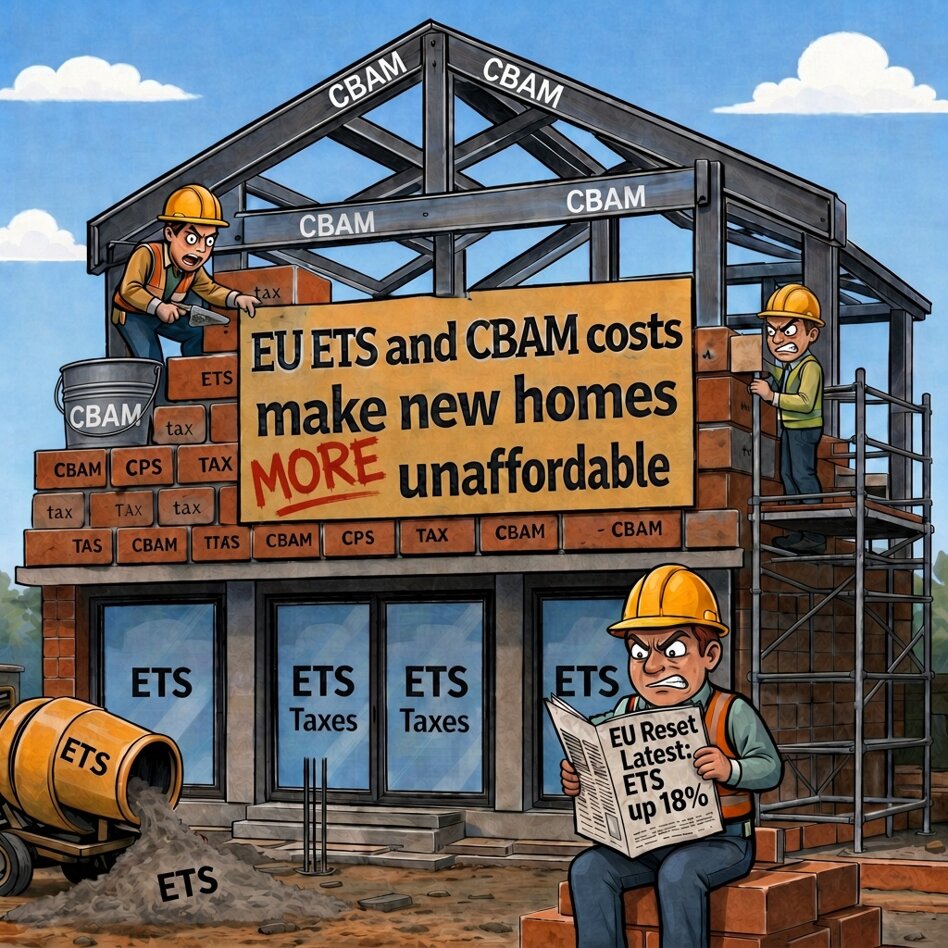
B. Joining the EU’s Emission Trading System
This section scrutinises the second section of the European Commission Document, COM(2025) 408 final, published on 16 July 2025, which covers the potential to link the UK and EU Emissions Trading Systems (ETSs).60 This is part of the same European Commission document covering the agreement for the UK to join the EU’s SPS area; however, unlike the Internal Electricity Market, the Council of the European Union explicitly stated in Council Decision (EU) 2025/2468 that negotiations should be opened with a view to concluding two separate agreements.61 One would cover the SPS Area and the other ETS membership, meaning the UK could legally agree to join one but not the other.
Alternatively, the UK and EU could avoid conjoining their ETS markets, as the Council publication explains that Article 25(1a) of Directive 2003/87/EC provides for the mutual recognition of allowances between greenhouse gas emissions trading systems, provided that any such third-country emissions trading system is mandatory and based on absolute emission caps. The UK’s emissions trading system meets these criteria. So why isn’t the government simply negotiating mutual recognition with the EU rather than full membership of the EU’s ETS and subservient status to EU emissions regulation? The whole premise of the Reset must be questioned if mutual recognition is available.
Background
The UK was part of the EU’s ETS until 2021, when it established its own emissions trading system after leaving the European Union. The two systems have diverged not only in price, but also in the industries required to purchase emissions allowances, the number of allowances issued, and the number of free allowances granted to selected companies.
Importantly, the UK ETS price has consistently been lower than the EU ETS price since the two markets decoupled. The price differential has ranged from 40% lower to just 4% lower but has recently been around 20% lower. At the last ETS auction held in each jurisdiction in July, the UK price was 17% lower than the EU auction price and 21.4% lower than the German auction price.
The EU ETS has been expanded since the UK left and now also covers maritime transport and international aviation. Like the UK, the EU granted free allowances to companies that had to compete with imported goods not subject to emissions taxes in their domestic markets. Free allowances also helped to prevent EU companies from offshoring their manufacturing to avoid the ETS; the EU calls this ‘carbon leakage’. However, the EU has introduced a Carbon Border Adjustment Mechanism (CBAM), so goods imported from countries with lower or no carbon taxes will be subject to EU carbon tariffs. The EU’s CBAM tariff is being implemented gradually to mirror its reduction in free allowances, starting at just 2.5% of the full CBAM tariff in 2026 and reaching 100% by 2034. After which, the EU believes there will be no need for free ETS allowances.
The European Commission’s negotiating mandate for the UK to align with the EU’s ETS market, reproduced below with added emphasis, stipulates that the UK would also be required to follow the same decarbonisation pathway and ETS scope as the EU.
In the case of emissions trading, the agreement to link the United Kingdom and the Union’s greenhouse emissions trading systems would ensure at least the same decarbonisation ambition, thereby reducing the risk of carbon leakage and distortion of competition, but also the same scope (except the individual heating of housing) and regulatory alignment to relevant Union rules.
As with the other European Commission negotiating documents, joining the EU’s emissions trading system requires the UK to:
- dynamically align with all relevant EU laws,
- ensure that the UK has identical rules that are applied simultaneously,
- ensure the UK has uniform interpretation and application of EU rules following ECJ case law,
- agree that the ECJ is the ultimate authority for all EU law,
- accept that all UK laws in these areas will be EU laws and therefore exclusively covered by ECJ adjudication, and
- accept that dispute resolution will include cross-retaliation with other UK-EU agreements such as the Trade and Cooperation Agreement
As reproduced below in Section 1.2 of the European Commission Explanatory Memorandum, COM(2025) 408 final.
The new agreements should (i) guarantee dynamic alignment with all the relevant European Union rules, (ii) ensure uniform interpretation, (iii) include a dispute resolution mechanism with an independent arbitration tribunal based on the Trade and Cooperation Agreement with a role for the Court of Justice of the European Union as the ultimate authority for all questions of EU law; and (iv) include a robust mechanism to ensure compliance with rulings of the arbitral tribunal, for instance through the possibility to adopt appropriate measures to protect the Union interests and the possibility of cross-retaliation between the new agreements and between these and the areas covered by the Trade and Cooperation Agreement.
Differences in EU and UK ETS schemes
If the UK joined the EU’s ETS, it would have to apply emission allowances to the same industries as the EU. This would include electricity generation, industrial heating (excluding domestic housing), industry, and domestic and international maritime and aviation transport. The UK would have to agree to any EU-initiated expansion of the ETS and to follow the EU’s cap-and-reduction pathway. The UK would also have to dynamically align with the EU’s financial regulations governing trading in EU emissions allowances and their derivatives.
While the UK ETS covers many of the same areas as the EU’s ETS, there are differences in the treatment of maritime cargo and passenger ships over 5,000 GT. The EU’s ETS covers 100% of CO2, CH4 and N2O emissions from maritime voyages between EEA ports and 50% of emissions from voyages between EEA ports and non-EU ports. The UK’s ETS currently covers only emissions from domestic voyages and in-port emissions, but allowance surrender does not start until April 2028.
The EU plans to extend its ETS to smaller maritime vessels between 400 and 5,000 GT, increase its emissions coverage rate on international voyages and include municipal waste incineration. The UK also plans to include energy from waste and waste incineration in its ETS from 2028.
The EU has a separate ETS2 system, which covers building heating and cooling, road transport, and SME industrial sites. It is currently in the reporting stage and will not require allowance surrender until 2028. It will be charged through fuel suppliers rather than on individual households, drivers, and businesses. There are no free allowances, and a significant share of the revenues collected is planned to be used to help poorer households pay for the charges. Although the proposal for the UK to join the EU’s ETS does not specifically mention the EU’s ETS2, the agreement does require the UK to follow any expansion of the EU’s ETS system.
The main difference between the UK and EU ETS systems at the moment is the price and the coverage of maritime transport. The EU’s emissions auction price is about 20% higher than the UK emissions auction price. This appears to be largely due to supply and demand. The UK has deindustrialised more than the EU, so fewer companies need to purchase ETS allowances. However, as an island, the UK relies more on maritime transport for goods. Joining the EU’s ETS will not only increase emissions prices for UK industry and manufacturers but also increase the transport cost of imported goods.
Costs to the UK of joining the EU’s ETS
As with the other Reset agreements, the European Commission wants the UK to pay to join the EU’s ETS and CBAM. Both are specified in Section 4. Budgetary Implications of the various Commission documents are shown below.

However, the highest costs to the UK of joining the EU’s ETS will be from:
- the approximately 20% increase in the ETS price, which will increase costs for all UK industries required to purchase emissions allowances even though the UK will still operate its additional CCL charges, and the UK’s Carbon Price Support tax will be in place until 2028;
- the increase in the cost of imported goods due to the expansion of the ETS to cover maritime transport; the UK is a much greater user of sea transportation than the EU;
- the requirement to follow the EU’s cap-and-trade pathway of allowance reduction; and
- the requirement to apply the EU’s CBAM tariffs even onto essential input materials and finished goods that the UK no longer makes.
What is causing the price differential between the EU and UK ETS
Both the UK and the EU are reducing the number of emissions allowances they auction each year to force companies to reduce their emissions. The EU is reducing the number of emissions allowances it auctions by 4.3% each year between 2024 and 2027; this will increase to an annual 4.4% reduction after 2028. The EU system is designed to reduce emissions in the areas covered by its ETS by 62% compared to 2005 emissions, the year the ETS was introduced, by 2030. The EU is also phasing out its free allowances from 2026 to 2034, in line with the introduction of its CBAM.
After leaving the EU’s ETS, the UK’s emissions allowance reductions were increased: first by about 5% more than the EU, and then, in 2023/4, by introducing a cumulative cap of 936 million allowances for the 2021-2030 period. The UK’s total allowances are capped at 77.4 million for 2026, down from 92 million in 2024. Each allowance is equal to 1 tonne of CO2 equivalent.62 The first allocation period, 2021 to 2026, had a total cap of 712 MtCO2e, but for the 2027 to 2030 period, the total allocation has been reduced to just 224 MtCO2e. The UK ETS Authority governs the UK’s scheme.63 Like the EU, the UK ETS Authority allocates free allowances to companies facing international competition from imports from countries with less stringent emissions regulations.64
The UK ETS auctions are held every fortnight, with companies bidding for 2,074,500 allowances. ETS auctions require UK companies to pay HMRC between £200 and £280 million each month, or £2.4 to £3.4 billion each year. This reduces their capital for investment and disrupts their cash flows. The ETS has become merely another tax on businesses; it increases production costs, which are passed on to consumers.
UK emissions auction volumes will also fall, from 69 million in 2024 to just 24 million by 2030. However, the UK won’t begin phasing out its free allowances until it introduces a CBAM. This applies only to the products covered by the UK’s proposed CBAM, which is due to start in 2027 unless the UK joins the EU’s ETS and CBAM, in which case it will start immediately.
The EU issued no free allowances for maritime and aviation operators in 2026, but issued 481 million free allowances in 2025 to stationary installations (the most recent published numbers). EU Member States allocate their free allowances to their industries in accordance with EU regulations set by the EU Commission.65 If the UK joined the EU’s ETS, this would also apply to UK allowance distribution. Under EU rules, free allowances may be granted to industries susceptible to import competition from countries without an ETS or with a lower ETS price. The industries covered include Steel, Cement, and Chemicals, which receive 100% free allowances, whereas less-exposed sectors receive a smaller proportion of allowances, down to 30% in 2026, and this will fall to zero in 2030.
EU and UK ETS auction prices
Despite the UK’s faster allowance reductions, UK ETS prices have remained below those of the EU ETS, and the spread between them is highly volatile. For example, the EU’s ETS auction price was over €90 per tonne in January 2026, equal to about £79.21, so about 17% above the UK price of £67.55, but in March the EU ETS auction price was 64% higher than the UK auction price at €69.12 (£59.80), while the UK price was just £36.38. In May, the EU price was €73.85 per tonne (£63.83), 30% higher than the UK price of £49, but by the end of July, the differential was back at 17% with the EU auction price at €80.93 and the UK price at £59.26.66 As shown in the chart below:
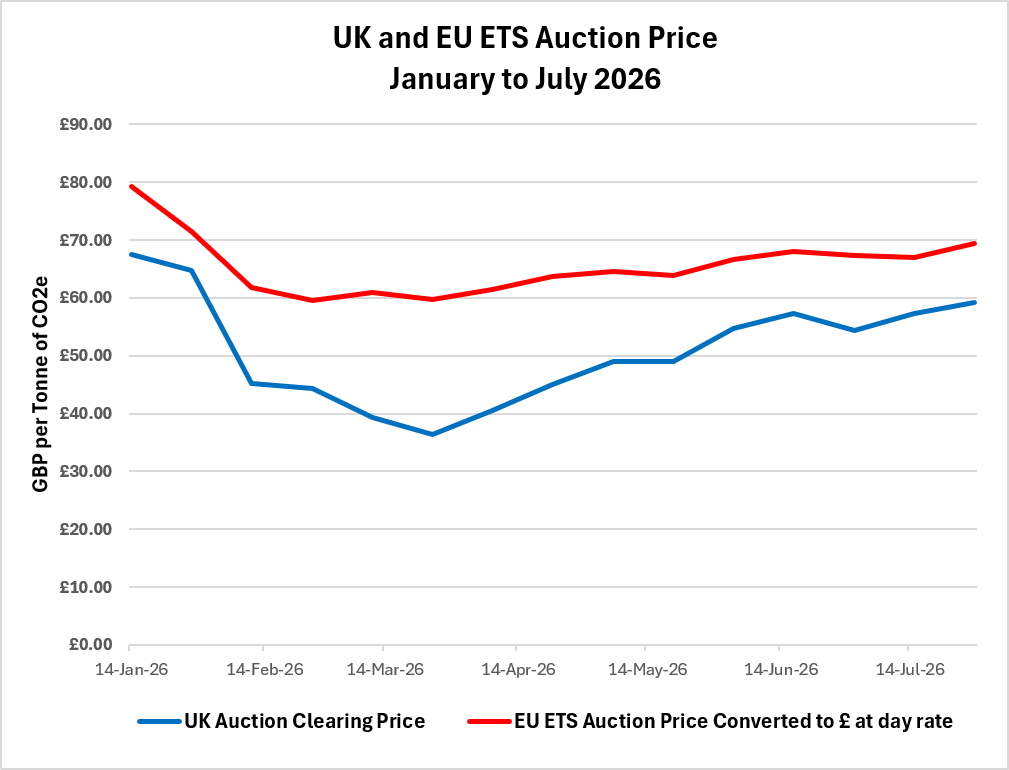
The UK emissions market is much smaller than the EU’s market, roughly a tenth of the size, and the UK has deindustrialised at a faster pace than the EU and has ceased to use coal to generate electricity, unlike many EU countries.
The UK’s ETS covers only about 25% of the UK’s total territorial emissions: mainly power generation, energy-intensive industries (oil refining, steel, cement, chemicals, etc.), aviation, and domestic maritime emissions. The EU ETS covers sectors that are responsible for about 40% of EU emissions, including international shipping.
The UK’s ETS is smaller than the EU’s, covering fewer than 600 industrial sites. Of these, 385 received some amount of free allowances67 95 received no free allowances in 2026 but have in the past, while UK electricity generators, some waste incinerators, Combined Heat and Power (CHP) units, and industrial boilers have never qualified for free emission allowances and must cover all of their emissions by buying allowances at the auctions or on the ICE market.
In contrast, the EU ETS covers over 16,000 stationary industrial sites in the EU and the EEA, 1,600 aircraft operators, and 2,600 maritime operators.68 The EU issued 934.5 million allowances for stationary installations, maritime, and aviation. This is the number after the reduction for unused allowances still in circulation and the Market Stability Reserve’s automatic supply adjustment.69
The cost of joining the EU’s ETS
Joining the EU’s ETS and following its rules on emissions allowances will not help UK industry. The UK has very little primary steel to protect, with only one remaining steelworks still operating blast furnaces, even less primary aluminium to protect, and no ammonia production for fertilisers. But the UK does have other industries to protect, such as ceramics and glass production, which would fall outside the EU’s free allowances.
Using the auction prices at the end of July 2026, joining the EU’s ETS would increase the carbon costs of UK-produced basic products like aluminium, iron and steel, cement, glass, and bricks by 17%. Many of these producers still benefit from free allowances, but if the UK joined the EU’s ETS, its free allowance policy would have to mirror the EU’s.
The companies that bought the 2,074,500 allowances, spending between £200 and £280 million each month, would, under the EU’s ETS, have spent £240 to $340 million each month, or £2.9 to £4 billion each year. It is impossible to understand why any government would want to increase costs for businesses by raising carbon taxes and import costs at a time when most UK businesses are already struggling with low demand and higher costs, including higher wages, employment taxes, and greater employee rights.
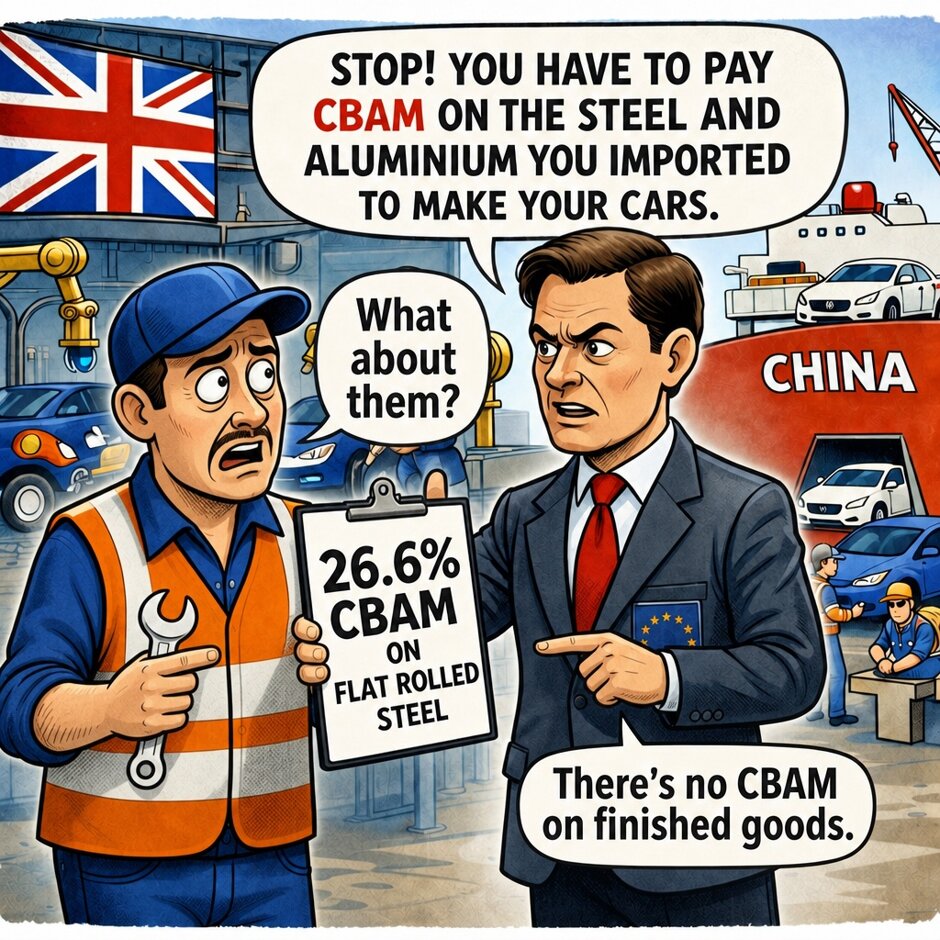
C. Aligning with the EU’s Carbon Border Adjustment Mechanism
It is claimed that the UK should join the EU’s ETS because it would exempt UK exports from the EU’s carbon tariffs, known as the CBAM. In fact, joining the EU’s CBAM is a mandatory part of joining the EU’s ETS agreement, specified in Section 1.3, ‘Level Playing Field Benefits’, shown below:
The agreement to link the United Kingdom and the Union’s greenhouse emissions trading systems would have to satisfy the conditions set out in Article 2(6) of Regulation (EU) 2023/956 establishing a carbon border adjustment mechanism (‘CBAM regulation’).
However, this will not level the playing field or increase UK exports to the EU; it will raise the price of all UK goods, negating any CBAM savings. The EU’s ETS is more expensive than the UK’s and covers more industries; joining it would raise carbon prices across all UK industries, regardless of whether they export to the EU. The EU’s ETS and CBAM cover goods that the UK no longer produces in any quantity and generally imports from the EU rather than exports to it. The EU’s ETS also includes some industries not currently covered by the UK’s ETS, most notably international shipping, which will push up import prices for both UK manufacturers that have to import input materials and UK consumers, who will pay more for imported finished goods.
Joining the EU’s ETS and CBAM is meant to protect the few UK companies that export CBAM goods to the EU, but it will ultimately force the UK to impose a carbon tariff on imports from non-EU countries. So, the protection is for EU producers, not UK manufacturers who will have to pay more for imported materials. Joining the EU’s ETS and CBAM will not create a level playing field.
EU CBAM charges on UK exports could be minimal
However, there are many reasons why the EU’s CBAM charges on EU exports will be minimal and avoiding them is not a valid reason to force all UK manufacturers to pay the EU’s higher ETS charges:
- For almost all of the goods covered by the EU’s CBAM, the UK is a much larger importer from the EU than it is an exporter to the EU.
- In many CBAM products, UK exports to the EU are minimal.
- In some of the industries covered by the EU CBAM, UK producers have almost all gone out of business or moved their production offshore. This is most noticeable in UK steel production (both EAF and blast furnace), aluminium, and fertiliser production.
- For many UK exports, the additional cost of the CBAM would be minimal compared to the value of the product because CBAM charges are calculated based on weight and the emissions released during production per tonne of finished product, rather than on the value of the finished product. For example, some high-value aluminium products would have CBAM costs of less than 1% even when CBAM is fully applied, which won’t be until 2034. At present, the CBAM is charged at just 2.5% of the total to account for EU free allowances.
- The UK’s default emissions values for CBAM goods have been published by the EU, and the UK’s default emissions are relatively low and generally lower than those for the same goods produced in the US, India, or China (more on this below).
- The UK is one of just 3 countries currently being reviewed by the EU for a reduction in the total CBAM costs under Article 9 of Regulation (EU) 2023/956, which allows an authorised CBAM declarant to claim a reduction in the number of CBAM certificates to be surrendered if a carbon price has been effectively paid in a third country. This legislation is not yet finalised, but the UK, South Korea, and South Africa are the only three countries with ETS programmes under consideration by the EU. Article 9 would further reduce the amount that UK exporters would be expected to pay, and make joining the EU’s expensive ETS scheme unnecessary.70
- For a non-EU or EEA country to be eligible for a reduction in CBAM charge under Article 9 of the CBAM regulations (EU) 2023/956, its domestic carbon prices must be: defined in law; be a monetary amount paid as a tax, levy, or fee as emission allowances; it must have been paid, not a free allowance, a credited allowance, or an accessed allowance; the scheme must be legally binding, not voluntary; the exporter must have detailed proof of payment; and the allowance must be attributed to a specific good. The UK’s ETS system already meets all of these requirements, meaning there is no need to join the EU’s ETS.
EU CBAM calculations
The CBAM charge the EU adds to an import is the EU’s CBAM certificate price, which is set quarterly, multiplied by the net emissions per tonne during the production of the imported good. Net emissions cover only emissions subject to CBAM (other emissions are ignored) and are the difference between the imported goods’ emissions and the EU’s benchmark emissions, multiplied by the CBAM phase-in amount. The EU’s benchmark emissions are those from the most efficient EU installations that produce the same good and use the same production process. The benchmarks are straightforward for simple chemical products such as hydrogen and fertiliser, but more complicated for steel or aluminium products, where the production process can make a big difference to emissions. Effectively, the CBAM is a charge on the difference between the imported good and the EU’s most efficient producer, after adjustment to reflect the proportion of EU production that still receives free allowances.
If net emissions are negative because the imported good has lower emissions than the EU benchmark after adjustment for free allowances, then net emissions are set to zero, so no CBAM will be charged. This is the case for HS 25070080 Kaolinic Clays, where the UK default emissions for 2026 are 0.308 tCO2e/t, while the EU benchmark emissions are 0.666 tCO2e/t. This example is interesting because Kaolin is one of the few EU CBAM products where the UK exports more to the EU than it imports from it. In 2025, the UK exported 542,240 tonnes of Kaolin (HS250700) to the EU, but imported just 12,990 tonnes. The UK government should not be pressured by Kaolin exporters to align with the EU’s ETS, despite their large net exports, as Kaolinic clay CBAM charges will be zero.
Emissions default values – according to the EU
The EU has published its CBAM default values for its main trading partners, 119 countries, and a default value for everyone else.71 The spreadsheets cover about 350 individual CBAM goods, listed by 6- or 8-digit tariff codes. The EU apparently hopes that exporters will calculate the exact emissions associated with their products, but this is a complicated process, and importers dealing with a variety of goods will probably opt for the default values. Specialist producers of a single product will benefit from being able to prove their actual emissions, especially if they are below the EU Benchmark.
To further discourage imports of high-emission goods, the EU has increased the total default emissions by 10% in 2026, and will increase them by 20% in 2027 and 30% in 2028. This works if domestic EU suppliers offer competitively priced products compared with imported goods plus the CBAM charge. However, this is not the case in the UK, where upstream producers rely on imported base materials and ingredients. If the UK joins the EU’s scheme, it will be forced to add a CBAM tariff to inputs imported from outside the EU or to buy more expensive inputs produced in the EU. This will drive up domestic prices for finished goods in the UK and make UK exports less competitive in non-EU markets, which currently have higher growth than EU markets.
Comparative advantage without joining the EU’s ETS and CBAM
In general, the default values the EU has assigned to UK goods are lower than those it has assigned to US, Indian, and Chinese goods. For example, the EU default emissions for UK HS 252310 Grey clinker cement are 20% lower than the default emissions for US imports, 32% lower than for Chinese imports, and 34% lower than for Indian imports. This is the case for most of the itemised default values, except for products made from iron and steel (HS73), where UK default values are generally considerably higher than those assigned to US products, although still lower than for Indian and Chinese steel products. For example, the EU’s default value for total emissions for HS73269030 Ladder and steps made of iron and steel for British exports is 66% higher than the US default emissions, but 25% lower than the EU’s default emissions for China and 53% lower than the EU’s default emissions for India.
The table below shows the substantial variation in CBAM charges for a relatively simple product used in fertiliser production: anhydrous ammonia. This calculation does not account for any Article 9 deduction for carbon prices already paid in the country of origin.
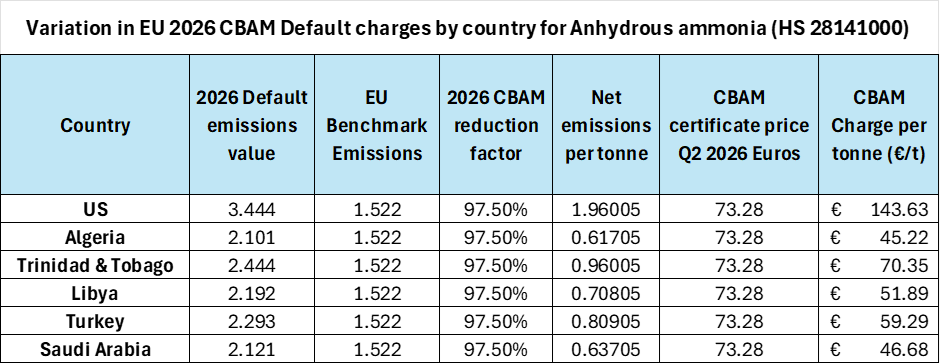
The EU is increasing country default emissions values by 10% in 2026, 20% in 2027 and 30% in 2028 and onwards for most products except fertiliser and fertiliser chemicals, which will only be increased by 1%. The EU is also reducing its CBAM reduction factor as it removes free allowances, so there will be no free allowances by 2034. The table below shows how this will work. The example used is anhydrous ammonia, an essential ingredient in fertiliser production. The US is currently the UK’s major and cheapest supplier. It supplies about a third of UK imports. If the UK joins the EU’s CBAM, it would increase the cost of US anhydrous ammonia by 34% in 2026, rising to 59% in 2034. This calculation assumes that the EU’s CBAM certificate price remains constant. This would obviously not be true – it will increase as the EU reduces the number of allowances it auctions and ends free allowances.
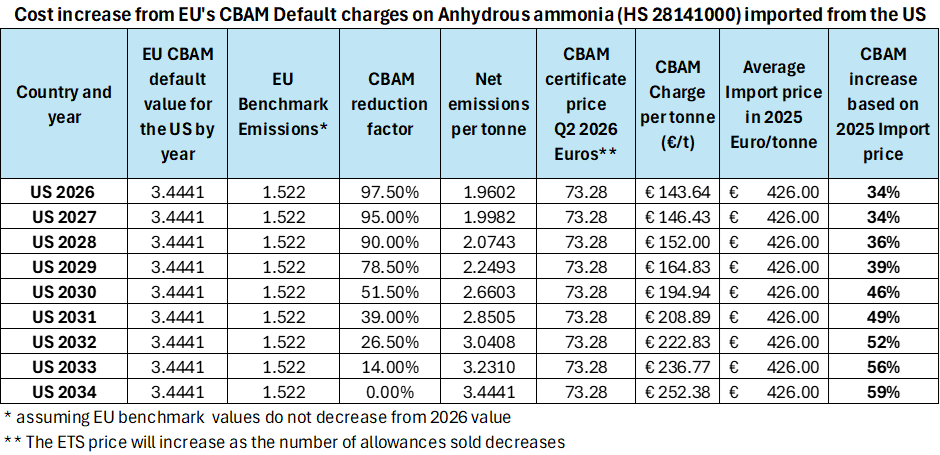
The EU’s CBAM coverage does not help the UK
Small UK exports to the EU of cheaper, homogeneous CBAM products
Another reason the UK should not join the EU’s CBAM programme is that the EU is applying CBAM only to simple goods made from six basic commodities: iron and steel, aluminium, cement, fertiliser, hydrogen, and electricity. The UK is not a significant exporter of any of these items, due in part to its own Emissions Trading System, Carbon Price Support tax, Climate Change Levy, other environmental regulations, and high industrial electricity prices, which have driven production of many of these materials out of the UK. For example, the EU has applied a 50% lower default CBAM emissions value to UK exports of HS 3102 80 Mixtures of urea and ammonium nitrate in aqueous or ammoniacal solution than it has to similar imports from the US, India, and China, but the UK exported only 107 tonnes of this product to the EU in 2025, about 0.015% of total EU imports. Any perceived benefit of the lower CBAM default value is negated by the small amount of UK exports that would benefit.
This is not an isolated example; the highest volume of UK fertiliser exports to the EU was 25,933 tonnes of HS 310240 in 2025. The EU imported over 8 million tonnes of the same product, so UK exports accounted for about 0.3% of that. Even though the UK’s default emissions value assigned by the EU is 55% lower than the US’s emissions value, this wouldn’t increase UK exports of HS 310240 if the UK joined the EU’s CBAM, because this product is made in the UK using imported ammonium nitrate, which would attract a CBAM charge, making the UK product even less competitive than it already is.
CBAM costs are immaterial for high-value products
The CBAM is most detrimental to exports of low-value goods and heavy goods with high CO2 emissions per tonne of production, but when it is applied to high-value goods and/or lightweight goods, even those with large emissions per tonne, the CBAM cost becomes immaterial as a proportion of the export price.
The EU’s CBAM is based on emissions per tonne of production; it doesn’t reflect the value of the goods, so for high-value aluminium parts the CBAM will be negligible, and UK exports will be unaffected, at least unaffected by CBAM payments on their exports. Instead, they would face additional CBAM payments on imported aluminium materials, making their products less competitive in the EU.
By contrast, for heavier, cheaper goods such as cement clinkers, the EU’s CBAM already adds 18% to the import price, even though it is only being phased in gradually. When fully applied, it would have added over 90% to the UK’s average 2025 per-tonne export price. This would affect UK clinker exports, if we had any. The UK exports very little clinker, so joining the EU’s CBAM would make almost no difference. For example, in 2025, the UK’s total HS 252320 Cement clinker exports to the EU were worth £816,000, even though the EU’s clinker imports were worth over £550 million that year. UK exports accounted for just 0.15% of the EU’s clinker imports. Paying to join the EU’s ETS would push up cement prices for all UK cement users, while having no effect on UK cement exports to the EU.
Meanwhile, for high-value aluminium fittings, the CBAM effect will be negligible even though the EU’s default emissions value for UK aluminium exports is more than double the default emissions for cement clinkers, because aluminium products are so much more valuable per tonne relative to their CBAM charge. For example, for HS7609 Aluminium tubes and pipe fittings, the added CBAM cost would add just 0.06% to the average 2025 export price per tonne and would have little effect on UK exports to the EU, which were just 4% of total EU imports. Even if the CBAM were applied in full, it would add only 0.15% to the price. But again, if the aluminium material used to make the tubes and pipe fittings is imported, this will push up the price of the goods, making them less competitive in the EU and in all other export markets.
The UK’s largest share of EU aluminium imports is in HS7613 Aluminium containers for compressed or liquefied gas, where the UK supplies a fifth of EU imports and tends to supply more expensive specialist containers. So, the CBAM cost would have added only 0.6% to the average export price per tonne in 2025 and, when fully applied, it would have added 1.2%. This is a niche market; the US is the world’s largest exporter of these products, and the UK is the second-largest exporter. The difference between the US’s and UK’s EU CBAM defaults for aluminium products is between 4.4% and 4.8%, so paying to join the EU’s ETS would not make UK exports of aluminium products to the EU more competitive with those from the US. However, both countries have considerably lower default values than India, which is 37% higher than the UK’s, and China, which is 55% higher than the UK’s. Without joining the EU’s CBAM, the UK and the US will be able to maintain their market share in the EU for these aluminium products as they will both be more competitive than imports from India and China.
Joining the EU’s CBAM will make UK exports less competitive
The UK has reduced or ceased production of many of the items covered by the EU’s CBAM, but it still imports them because they are important input materials for higher-value, complex goods still made in the UK. The best example of this is aluminium.
The UK has almost no primary aluminium smelting capacity left and produces only 5% of the aluminium it uses domestically.72 UK aluminium imports were primarily rolled aluminium used to manufacture vehicle and aircraft parts.73 The UK’s aluminium exports in 2025 consist of 54% scrap aluminium and 22% unwrought aluminium; only 24% were aluminium products, totalling just 270,000 tonnes. However, the UK imported 1.25 million tonnes of aluminium in 2025, 40% of which was plate, sheet, and strip aluminium that will be used by UK aircraft parts manufacturers, car manufacturers, construction projects, and to make aluminium drink cans that are now required under UK packaging recycling regulations.74
Adding a CBAM charge to imported aluminium would increase the cost of downstream products such as cars and aircraft parts, most of which are exported and make up the UK’s most valuable export sector. Export goods must remain price-competitive in global markets; adding a CBAM to these input materials will make this more difficult and is likely to lead to the entire assembly plant moving out of the UK. Meanwhile, the small amount of aluminium that is still smelted in the UK comes from a plant in Scotland that uses hydroelectric power, so its emissions are minimal. Not that the EU is interested in minimal emissions; despite its pretentions about the ETS and CBAM being about reducing GHG emissions, the EU’s CBAM benchmark only counts the direct emissions from aluminium smelting, not the indirect emissions from the electricity used in its production, even though this can account for 70% to 80% of the emissions. In the EU’s CBAM calculations, aluminium is either Primary (K) with benchmark emissions of 1.423 to 1.493 or Re-smelted from scrap (L) with benchmark emissions of 0.091 to 0.148.
What is the purpose of the UK-EU Reset and ETS alignment?
While the entire premise of the UK-EU Reset is that it will protect UK exporters from having to pay the EU’s CBAM charges, the UK either exports so little of these goods to the EU that there is very little left to protect, or its exports are so valuable that the CBAM cost is immaterial. UK deindustrialisation has already decimated the industries covered by the EU’s CBAM.
Instead of protecting UK exporters, the main result of the UK adopting the EU’s CBAM system would be to increase the costs of goods imported from outside the EU, including materials and semi-finished goods. Dynamic alignment with the EU’s ETS and CBAM regulations would protect EU producers from competing with cheaper non-EU producers for UK customers while pushing up carbon costs for UK domestic production. In many cases, the EU is the main provider of UK imports, so an industry such as the UK cement industry would benefit more if it could keep EU cement products out of the UK market; instead, joining the ETS will mean UK cement producers will have to pay a higher ETS cost while still having to compete with EU imports.
For example, the EU already accounts for 100% of UK cement clinker imports, 75% of UK cement imports (excluding Portland cement), and about 85% of UK aluminous cement imports.75 Joining the EU’s ETS and CBAM will not protect UK producers from EU imports that benefit from lower industrial energy costs.76 In addition, UK cement producers face several environmental taxes and regulatory obligations: the Climate Change Levy (CCL) on energy use; the Aggregates Levy on rock, sand, and gravel used in concrete; the Landfill Tax on cement plant waste; strict Environmental Permitting Regulations limiting emissions of NOx, SO2, particulates, and dust emissions; and compliance with the UK’s Net Zero 2050 targets. Cement producers are also under pressure to adopt Carbon Capture and Storage and to use alternative fuels to meet Net-Zero targets. All of these taxes and regulations are designed to raise costs and push the industry toward lower emissions, but the EU’s CBAM will not compensate producers for these additional costs; it will only compensate for the difference between EU and imported ETS costs.
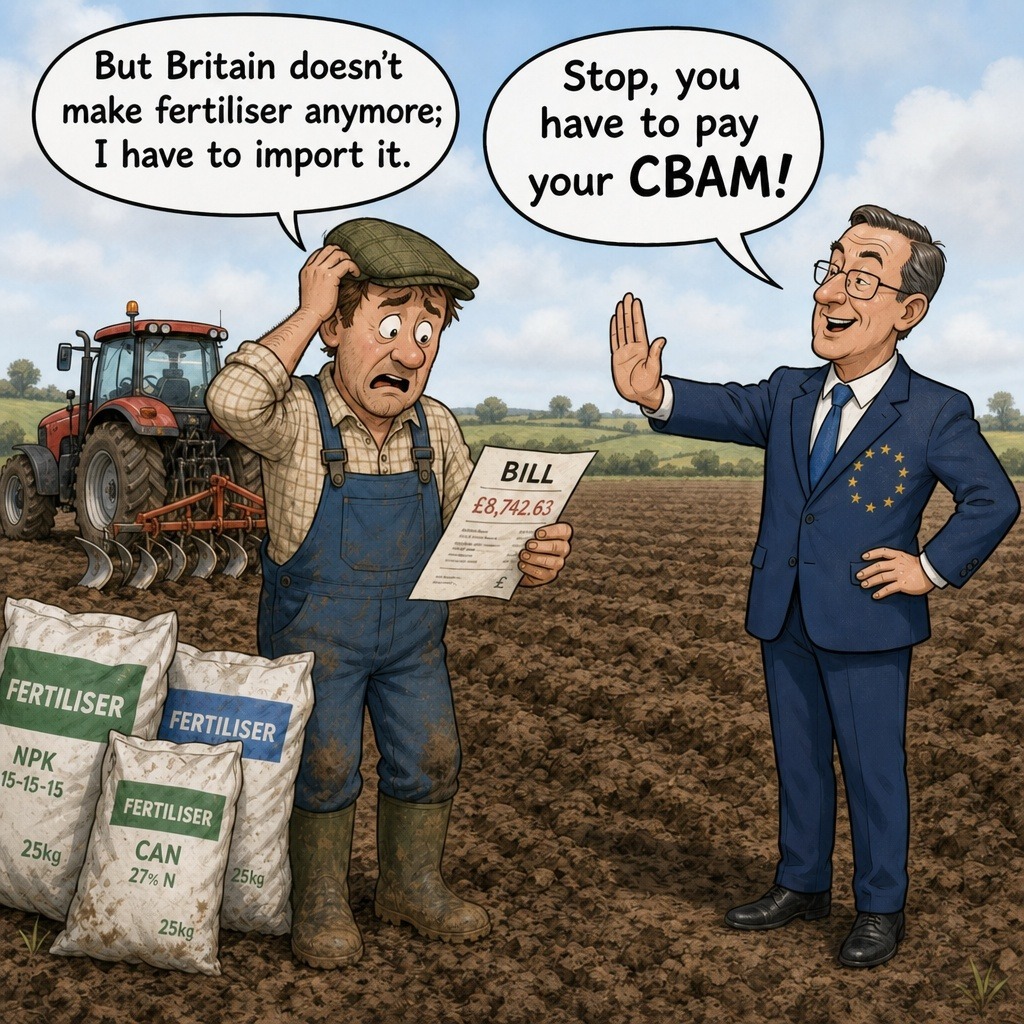
UK deindustrialisation and fertiliser production.
The most ridiculous excuse made for joining the EU’s ETS market to protect UK exports is the case of fertilisers. The UK is no longer a major exporter of the key ingredient used to make fertiliser — ammonia. In 2021, the UK exported 232,075 tonnes of HS2814 Ammonia, but in 2025 these exports had dropped to just 20,408 tonnes, of which just 14,000 tonnes went to EU countries. At the same time, UK ammonia imports increased from just 29,075 tonnes in 2021 to 351,980 tonnes in 2025. The UK’s overzealous application of carbon taxes has not reduced its need for ammonia, only its ability to produce it domestically.
The UK’s largest ammonia supplier in 2025 was the US, followed by Algeria, Trinidad and Tobago, Libya, Turkey, Saudi Arabia, and the UAE (all countries that encourage their natural resource industries). The UK imports very little ammonia from any EU country. Ammonia is generally produced from natural gas, and the EU doesn’t have much gas; only 10% of its gas requirements are supplied from EU countries. As can be seen in the table below, joining the EU’s CBAM would force the UK to add €143.63 per tonne to the price of the ammonia it imports from the US; this would have increased the UK’s average import price from €427 per tonne in 2025 to €570.63 per tonne and turned the US from being the UK’s cheapest supplier, into its second most expensive. The US supplied a third of the UK’s ammonia imports in 2025. The CBAM would also have added 10% to 14% to the import prices of the UK’s smaller ammonia suppliers.

US ammonia would still be cheaper than ammonia from any EU supplier, so forcing the UK to add a CBAM tariff to its US imports would drive up costs for all UK fertiliser producers and users; it could encourage the UK to import more ammonia from Algeria and Libya if they have available supplies, but it is unlikely to revive the UK’s dormant ammonia industry.
The UK still blends and granulates fertiliser, using imported raw ingredients, most importantly ammonia.77 CF Fertilisers’ Billingham plant ceased ammonia production permanently in July 2023 after being temporarily idled in August 2022. This was the UK’s last major ammonia producer.
The UK produces less than 30% of the fertiliser it uses each year, but even this amount relies on imported ingredients. Adding a CBAM to imported ammonia and imported nitric acid made from it would increase costs for fertiliser mixers, which would be passed on to farmers and eventually raise the price of domestically produced food.
In the UK, fertiliser use typically increases arable crop yields by 30–50% and grassland productivity by 40–60%, compared to unfertilised systems. Without fertiliser, most soils cannot supply sufficient nitrogen, phosphate, and potash to sustain high yields, making fertiliser critical for both food security and livestock forage production.10 Making fertiliser more expensive than it needs to be by adding the EU’s higher ETS charge to domestic production or a CBAM on imported fertilisers would make UK-produced foods more expensive.
The EU’s CBAM covers imported fertilisers and the chemicals used to produce fertilisers: nitric acid; Sulphonitric acids; ammonia, anhydrous or in aqueous solution; nitrates of potassium; mineral or chemical fertilisers, nitrogenous; mineral or chemical fertilisers containing 3 of the fertilising elements: nitrogen, phosphorus, and potassium; and mineral or chemical fertilisers containing 2 fertilising elements.78 In 2025, the UK imported 3.8 million tonnes of these fertiliser products, which will be subject to CO2 and nitrous oxide emissions charges if the UK joins the EU’s CBAM.79
It is inexplicable that the EU and the UK would consider increasing the cost of imported ammonia when neither of them still makes it efficiently, and it is so essential for agricultural industries.
Most fertilisers are made from ammonia (NH₃), which is in turn made from natural gas. It should therefore be no surprise that the list of UK import suppliers consists entirely of countries with plentiful natural gas. The UK also has plentiful natural gas, but since the introduction of the windfall tax in 2022, and the limits placed on new well development on the UK side of the North Sea, UK gas production, ammonia production, and ammonia exports have dropped.
Although fertiliser production is emissions-intensive, conventional production emits about 2–3 tonnes of CO₂ per tonne of nitrogen fertiliser, plus nitrous oxide (N₂O) emissions. It is also essential for food production.
Sulphonitric acids, nitrates of potassium, and mineral or chemical fertilisers containing either 2 or 3 fertilising elements are on the EU’s CBAM product list, but are not currently produced on a large scale in the UK. Fertilisers containing 2 and 3 fertilising elements were made at the CF Fertilisers Ince site, which was closed in 2023. Adding a CBAM to imported products when there is no alternative domestic supplier will necessarily increase agricultural production prices.
In 2025, the UK produced around 1.2 to 1.3 million tonnes of mineral fertilisers annually, dominated by nitrogen-based products (ammonium nitrate, urea, and NPK blends). Domestic production of phosphate and potash fertilisers has largely ceased, with the UK now reliant on imports.80 Domestic production now accounts for less than half of the UK’s fertiliser demand, with the remainder imported from the EU, North Africa, and North America.81
Compared to 2000, UK fertiliser output has halved, and the product mix has shifted away from broad-spectrum fertilisers toward nitrogen-only and imported blends, driven by plant closures, energy costs, environmental regulation, and global market restructuring. Mimicking falls in production, UK fertiliser use has fallen by 19.3% in the 10 years up to 2024.
CF Fertilisers closed its plant in Ince, Cheshire, in 2022, when European gas prices spiked.82 Given the gas-intensive nature of fertiliser production, it has moved to regions with cheaper gas. UK ETS allowances, along with strict nitrogen-emissions regulations, have made domestic fertiliser production less competitive with imported fertiliser.83 Most of the UK’s ammonia imports come from the US, but they are not cheaper than UK-produced ammonia due to differences in ETS costs. The biggest price differential comes from natural gas prices and the UK’s additional CPS and CCL charges on the energy used to make ammonia. The UK should be an efficient producer of ammonia, but instead we import it from the US, where gas prices are a third to a quarter of those in the UK.
Most fertilisers are made from ammonia (NH₃) using natural gas as a feedstock. It takes about 0.9 tonnes of natural gas (methane, CH4) to produce 1 tonne of ammonia. The process requires high temperatures (400–500°C) and pressures (>100 bar), typically generated by coal or gas combustion. Conventional production emits about 2 to 3 tonnes of CO₂ per tonne of nitrogen fertiliser, plus nitrous oxide (N₂O) emissions from nitric acid production, which can add another 0.2 to 2 tonnes of CO₂-equivalent (CO2e) per tonne, depending on abatement technology.
Almost all ammonia (2NH3) is produced by the Haber-Bosch process, which uses natural gas and air at high pressure and a medium industrial temperature. Instead of adding a CBAM to imports that the UK doesn’t make any more, the UK would be better off encouraging UK gas production and exploration in the North Sea, allowing hydraulic fracturing for gas, and removing the additional 38% ‘windfall’ tax on gas production, thereby lowering the cost of the UK’s domestic feedstock for fertiliser production. There is already an ETS on the energy used in combustion, an ETS charged on the production of ammonia and nitric acid, and the CPS and CCL. This is triple taxation. Removing these additional energy costs would reduce the cost of an essential input for food production and food security.
There is no need to impose a CBAM on fertiliser or ammonia used to make fertiliser because there are no longer any UK producers to protect. Instead, joining the EU’s CBAM would protect the EU’s fertiliser producers from cheaper international producers, even though the EU has almost no gas feedstock of its own. UK farmers will have to pay higher costs to protect EU firms.
Steel exports benefit if the UK doesn’t join the EU ETS and CBAM
The UK exports very little basic steel (HS72) to the EU — or anywhere else for that matter. The UK’s main steel export by weight is scrap steel, exported for recycling in Türkiye, Egypt, India, Morocco, and Pakistan. The UK’s most valuable export to the EU of products made with iron and steel was HS7308 Structures and parts of structures, at 277,954 tonnes worth about £736 million. The Euro per tonne average 2025 export price was about €3,319, so the EU’s CBAM charge would have added 4.2% to the export price per tonne.
The table below shows the default CBAM charge that could be applied in 2026 to UK exports of basic steel and steel products to the EU.
CBAM charges using EU default emissions values for various British-made steel export products

The CBAM charge would be lower if the importer knows and can prove the actual production emissions. It would also be lower if the EU allows its importers to deduct the amount of ETS charge paid in the UK by the steel mill. As we have seen with aluminium, low-value products such as basic HS72 Iron and Steel will be the most affected, and it will be in the interest of producers to know their exact emissions. For high-value products, the CBAM charge is almost immaterial, adding around 1% to the export value. CBAM charges will be paid by the importer, so unless there is a very competitive EU supplier, the CBAM charge is unlikely to alter high-value British exports.
That said, even lower-value, more homogeneous products will benefit from the EU’s CBAM if their rival exporters have higher EU-attributed emissions for their exports. For example, for HS721391 Bars and rods, hot rolled in irregular coils, the default emission value for British-made exports to the EU is 2.541, whereas for Indian exports it is 4.697. The 2026 CBAM charge would be €88.75 per tonne for British-made steel bars and rods, but €246.74 per tonne for Indian steel bars and rods. This example does not assume any UK discount under Article 9 due to UK ETS payments.
In 2025, the average UK export price for HS721391 products was 46% higher than the average Indian export price, but if the CBAM charges had been added, the difference would have been reduced to just 7%.
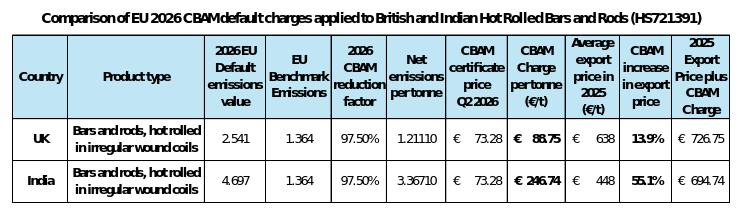
So, without joining the EU ETS and CBAM, UK exports will still benefit, as British products will be more competitive in the EU market relative to the same products made in nations with higher carbon emissions or without their own emissions taxes. This comparative advantage would be reduced if the UK joined the EU ETS, depending on whether the increase in UK steel production costs and input costs exceeds the EU’s CBAM costs. However, if the UK does receive Article 9 CBAM reductions, it would be better off not joining the EU’s ETS.
How much will IEM, ETS, CBAM, and RED III cost?
The table below shows the small savings from joining the EU’s Internal Electricity Market, the increased cost to businesses from the EU’s higher Emissions Trading Scheme and Carbon Border Adjustment Mechanism, the contribution towards the cost of running the EU’s electricity market, and the contributions towards the cost of the EU’s policy work on the ETS and CBAM.
I have included an estimate of the amount the EU will require the UK to pay into its Cohesion Fund, which is a requirement of joining the IEM. I have also estimated the cost to UK households and businesses of complying with the EU’s RED III timetable that would require the UK to reach 42.5% of total renewable energy by 2030. The CBAM costs and the RED III compliance costs will be relatively low in 2027 but increase sharply by 2030 and 2034. In total, the cost would be in the range of £2.3 to £4.4 billion a year, averaging £3.5 billion. As shown in the table below.
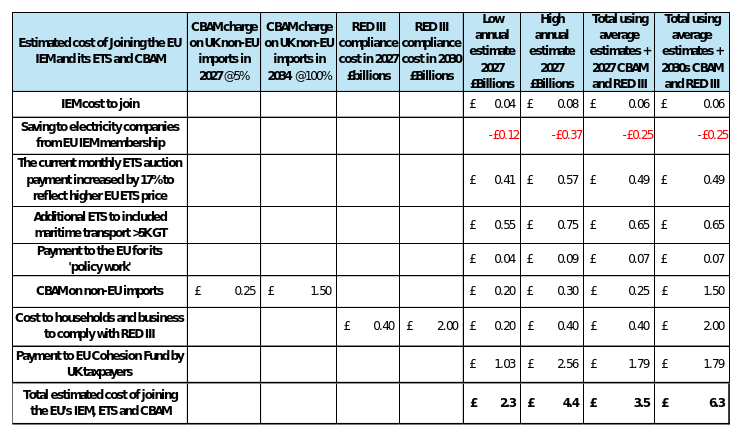
The UK will not benefit from joining the EU’s CBAM, as it exports very few of the products subject to the EU’s charges. The UK is a net importer of most of the CBAM products with: 100% or its electricity and hydrogen imports coming from the EU so there would be no CBAM charge; around 60% of the UK’s imports of Aluminium, Fertiliser, Iron and steel, and products made with iron and steel also come from the EU but the remaining 40% generally come from countries which high emission default values. Consequently, the UK would be forced to apply the EU’s CBAM charges to these imports even if they are essential materials for the production of other goods. The bulk of the UK’s cement and ammonia imports come from outside the EU, and because these are heavy, homogeneous, and relatively cheap products, applying the EU’s CBAM will greatly increase import costs from non-EU countries.
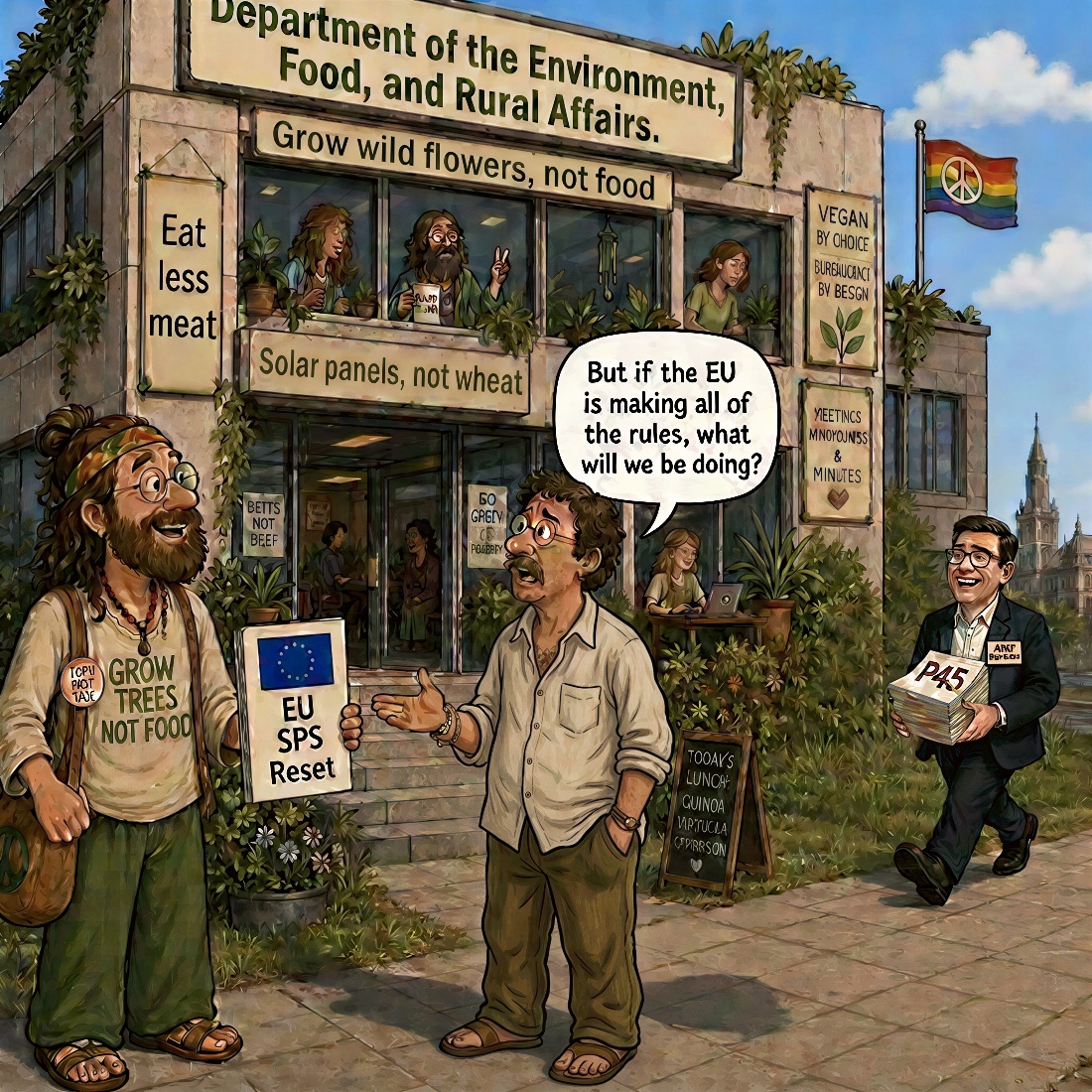
Part 2. Joining the EU’s SPS Area and following its food and agricultural regulations
The legal basis of the UK’s alignment with EU food and agricultural regulations is explained in the European Commission’s Publication, COM(2025)408 Final, dated 16 July 2025. As with the other sections of the Reset Agreement already discussed in this paper, joining the EU’s SPS Area will also require immediate and complete adoption of all relevant EU regulations, and ECJ arbitration of any disputes and cross-retaliation with the Trade and Cooperation Agreement in the case of non-compliance by the UK, as stated in section 1.2, paragraph 4, reproduced below:
The new agreements should (i) guarantee dynamic alignment with all the relevant European Union rules, (ii) ensure uniform interpretation, (iii) include a dispute resolution mechanism with an independent arbitration tribunal based on the Trade and Cooperation Agreement with a role for the Court of Justice of the European Union as the ultimate authority for all questions of EU law; and (iv) include a robust mechanism to ensure compliance with rulings of the arbitral tribunal, for instance through the possibility to adopt appropriate measures to protect the Union interests and the possibility of cross-retaliation between the new agreements and between these and the areas covered by the Trade and Cooperation Agreement.
The UK will have no ability to scrutinise EU regulation, no ability to tweak them slightly to suit British farmers or British consumer preferences, and no ability to delay their implementation. All UK laws regarding food and agriculture will be EU laws going forward, and only the European Court of Justice (ECJ) will be able to adjudicate any disputes. Furthermore, the UK will have to pay the EU for being ruled by the EU. Section 4 of the Commission’s publication on Budgetary Implications is one simple sentence, shown below, emphasis added:
4. BUDGETARY IMPLICATIONS
The agreements should include provisions to ensure the United Kingdom contributes financially to support the Union’s work in these policy areas
This section of the Reset is not about the UK rejoining the EU, as many ‘Remain voters’ seem to hope, but about the UK becoming a captured market for EU food producers. The UK will find it is restricted to importing EU food and agricultural goods. More importantly, all UK farmers and food manufacturers will have to follow the EU’s regulations even if they don’t trade with the EU, trade with non-EU countries, or don’t trade at all. Purely domestic businesses will be required to comply with all EU standards for food production, food marketing, nutrition labelling, and packaging materials, and UK farmers will have to follow EU agricultural practices and processes.
The EU’s intention to use ‘cross-retaliation’ between the Trade and Cooperation Agreement (TCA) and the UK-EU Reset agreement could be economically damaging to the UK. If the UK were ever to baulk at adopting an EU regulation, the Reset agreement would allow the EU to retaliate under the TCA. The TCA is an exceptionally good trade deal between the UK and the EU. It is the only EU trade agreement that is completely free of tariffs and quotas. This is highly unusual. All of the EU’s trade agreements with countries outside the European Economic Area have limitations on agricultural trade, either as seasonal tariffs or tariff rate quotas, where the reduced tariff applies only to a small quota of goods, and any imports above this amount are subject to the EU’s regular tariffs.
Unfortunately, the UK’s negotiators of the TCA in 2020 seemed unaware that the EU can also restrict trade by imposing strict, sometimes absurd, non-tariff barriers that can be just as effective at keeping imported goods out of the EU market as small quotas and high tariffs. For example, a UK manufacturer of cakes and brownies had to reformulate its best-selling products, replacing eggs and butter with vegan alternatives to avoid the EU requirement for an Export Health Certificate and Veterinary inspections.84 Many other UK exporters were similarly surprised to find they had to complete extensive trade documentation when exporting to the EU under the TCA, even though, for the most part, UK food and agricultural regulations were the same as the EU’s and often the UK had higher agrifood standards.
Department for Food, Agriculture and Rural Affairs response to EU SPS Agreement
The UK’s Department for Environment, Food and Rural Affairs (DEFRA) has recently published its response to the European Commission’s publication, and it is a complete capitulation. The document states: ‘it is our intent that the [SPS] agreement will take effect in mid-2027.’ DEFRA has also published additional documents advising every business in the agricultural and food sector to prepare to comply with all EU regulations by mid-2027, whether or not they trade with the EU.85 DEFRA admits that the negotiations have not been finalised — but they seem determined that the SPS Agreement will go ahead, that process and production changes will be necessary, and that they will occur.
In essence, the civil servants at DEFRA have removed the UK’s only bargaining chip – the ability to walk away from its negotiations with the EU. DEFRA officials have told all UK agrifood businesses to begin preparing to comply with all EU regulations (to meet the mid-2027 deadline), and producers will also have to begin altering their supply chains that use imported ingredients from outside the EU. All of this before UK negotiators have finalised which agrifood areas will remain free of EU regulations and how much the UK will have to pay.
The UK will have to pay the EU for the privilege of obeying its Agricultural and food regulations, and this figure has yet to be finalised. Should the EU demand a fee the UK deems unreasonably high and so walk away from the agreement, UK businesses will rightly complain that they have spent money unnecessarily adopting EU policies – as instructed by DEFRA. Some may see this as a sunk cost, so alignment may as well continue. The EU may even claim that a payment is still owed as compensation for ‘their policy work ’, as this is how they justified the payment in the Common Understanding agreement from May 2025.
A better solution would have been to grant UK businesses a grace period after the terms are agreed, giving them time to implement the required regulatory changes. This way, sectors carved out of SPS alignment will not have to act unnecessarily.
Ironically, if the UK does end up dynamically aligning with EU agrifood regulations, it won’t need DEFRA. The whole department can be disbanded. Which is probably a fitting end to the people who stupidly decided to publish documents instructing all food and agricultural businesses to comply with EU rules before any agreement was finalised.
DEFRA admits that the SPS agreement will affect areas including:
- official controls across the agrifood system
- general food law, consumer information and hygiene rules
- food additives, flavourings, supplements, and novel foods
- food and feed contaminants
- marketing standards for specific foods
- food contact materials
- other food‑related measures (such as organic rules, mineral waters and irradiation)
- feed products and feed hygiene
- genetically modified organisms
- animal health, breeding and welfare
- plant health
- plant and forest reproductive material
- plant protection products (pesticides) and their respective maximum residue levels
- biocides
- veterinary medicines maximum residue limits and antimicrobial resistance
Why is the government imposing this upheaval and expense on British businesses?
DEFRA claims that all of this upheaval in regulation is to allow trade to ‘resume’ in: ‘fresh sausages, burgers, certain types of shellfish and seed potatoes’. Implying that the UK is currently unable to export sausages, burgers, shellfish, and seed potatoes to the EU, but this is not true. Trade in all of these products has continued since Brexit, and in some cases it has increased. However, it is also misleading to imply that these are important export industries for the UK.
The UK has never been a major exporter of sausages to the EU, mainly because all EU countries make their own sausages, which are generally spicier than those in the UK. UK sausages are mainly sold in areas with large UK expat communities, such as Spain, Ireland, Malta, and Cyprus. Sausage exports have continued since Brexit, as shown in the table below. The UK exported 5,432 tonnes of sausages to the EU in 2025, almost as many as the 5,549 tonnes it exported in 2020. Instead, it is UK sausage exports to non-EU markets that have dropped since Brexit: down from a high of 2,389 tonnes in 2019 to just 666 tonnes in 2025. But DEFRA is unperturbed by this fall in exports to non-EU countries; it is just desperate to follow all EU regulations immediately. This government department does not want to do the job it is tasked with.
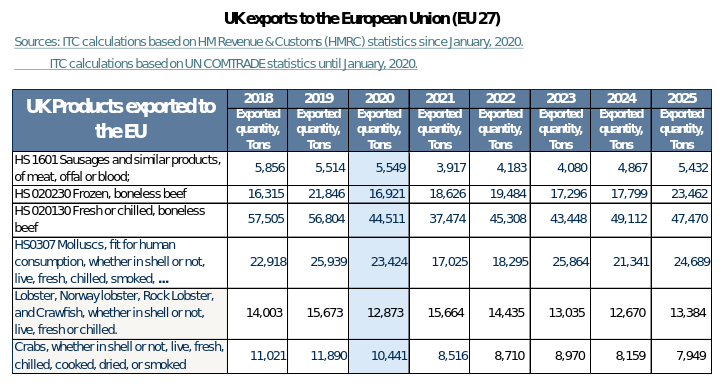
Equally strange is that DEFRA has not noticed that UK imports of sausages from the EU have increased since Brexit from 133,747 tonnes in 2020 to 150,741 tonnes in 2025. ‘Resuming trade in sausages’ is clearly not a valid reason to force every agrifood business in the UK to change its processes, packaging and supply chains. Trade in sausages is doing just fine.
This is also true of the UK’s exports of boneless meat, which would include mince and hamburger meat, although these are not separate export categories. The UK’s Fresh boneless beef exports were 48,402 tonnes in 2020, the transition year before Brexit changed UK-EU trade, and 47,926 tonnes in 2025.86 Frozen boneless beef exports were 35,329 tonnes in 2020 and 35,833 tonnes in 2025.87 Again, this is not a reason to pay the EU to follow all of its agrifood rules. The only fall in boneless beef trade is in UK imports of EU fresh boneless beef, from 132,299 tonnes in 2020 to 128,392 tonnes in 2025. However, this has been more than offset by the increase in imports of frozen beef from the EU, which rose from 76,195 tonnes in 2020 to 88,500 tonnes in 2025.
Similarly, exports of molluscs and lobsters to the EU were higher in 2025 than in 2020, while crab exports were slightly lower in 2025. The difference in crab exports is likely due to processing, such as deshelling, occurring outside the UK or EU, which makes the returned meat ineligible for classification as a UK export under the TCA rules. This has certainly happened to UK scrimp and prawn exports to the EU, which are mostly shelled in Vietnam, so can no longer be classed as a UK export to the EU.
Incredibly, UK Seed potato exports also don’t need a Reset with the EU. UK exports in 2019, before Brexit, were 103,961 tonnes, and in 2025 they were 104,215 tonnes. More importantly, the UK’s main export markets are not in the EU, and weren’t before Brexit either. Instead, Egypt is the UK’s main export market for seed potatoes, and Morocco is the UK’s second-largest export market. These two markets buy about 70% of UK exports; neither is in the EU.88 We can see in the table below that the UK’s other larger markets for seed potatoes are Indonesia, Brazil, Serbia, Thailand, Saudi Arabia, Turkey, Jamaica, Kazakhstan, Kenya, and South Korea.
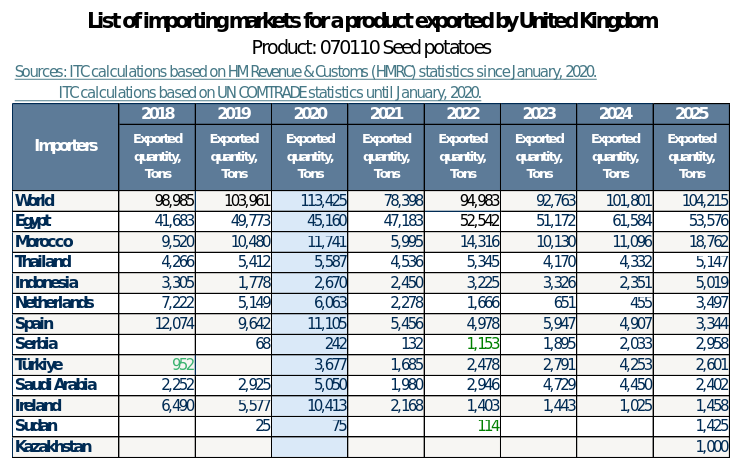
For some inexplicable reason, DEFRA is only interested in exports to the EU. The UK continues to import seed potatoes from the EU without joining its SPS Area, with imports of 6,207 tonnes in 2019 and 10,590 tonnes in 2025. While seed potato exports to Europe in 2020 were inflated by Ireland’s stockpiling, it bought twice as many seed potatoes in 2020 as the year before. But in general, the UK’s main markets for seed potatoes are outside the EU. So why is DEFRA so determined to force all UK agrifood businesses to spend money to change their products, processes, and packaging, among other things, to supposedly ‘resume UK Seed potato exports’?
The DEFRA publication is clearly aimed at UK importers of EU agrifood, as the only tangible benefits it mentions are for importers. According to DEFRA: ‘for most imports from the EU, you will not need to use digital systems; this is because most goods will be exempt from prenotification controls.’ It adds that non-exempt goods must use EU digital systems, such as Traces NT.
DEFRA’s publication clearly shows that SPS dynamic alignment with the EU is not about helping UK exporters at all: it is EU goods entering Great Britain that will no longer need export health certificates, phytosanitary certificates, ISPM15 marking for wood packaging material, and Northern Ireland plant health labels. DEFRA makes no mention of whether UK exports to the EU will have similar certificate-free trade. Instead, DEFRA proclaims that dairy, fish, eggs, meat, plants, and plant products will no longer need routine SPS border checks when entering Great Britain from the EU. Only live animals may still need certification for movements from Great Britain to Northern Ireland. We will cover the many biohazards currently in the EU but not in the UK later in this section, but DEFRA is ‘intent’ on removing all SPS restrictions by mid-2027. This is already unbelievable, but it gets worse.
As previously mentioned, each of the DEFRA publications about industry preparations to join the EU’s SPS area explains that British food and agricultural laws will now be made by the EU, and that EU laws will apply to all British agrifood producers, food processors, food packaging, border control, and food transport businesses, whether or not the business trades with the EU. EU rules change regularly, and these businesses will need to be prepared to change their processes whenever the EU changes its rules. UK food businesses may also need to change their supply chains, as the EU’s agrifood laws will now apply to non-EU agrifood imports. The passage below comes from DEFRA’s guidance for Border control post and control point operators: preparing your business, updated 30 July 2026:
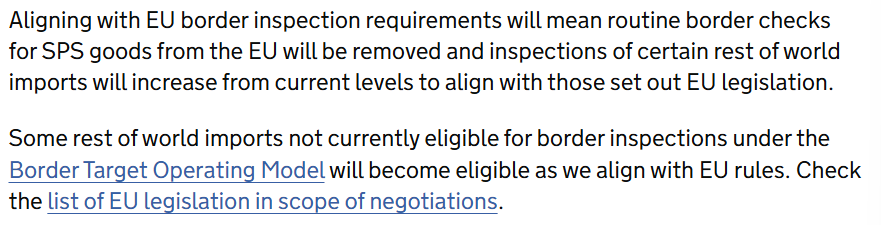
DEFRA’s guidance for Food manufacturing, processing, and standards: preparing your business is equally damaging to UK businesses. Under the SPS agreement, Great British food and feed authorisations and regulations will cease to apply, and EU authorisations and regulations will apply instead. In line with other areas of the agreement, food manufacturers will have to comply with EU rules on food standards, safety, labelling, and the regulation of certain products. Again, this applies to all food manufacturers, whether or not they trade with the EU, and covers EU food hygiene rules, EU business operator address requirements, EU production authorisation requirements, EU food composition standards, EU food marketing standards, EU food labelling requirements, and EU food contract material regulations. Food manufacturers must comply with all EU product, process, and operational requirements, even if their current processes achieve the same end result.
British food manufacturers that don’t export to the EU will need to reformulate their products, while those that currently export to the EU will already be compliant. Manufacturers serving the British domestic market will need to remove any feed or food additives, food contact materials, flavourings, colourings, genetically modified ingredients, novel foods, and smoke flavouring that do not comply with the EU’s current regulations. Importantly, food packaging and food contact materials including processing equipment, must comply with the recent technical changes made to EU Regulation 2023/2006, plastic materials in contact with food must comply with EU list of authorised substances, recycled plastics and plastics used in food packaging must comply with the EU’s new Regulation 2022/1616, Food contact material cannot contain Bisphenol A (BPA) and businesses should reformulate their products to remove BPA to ensure compliance with EU Regulation 2024/3190, use of the ‘do not eat’ logo will be compulsory under EU rules for materials intended to come into contact with food. Ready-to-eat food producers will need to comply with EU food safety criteria for Listeria monocytogenes. All food and feed businesses must comply with the maximum contaminant levels set out in EU Regulation 2023/915.89 UV treatment of spring waters will no longer be permitted in Britain in line with EU DIRECTIVE 2009/54/EC. There are many more requirements; some will be addressed later in this chapter, but the takeaway is that all businesses will have to comply. This is not about increasing trade; the SPS agreement is about EU control over UK law.
DEFRA does admit the ‘negotiations are ongoing’, and that ‘not all details are confirmed at this stage’. This is more than an understatement. While the Public Servants at DEFRA may be ‘intent’ on obeying the EU and willing to pretend that they are helping UK sausage and seed potato exporters by driving up costs for all other businesses, there are several issues that need to be negotiated – most importantly the amount the EU intends to charge the UK for this non-benefit to its tiny sausage export industry. But we should not overlook the EU’s Luddite attitude to new agricultural technology and its inability to control plant and animal diseases, which would be free to enter Britain if the SPS Reset goes ahead.
Why won’t the Reset increase UK agrifood exports to the EU?
The Reset, at least in terms of food and agriculture, has been sold to the British people as a way to help UK food producers export their goods to the EU. While this may sound like a noble ambition, the UK has never been a large exporter of food to the EU for several obvious reasons:
- The UK has a large population compared to its land mass, soil fertility and climate; consequently, it has needed to import food to feed its population since the 1800s. It imported 35% of the food it consumed in 2025. Even for indigenous foods that can grow in the UK climate, the UK is only 72% self-sufficient.90
- UK wholesale food tends to be more expensive than EU food because the UK has not subsidised its farmers to the same extent as EU countries. The UK is now subsidising farmers to take land out of production for environmental reasons, which will also increase wholesale food prices in the UK. UK retail food prices can be lower than some EU countries primarily because the UK does not add VAT to basic foods, unlike many EU countries.
- The EU continues to subsidise its farmers through the Common Agricultural Policy (CAP) payments system, and those subsidies were increased in the budget after the UK left the EU and will be increased again in the next budget. In the EU’s 2021 to 2027 budget, total CAP payments are €386.6 billion. In addition to CAP subsidies, the EU Common Market Organisation (CMO) pays producer organisations for dozens of products, including peaches, citrus fruits, and olives. Direct payments, which lower production costs, are also paid to support certain processing sectors, such as peach juicing in Greece. 91
- Many EU countries have large amounts of farmland relative to the size of their populations, and their farmers and food producers have expanded their production in order to supply the UK with food, such as Ireland.
- Several EU countries have mechanised their production and rely on supplying the UK’s much larger market, such as the Netherlands, Belgium, and Denmark.
- Mediterranean EU countries, such as Spain, have warmer climates and longer growing seasons and can supply the EU with fruit and vegetables that can’t grow in the UK.
- Central European countries have different food preferences; for example, they traditionally eat pork rather than lamb and so are not interested in importing UK lamb, which is one of the few commodities where the UK supply exceeds demand, thus enabling exports to the continent.
- The UK has a large dairy herd and exports raw milk. However, almost all UK milk exports go from Northern Ireland to the Republic of Ireland, so the Reset is not necessary, as Northern Ireland is already part of the EU’s SPS Area and it already follows all EU agricultural regulations.
- EU industrial electricity costs are lower than those in the UK, so food processing costs are generally lower in the EU, making EU processed foods cheaper than similar British foods.
- Finally, the UK has increased its minimum wages and its employers’ national insurance; this has made employment in farming, food production, and food distribution more expensive in the UK and consequently increased wholesale food prices. This is another reason why reducing export paperwork will not miraculously increase UK food exports to the EU.
For these reasons, UK farmers cannot compete in the EU market; EU red tape is not the problem. Reducing customs and border checks will only make it easier for UK retailers to import EU agrifood products and could allow dangerous plant and animal diseases to enter the UK.
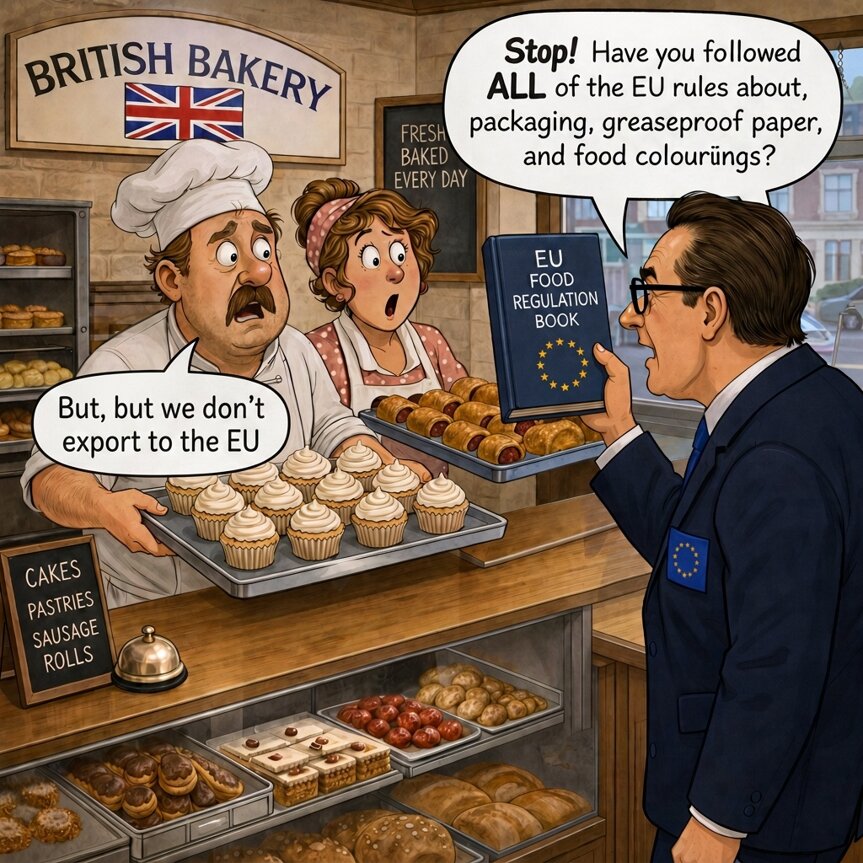
Who will be hurt the most by these changes?
As with all sections of the Reset, the UK will have to pay the EU for being ruled by the EU. The European Commission document has not specified the amount of this payment, but it is likely to be based on the UK’s relative economic size within the EU rather than on the increase in UK food exports to the EU, as almost all EU member states’ budgetary contributions are based on the relative size of their economies.92 The three European Economic Area (EEA) countries, Norway, Iceland, and Liechtenstein, contribute to the EU’s Cohesion Fund in return for access to the EU’s food market and other EU programmes.
For example, during the 2021-2028 EU budget period, Norway will contribute €3.17 billion to the EU’s Cohesion Fund for access to the EU SPS area. This is equivalent to approximately €453 million (£385 million) per year.93 As the UK economy is about 7 times larger than Norway’s, if the UK is asked to pay a similar budgetary share to Norway for SPS access, the EU would likely require an annual payment of almost £3 billion to access its SPS system, dwarfing any potential gains.
However, the real cost to the UK economy will not be borne by taxpayers, but by small businesses operating solely within the UK, which will have to change their products, processes, and packaging to align with EU regulations, despite having no dealings with the EU. Furthermore, they will have to continue implementing changes whenever the EU amends its regulations, without any say in the new rules and without any way to protest them.
The UK’s Reset negotiator, Nick Thomas Symonds MP, claimed that UK agrifood exporters to the EU have spent just £210 million on something he called a ‘paperwork tax’ over the three years from 2023 to 2025. This is only £70 million annually and a tiny fraction, just 2.4%, of the UK’s potential annual SPS Area payment to the EU of £2.9 billion. Thomas-Symonds’ ‘paperwork tax’ of £70 million is an even smaller proportion of the UK’s annual agrifood exports of £12.12 billion, which are in turn a tiny fraction, just 1.3%, of the UK’s total exports.
Dynamic alignment with the EU’s SPS regulations will reduce this paperwork only slightly.94 UK exporters will still have to complete: customs declarations; rules of origin compliance to qualify for zero tariffs under the Trade and Cooperation Agreement; VAT obligations and potentially register for EU VAT and file EU VAT returns on B2C sales; comply with EU safety, labelling, and packaging rules including EU waste rules; EU EORI forms; EU Safety and Security declarations, packing lists and transport documents; and submit to EU customs risk checks, anti-fraud checks, security screening and weight/volume inspections as well as pay the usual haulage costs, insurance and cold chain energy costs. All those other costs will still exist, even under the proposed EU SPS capitulation.
But UK taxpayers will be asked to pay 40 times the amount ‘saved’ by private companies from access to the EU SPS area. The companies that benefit won’t necessarily be UK companies: the UK’s top 10 food exporters to the EU include two Danish companies, Arla and Tulip; a German company, Muller; an Irish company, Kingate Investments; and two US multinationals, Cargill and Bunge. But UK taxpayers will be subsidising their export costs. Most of the £70 million payment that Dynamic Alignment will remove does not go to the EU but to UK local authorities who issue the Export Health Certificates and veterinary checks for food exports: the loss of this local authority revenue should be subtracted from any ‘saving’.
Potential Benefits from alignment
Although there have been some absurd projections of economic benefits to the UK from dynamic agrifood alignment, these are easily rebutted. The original Cabinet Office claim was £9 billion ‘by 2040’ for the entire reset package, i.e. about £600 million a year. Then DEFRA claimed in Aug 2025 that merely removing SPS export health certificates and veterinary checks would add ‘up to’ £5 billion a year to the UK economy.95 That is absurd. In total, the UK only exported £12 billion of Food and live animals to the EU in 2025. Removing some paperwork while leaving all other costs in place won’t increase UK food exports to the EU by £5 billion. This would require a 40% increase in current food exports. The UK doesn’t have the capacity to increase its food production by this amount and didn’t export anywhere near that amount of food when it was a full EU member. According to the ONS, UK Food and live animal exports in 2020, the last year of the UK-EU Transition Agreement, were only £10.8 billion in 2020 prices, despite full EU access. This would be equivalent to £12.9 billion in 2025 prices.96 So, at best, exports could increase by £900 million, but the cost of joining will probably be three times that.
The DEFRA publication touting the £5 billion-a-year economic boost quotes a beef processor CEO who claims the SPS agreement should cut costs for his business and make his carcass balance trade with the EU smoother. What is not explained is that his company, Dunbia, is a wholly owned subsidiary of the Irish beef processor Dawn Meats, and that carcass balance refers to selling offal and offcuts to EU markets, not prime beef. Any benefits from lower trade costs will accrue to private companies, but the much higher cost of joining the EU’s SPS Area will be borne by the UK Government and, eventually, by all UK taxpayers.
Cui Bono – who stands to gain?
The EU will be the real beneficiary of the Reset. Having more countries follow EU regulations strengthens the EU’s negotiating power in its trade agreements with other countries. It makes the EU relevant. EU officials have bragged that while the US and China may be military and economic superpowers, the EU is the world’s regulatory superpower.
At present, all British products exported to the EU must conform to EU standards and regulations, just as products exported to the UK, the US, or any other country must conform to that country’s standards and regulations. Exporters do not have to pay to comply with the importing country’s regulations. This is simply business as usual. Nor do countries charge foreign companies for conforming to their rules, although they will fine any company whose goods don’t meet their import standards.
The whole basis of the Reset is unnecessary and fraudulent. The Reset will force UK companies that don’t trade with the EU or don’t trade at all to change their production processes to comply with EU regulations. Meanwhile, the companies the Reset claims it will help already conform to EU regulations, as they must to export to the EU.
Any company that wants to trade with the EU can ensure its goods meet EU standards without requiring the government to force all other British companies to follow them. Many UK companies trade with non-EU markets and need to make products that meet those countries’ standards. Forcing UK taxpayers to pay for some companies’ transaction costs when trading with the EU, but not the costs of companies that trade with other countries, is unfair. Forcing companies that don’t trade with anyone and simply cater to the UK domestic market – about 90% of UK companies fall into this bracket – is absurd.
The UK’s Reset negotiator appears to know so little about trade that he does not understand that the whole country need not follow EU regulations for some companies to trade with the EU. And that the UK can follow whatever EU regulation it likes without paying the EU to do so. The only benefit of the Reset would be for the EU to acknowledge that UK agrifood standards are the same as or better than the EU’s, and therefore that food can be imported with minimal certification. This is how the UK handles food imports from the EU. It is not difficult. The UK and the EU could agree on mutual recognition of each other’s food and agriculture standards. But the EU has resisted doing so because it is a Customs Union and has no interest in importing goods from outside its collective borders. The EU’s raison d’être is for its members to buy from each other, and only export goods to non-member countries. This is why they have refused to agree to mutual recognition with the UK.
If the Government were seriously concerned about the EU’s SPS compliance costs for UK food exporters, it could have subsidised the health checks rather than agreeing to pay the EU to join its SPS area and force non-exporting companies to change their production methods to comply with EU regulations. This would have saved UK taxpayers 97% of the expected SPS fee and saved non-exporting UK farmers and food manufacturers untold amounts in compliance costs. We can only imagine why the Government didn’t think of this.
Logistics and border control
Even DEFRA’s guidance to hauliers and logistics businesses inadvertently confirms that the benefits for UK companies may be limited, even though the rule changes will affect all businesses in the Distribution, transportation, and warehousing industries, whether or not they trade with the EU.97 DEFRA admits that there should only be fewer physical SPS inspections for animal, plant, and food products, but this is not a given, and customs controls will remain. Meanwhile, Britain will have to align with EU checks on goods imported from non-EU countries. The UK imports about 85% of the fruit it consumes each year, and over 60% of that comes from outside the EU. DEFRA’s guidance explains that some non-EU imports currently not subject to routine inspection will now need to be inspected under EU regulations; it gives as an example ‘products of animal origin and some citrus fruit’.
DEFRA also states that the Windsor Framework will remain in place, and it expects the need to label goods ‘not for EU’ to reduce significantly, but not be completely removed. Hauliers will still be responsible for ensuring that all commercial documentation is accurate and complete, including consignment details; otherwise, they will be delayed at the border. Hauliers are also advised to update their IT systems, SPS declarations and certification processes.
Rather incredibly, the DEFRA document claims that the UK will remain an independent trading nation and will respect its international obligations as a member of the World Trade Organisation (WTO) and the Three Sisters Agreements. The Three Sisters Agreements are the WTO’s standard-setting bodies: the Codex Alimentarius Commission (Codex), the International Plant Protection Convention (IPPC) and the World Organisation for Animal Health (WOAH). However, the EU regularly ignores the decisions of CODEX, the IPPC and the WOAH. It will be impossible for the UK to obey both the EU’s regulations and the WTO’s. We discuss some of the EU’s transgressions against WTO regulations later in this chapter.
UK’s agricultural technology industry – in danger from EU SPS alignment.
Although the SPS Reset is unlikely to increase UK exports, the Reset’s certificate-free trade could allow the importation of many plant and animal diseases currently in continental Europe. This would be extremely dangerous for British farms.
In addition, the UK has developed an agricultural technology industry that could only exist outside the EU’s regulations on genetically modified organisms (GMOs) and its precautionary principle. The UK’s Agtech sector includes almost 2,500 companies and employs over 56,000 people. The sector is worth roughly £28.4 billion, which is more than double the UK’s total Food and live animal exports to the EU. The Agtech sector covers farming efficiency, sustainability, and biotechnology. The UK has the potential to develop new crops and export them globally, but if we adopt dynamic alignment with the EU, UK farmers may be prevented from benefiting from these developments.
The UK is hoping to exclude England’s Genetic Technology (Precision Breeding) Act 2023 from the SPS agreement. However, the DEFRA publication Genetic Technologies: preparing your business states that the UK government will align with EU rules on genetically modified organisms (GMOs) under the SPS agreement.98 This also includes genetically edited plants and animals, as the EU court does not distinguish between the two. In July 2018, the CJEU found that genetically edited plants and animals should be treated as GMOs for EU regulatory purposes.99 DEFRA explains that this will mean any authorisation for GMOs will revert to EU single market processes. GMO marketing regulations, which have been the sole responsibility of Great Britain’s competent authorities, will revert to centralised EU responsibility. Applications for authorisation will need to follow EU processes and guidance,100 market authorisation applications need to follow the EU’s General Food Law101, and Agtech businesses will be required to proactively disclose and notify the European Food Safety Authority (EFSA) of commissioned studies.102
The EU’s GMO regulations, such as the 2001 GMO Directive and its continued strict treatment of gene-edited crops, have significantly constrained the development of Agtech industries in the EU by imposing high regulatory burdens, long approval timelines, mandatory traceability and labelling, and allowing member‑state cultivation bans. The EU’s New Genomic Techniques (NGT) framework (2026) partially relaxes rules for some gene‑edited crops, but the core constraints remain for most advanced ag‑tech, which are still regulated under the EU’s existing strict GMO rules and must undergo risk assessment and obtain authorisation before being commercialised.103
After two years of consultations and evaluations, the European Commission introduced its proposal to regulate plants derived from new genomic techniques (NGTs) on 5 July 2023. On 4 December 2025, the European Parliament and the European Council reached a provisional political agreement on the proposed regulation, with formal adoption and publication in the EU Official Journal expected in 2026 and application 2 years after publication. The new regulation would establish two regulatory pathways: Category 1 NGT plants, equivalent to conventional plants, and Category 2 NGT plants, which remain subject to existing GMO legislation requirements, including optional EU Member State prohibitions on cultivation (see below). Until this final proposal is adopted, genome-edited products in the EU will continue to be regulated under the GMO Directive, regardless of their risk levels.
However, EU authorisation is slow, expensive, and uncertain, and new gene-edited plant varieties are often obsolete by the time they have gained EU approval. The new rules also limit the commercial viability of new plants, as the EU allows NGTs to be patented but wants them to remain available and affordable for all farmers. As EU farms tend to be small compared to US, Chinese, Canadian, Australian, or New Zealand farms, making a product ‘affordable for all farmers’ will limit development of NGTs in the EU and in the UK if the UK joins their SPS Area and follows EU Agtech regulations.
DEFRA’s publication, Genetic technologies: preparing your business, seeks to promote the benefits of complying with EU rules by suggesting that doing so will open up a larger market for UK inventions. However, this is unlikely, as only 2 EU members cultivate the few genetically modified plants that have been approved by the EU. An EU Directive allows Member States to prohibit the cultivation of GE plants in their respective territories for non-scientific reasons (Directive (EU) 2015/412). Eighteen Member States ‘opted out’ of GE crop cultivation for all or part of their territories, although none of the 5 Member States (the Czech Republic, Portugal, Romania, Slovakia, and Spain) that grew GE corn opted out. However, as of 31 December 2025, only Portugal and Spain were still commercially cultivating GE corn, with Spain accounting for about 99% of the EU’s total GE crop area. Similarly, 17 Member States have opted out of cultivating biotechnology-derived seeds: Austria, Bulgaria, Croatia, Cyprus, Denmark, France, Germany, Greece, Hungary, Italy, Latvia, Lithuania, Luxembourg, Malta, the Netherlands, Poland, Slovenia, and Wallonia, a region in Belgium. All of these Member States and regions have decided to prohibit the cultivation of Monsanto 810 corn (MON810) and the 7 varieties of corn that were submitted for EU-wide approval in 2015 (apart from Denmark and Luxembourg, which have only prohibited MON810 and 3 of the 7 varieties of corn that were submitted for EU-wide approval).104
If the Reset proceeds, Britain would be the only country within the EU’s SPS area with a positive attitude towards new agricultural technology, yet without a vote in the formation of EU regulations. The majority of EU members’ overly negative attitude to GE plants should lead the UK Agtech industry to expect that any new regulations in this area, which the UK would be forced to adopt immediately under dynamic alignment, would be anti-GM and anti-Agtech in general.
Despite decades of data and experience demonstrating the safety of genetically engineered (GE) crops, as well as the benefits of their cultivation in reducing pesticide use, mitigating impacts on non-target organisms, and enhancing soil health, crop yields, and farmers’ incomes, the European Union (EU) still lacks a predictable and practicable approval process for genetically modified (GM) crops. Instead, it requires excessive data submissions. Delays in the EU’s approval process for GE crops have also impeded their export to the EU, even though these products have been approved and safely cultivated in many countries for many years.
Delays in the EU’s biotechnology approval procedures under the Genetically Modified Organisms (GMO) Directive (EC) 2001/18, together with the EU’s limited efforts to normalise trade in these products, should concern the UK Agtech industry. In 2024, the EU issued 5 approvals and 5 renewals for GE crops, compared with 8 approvals and 5 renewals in 2023. While these authorisations are welcome, the EU’s average approval time for new GE crops in 2023 was approximately 4 years. By contrast, the EU’s own legally prescribed approval time for such products is 12 months (6 months for the review with the European Food Safety Authority (EFSA) and 6 months for the political committee process known as comitology).
According to the USTR’s 2026 report on International Trade Barriers, as of 31 December 2025, the US had submitted 30 applications for agricultural biotechnology products (including renewals of approvals) to the EU, covering corn, soybean, rapeseed, and cotton. The USTR Report explains: ‘Of those applications, 29 were under scientific review by the European Food Safety Authority (EFSA), and 6 were waiting for action by the European Commission through ‘comitology’105. Delays at both stages contribute to increasingly lengthy EU approval timelines. For example, EFSA continues to demand unnecessary studies during risk assessments, resulting in unpredictable delays in issuing final opinions. In comitology, repeated findings of ‘no opinion’ by the relevant Standing Committee on Plants, Animals, Food and Feed also delay the EU’s decision-making on GE approvals, requiring products to undergo an additional assessment by an Appeal Committee before receiving final approval.’
The EU has other barriers to trade in biotechnology products. For example, the EU has yet to establish a practical level for the presence of Agtech products in feed shipments and instead maintains a 0.1% limit on unapproved biotechnology traits, although complying with such a low limit is not commercially feasible. This disrupts trade in products that have otherwise passed international safety assessments.
Biosecurity – the real risk from certificate-free borders
A significant risk to the Reset’s common SPS area could come from unwanted imports, such as plant and animal diseases, crossing the border from continental Europe. The aim of the Reset is to have certificate-free borders for the movement of animals. The European Commission’s Reset publication COM(2025) 408 final, section 1.2 (a), explains this:
It would result in the vast majority of movements of animals, animal products, animal feed products, plants, and plant products between Great Britain and the Union being undertaken without the certificates or controls that are currently required or expected.
Countries that rely on agricultural exports generally have strict regulations to prevent animal diseases because their economies depend on these exports. Unfortunately, despite its large agricultural exports, the EU does not have a commendable record of containing animal and plant diseases.
Current DEFRA restrictions on EU agrifood
DEFRA currently restricts commercial imports of live cattle and sheep, fresh meat, hay and straw, pet food, and dairy products from Greece and Cyprus due to Foot and Mouth disease outbreaks, and in 2025 it had similar restrictions on imports from Germany, Austria, Hungary, and Slovakia.106
DEFRA continues to restrict non-commercial meat and dairy imports from the EU, EFTA countries, Greenland, and the Faroe Islands. DEFRA’s restrictions are not just to prevent the spread of Foot and Mouth Disease and African Swine Fever; it is also monitoring EU outbreaks of Peste des Petits Ruminants (PPR) in sheep and goats and Lumpy Skin Disease (LSD) in cattle. PPR is a highly contagious viral disease in sheep and goats that is currently present in the EU member states of Croatia and Hungary. Bulgaria had a PPR outbreak in 2025, while Greece and Romania had outbreaks in 2024.107 LSD outbreaks have recently occurred in cattle in EU members: France, Italy, and Spain.108
DEFRA’s decision to limit personal dairy and meat imports from EFTA countries, even though there are currently no outbreaks of any of these four diseases in EFTA countries, should serve as a warning to the UK. Adopting the EU’s SPS regulations and removing our border controls could lead our non-EU trading partners to impose similar precautionary restrictions on UK agricultural products. Canada currently restricts imports of dairy and beef products from France, Italy, and Switzerland to prevent LSD from getting into Canadian dairy cattle, even though Switzerland has not had an LSD outbreak.
DEFRA published a report in April 2025 assessing the risk of Foot and Mouth Disease entering the UK from the EU.109 The report explained that the risks are high: the UK imported over 20 million litres of unpasteurised and raw milk from 20 EU countries in 2024, while UK border authorities have seized illegal imports of Products of Animal Origin (POAO). In the 4th quarter of 2022, they seized 4.3 tonnes of diseased meat, then 45.4 tonnes in the full year 2023, 92.5 tonnes in the full year 2024 and 43.4 tonnes during the first 2 months of 2025: almost as much as during the whole of 2023. The seizures came from 18 different countries; all but 4 were EU members. Almost three-quarters of the 2025 seizures came from Romania, the EU country with the greatest infestation of African Swine Fever.
The BBC reported in February 2025 that Dover Port Health Authority had confiscated almost 100 tonnes of diseased meat in 868 separate consignments.110 This was during a period when the UK required any meat, dairy, fish, or eggs from the EU to have full third-country SPS paperwork: Export Health Certificates; Customs Declarations; Pre-notification on the UK’s Import of Products, Animals, Food, and Feed Systems (IPAFFS); and routine SPS border checks by Port Health Authorities of documents, identity, and physical checks. Had the UK had dynamic alignment and certificate-free trade with the EU, much of this diseased meat would have entered the UK and gone on to enter the UK food chain.
If the UK continues with the EU SPS reset, our border will no longer exist to protect our population, our plants, or our farm animals from diseases imported from or through the EU. The UK’s generally acknowledged, much superior animal protection regime will be in danger of disappearing over time. The UK will have no hard stop on closing our borders during outbreaks on the continent.
Foot and Mouth Disease
Removing border controls and creating a common SPS area between Great Britain and the continental EU would be extremely dangerous for UK animal-based agriculture. The UK has a climate where Foot and Mouth Disease (FMD) thrives in the types of animals most commonly kept on UK farms.
FMD is now in its second year in the EU, while the UK’s last FMD outbreak was almost 20 years ago in 2007 and was quickly contained and eradicated within 3 months. Containment and eradication of FMD is extremely important for the UK. The best way to avoid new FMD outbreaks is to prevent trade with countries that have or could have FMD. This is why DEFRA not only imposed restrictions on meat and dairy imports from Germany, Hungary, and Slovakia in 2025, all of which had outbreaks, but also applied restrictions to Austria, which did not have FMD but borders the other 3 countries. Similarly, DEFRA’s ban on non-commercial imports extends to EFTA countries, Greenland, and the Faroe Islands because they trade with the EU.
The UK does not have similar restrictions on its non-EU agricultural trading partners, which DEFRA does not list as having FMD. Both Australia and New Zealand, which export meat and dairy products to the UK, are FMD-free. North America, Central America, and the Caribbean are officially recognised as FMD-free by the World Organisation for Animal Health (WOAH). There have been no cases of FMD in the Mercosur countries111 since 2013, when Venezuela had an outbreak. As of 2020, 98.6% of South America’s cattle population was officially recognised as FMD-free by the WOAH due to a vaccination program. The region is working towards full eradication. Malaysia is the only country in the Comprehensive and Progressive Trans-Pacific Partnership (CPTPP) to have had a recent FMD outbreak, but the UK has never imported any dairy products or beef, pork, or sheep meat from Malaysia. Nor are we proposing to drop our border controls with them.
African Swine Fever
The EU has had African Swine Fever (ASF) for at least 4 years, and DEFRA monitors it.112 The WOAH records the number of outbreaks but not the number of animals infected. The UK’s National Pig Association reports that an outbreak in Estonia in 2025 occurred on the country’s largest pig farm and resulted in the culling of 28,500 pigs. According to WOAH, there have been no months without outbreaks in either domestic pigs or wild boar in Europe between January 2023 and April 2026.113
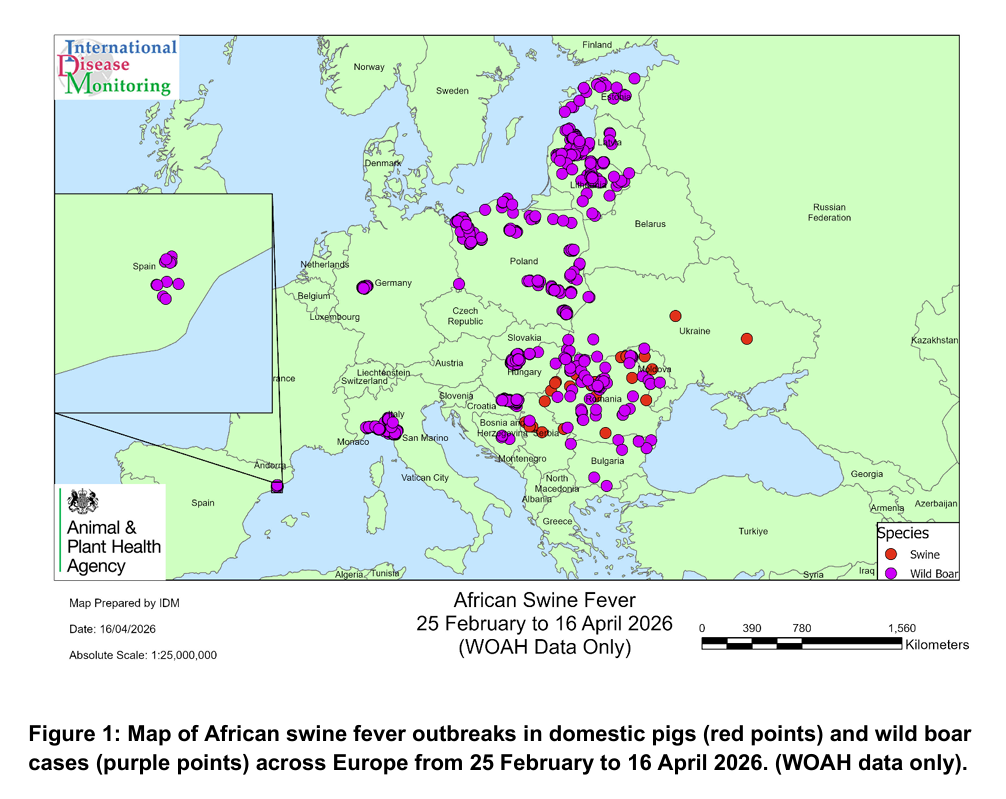
The UK has never had an ASF outbreak. However, ASF outbreaks have been ongoing in the EU since 2017, when they first appeared in domestic pigs in Romania. Romania has had 72 outbreaks so far this year in domestic pigs, 478 in 2025, 213 in 2024, and 533 in 2023. Other EU countries with ASF outbreaks in domestic pigs since 2023 include Bulgaria, Croatia, Estonia, Germany, Greece, Italy, Latvia, and Poland. EU countries with outbreaks in their wild boar populations are Bulgaria, Croatia, the Czech Republic, Estonia, Germany, Hungary, Italy, Latvia, Lithuania, Poland, Romania, Spain, and Sweden.
The UK’s other non-EU trading partners are less affected or AFS-free. But in the CPTPP trade agreement, the UK limited pork imports from CPTPP countries to just 55,000 tonnes by the 10th year, even though the UK imports over 600,000 tonnes of pork from the EU each year. Only 2 CPTPP countries have had ASF cases in the last 5 years. Malaysia experienced an outbreak in 2021, which it controlled through quarantine, culling, and tighter biosecurity measures. Vietnam is the only CPTPP country to have had an ASF outbreak during the last 5 years that was similar in size to the EU outbreak.
Plant biosecurity
But the potential dangers of certificate free borders are not just to farm animals; many crop diseases are also prevalent in the EU but not yet in the UK. Just as with the potential for imported animal diseases spreading from the EU to the UK, removing customs borders with the EU will also endanger UK horticultural crops. Since Brexit, the UK has introduced restrictions on the import of plant material into Great Britain from the EU to protect UK farmers and horticultural producers.114 The SPS Reset will reverse these protections.
Xylella fastidiosa is a bacterial plant disease first detected in cherry trees in the Balearic Islands of Spain in 2016, then spreading to Almond trees on the Spanish mainland in 2017 and to Portuguese lavender in 2019. It is now also found in Corsica, mainland France, and Italy. Furthermore, the Pauca subspecies has caused substantial damage to olive groves in southern Italy.115 The European Commission estimates that Xylella Fastidiosa could cause annual production losses of €5.5 billion and the loss of 300,000 jobs in the production of olives, grapes, almonds, and citrus fruit.116
Potato stolbur, grapevine Bois noir, and maize redness are all types of Candidatus Phytoplasma solani and have been reported in Germany, Romania, France, Italy, Spain, Belgium, Greece, Poland, and the Czech Republic. Although it is primarily a potato disease, it also affects tomatoes, peppers, peas, maize, and grapevines. The disease is not established in the UK, but cases were found in 2014 in strawberry plants imported from another EU member state, when the UK had certificate-free borders with the EU. DEFRA estimates the disease would have a medium-to-large economic impact, as it causes spongy, discoloured potato tubers that are unfit for processing and cannot be used as seed tubers. The disease also causes substantial reductions in potato yields.117 The disease has a similar effect on grapevines, with yield losses of 25% to 30% reported in the Czech Republic. While grapes are a less important crop in the UK than in many EU countries, vineyards now cover about 12 thousand acres in the UK, up from about 500 acres in 2000. Vineyards are predicted to increase as the UK climate warms, and they are seen as a more profitable use of agricultural land.
Other costs from the SPS agreements product scope
DEFRA published a list of UK legislation that it believed would have to be amended to comply with EU regulations under the EU Reset and would, in future, be subject to EU control.118
DEFRA listed: Sanitary and Phytosanitary (SPS) legislation; food and feed safety; and broader nutrition-related areas, such as food supplements, fortified foods, food for specific groups, nutrition and health claims, and nutrition labelling; wider agrifood rules related to food labelling, organics, key agri-food marketing standards, and compositional standards; as well as regulation of pesticides and biocides.
DEFRA has identified 18 agrifood areas covering 76 EU regulations that will now be UK regulations, and all UK firms in these sectors will need to ensure that they comply with them. Below are the 18 areas and the number of EU regulations in each area that the UK would need to adopt and enforce.
General Food Law & Consumer Information
Food manufacturing, retail, and import/export operations will see changes resulting from alignment with EU food law. This alignment will update areas such as UK requirements on risk analysis, traceability, and consumer information. (3 EU regulations)
Food Hygiene & Safety of Foods of Animal Origin
Alignment with EU hygiene rules will apply to British slaughterhouses, meat processors, and dairy producers. Covering rules on feed hygiene, feed producers, transporters, and farms regarding cleanliness, record‑keeping, and safety. (3 EU regulations)
Food Additives, Flavourings, Supplements & Novel Foods
Alignment with EU rules will affect ingredient suppliers; specialist manufacturers, such as infant formula producers, testing laboratories, and retailers; and requirements for additives, enzymes, contaminants, novel foods, and marketing. (10 EU regulations)
EU regulations are based on the EU’s Precautionary Principle. An example of the many regulatory changes that have occurred since the UK left the EU was in November 2021, when the European Commission published Implementing Regulation (EU) 2021/2090 in the EU Official Journal, denying authorisation of titanium dioxide (E171) as a feed additive for all animal species. The following year, the EU also prohibited titanium dioxide (E171) as a food additive under Regulation (EU) 2022/63, even though it has been used as a food colourant for over 70 years. The regulation included a commitment to review this decision, as titanium dioxide is also used as a colourant in medicinal products. The European Medicines Agency, using scientific investigation rather than the precautionary principle, reviewed its approval in April 2024, and in August 2025, over a year later, the European Commission issued a Staff Working Document allowing titanium dioxide to remain in medicines while maintaining the Regulation (EU) 2022/63 banning its use in food.119
This should serve as a cautionary tale about the EU’s asymmetric rulemaking, in which some departments take a hazard-based precautionary approach while others rely on scientific risk assessment. Under the Reset, the EU’s precautionary-approach department would be in charge of UK food and farming regulations. The largest Titanium Dioxide producer in Europe is a UK company.
Marketing Standards for Specific Foods
Producers and suppliers of coffee extracts, cocoa, chocolate, honey, sugars, fruit juices, fruit jams, jellies and marmalades, dried milk products, and other products covered by EU CMO regulations will need to adapt their marketing standards, product formulations, processing methods, and/or labelling to meet EU requirements. This would include the British varietal name ‘marmalade’, which would have to be relabelled as ‘citrus marmalade’ under the Reset, to conform with EU rules even if it is not exported to the EU. (8 EU regulations)
New EU rules mean that some British businesses will need to change the composition of their products to continue marketing them in the UK under specific (reserved) terms. These include:
- jams, jellies and marmalades: increases to the minimum amount of fruit required per 1,000g of finished product in jam, extra jam, jelly, and extra jelly (minimums vary according to fruit species and are category dependent) as per Directive 2024/1438120
- reduced sugar jams, jellies and marmalades: the ‘reduced sugar’ provision in domestic rules (requiring a soluble dry matter content of not less than 25% and not more than 50%) will be removed, and reduced sugar, jellies and marmalades will need to meet the reduced sugar definition of a minimum of 30% less sugar than a full sugar product as set out in Regulation 1924/2006121
- coconut juice and coconut water: minimum Brix level of 4.5 (sugar content)
- fruit nectars: new upper limits for honey or sugar included in fruit nectars — depending on fruit source, this corresponds to:
- 20% of finished product for fruit nectars when made from fruits with acidic juice unpalatable in its natural state (Part I Annex IV of Directive 2001/112)122
- 15% when made from low-acid, pulpy or highly flavoured fruits with juice unpalatable in the natural state (Part II Annex IV of Directive 2001/112)123
- 10% for fruits with juice palatable in the natural state (Part III Annex IV of Directive 2001/112)124
When businesses change the composition of their products or adjust their practices, they will also need to update their labels to ensure they remain accurate and compliant with EU food labelling rules. In addition to this, there will be some changes to the rules on how these types of food products should be labelled, even if no changes are made to the product itself, and these are set out in the food labelling section of DEFRA’s guidance.
Changes to Nutrition-related Labelling Composition and Standards (NLCS) rules
As the Reset also covers food marketing, UK retail packaging will have to change the nutritional information on the package to conform with EU labelling and marketing rules, even if they don’t export goods to the EU. Regulation (EU) 2021/2117 requires nutritional information to be included on any bottle of wine produced after the 2024 harvest. The label Information must cover calorific values and allergens, while the full nutrition declarations covering fat, saturates, carbohydrates, sugars, protein, and salt can be on a QR-code e-label along with the full ingredient list. The regulation also covers aromatised wine products such as vermouth, but not beer, spirits, cider, liqueurs, and other alcoholic drinks with an ABV above 1.2%. Drinks with less than 1.2% alcohol are considered to be food by the EU and require full nutrition and ingredients information.
British Businesses will need to comply with EU rules on nutrition-related labelling, composition and standards (NLCS), which cover:
- nutrition labelling on all food (see also section on food labelling)
- nutrition and health claims
- food supplements
- fortified food
- food for specific groups (including infants and young children, food for special medical purposes, and total diet replacement for weight control)
In 2022, the EU introduced regulations for total diet replacement for weight control products, Commission Delegated Regulation (EU) 2017/1798, which introduced new compositional, labelling and marketing requirements for food business operators.125 These include:
- nutrition labelling on all food (see also section on food labelling)
- nutrition and health claims
- food supplements
- fortified food
- food for specific groups (including infants and young children, food for special medical purposes, and total diet replacement for weight control)
The EU has also restricted and prohibited certain substances in food and food supplements. This is set out in the annexes of Regulation 1925/2006 on the addition of vitamins, minerals and certain other substances to food.126
Additional changes to NLCS legislation are optional for businesses. For example, changes that include:
- different forms of vitamins and minerals to be included in specific foods
- additional protein hydrolysates (protein hydrolysed into its component products including amino acids and peptides) to be used in infant formula
EU wine regulations also introduced new terms for wines with reduced alcohol content: “alcohol free” for products that do not exceed 0.5% alcohol content, “reduced alcohol” for products with an alcohol strength above 0.5%, and at least 30% less than the minimum alcoholic strength of the products before de-alcoholisation.
If the Reset proceeds, the UK’s budding wine industry will have to comply with these regulations, as will the UK’s low and no alcohol drinks industry, while UK whisky and gin manufacturers will be able to keep their present labelling.
Food Contact Materials – packaging and utensils
Manufacturers will need to change the packaging materials they use to comply with EU recycling requirements and the EU ban on certain plastics. This will be especially costly for SME food manufacturers, most of whom do not export to the EU.
Alignment with EU rules on plastics, ceramics, and other food-contact materials will affect packaging manufacturers, food processors, laboratories, retailers, and the NHS. It will update areas such as food-contact safety requirements, testing standards, and permitted materials. (6 regulations)
The EU regulatory amendments since the UK left the EU for Food Contact Materials, which covers both food processing equipment as well as wholesale and retail food packaging are covered by: Regulation (EU)2023/1442, Regulation (EU)2025/351, Regulation (EU)2023/1627, Regulation (EU)2025/2240, Regulation (EU) 2025/40 and Commission Regulation (EC) No 2023/2006.
Any company that exports to the EU will have already aligned their products with the EU’s packaging standards. For example, UK drink manufacturers who export to the EU have had to attach the bottle top to the bottle for their exports, and generally do so for their British domestic production as well.127
From 12 August 2026, following the EU’s Regulation (EU) 2025/40, Article 5(5), all food-contact packaging placed on the EU Market must comply with 3 limits on the use of per- or polyfluoroalkyl (PFAS) chemicals:
- 25 parts per billion (ppb) for any individual PFAS
- 250 ppb for the sum of non-polymeric PFAS
- 50 ppb for total PFAS, including polymeric PFAS
Any food packaging above these limits is banned from sale in the EU (PFAS used in other products, including medical devices, have not been banned in the EU).
PFAS chemicals are mostly added to paper, cardboard, and textile packaging to make them grease-, water- and heat-resistant. They are used in most countries, including the UK, China, Australia, Canada, and in most US states. They are used in takeaway containers and food wrapping, pizza boxes, grease-proof paper, microwaveable paper food trays and popcorn bags, and many ‘eco-friendly’ plant-based or compostable bowls and trays.
The UK has not banned PFAS and has no limits on their use. The UK’s 2023 PFAS Regulatory Management Options Analysis (HSE) has examined them and recommended further study. But if the Reset happens, all UK companies will have to change their packaging immediately to comply with EU standards.
Many other British drink companies that mainly or only cater to the British market have now switched from plastic bottles to aluminium cans to comply with recent changes to British recycling law.128 Like takeaway and ready-meal food manufacturers, these British drinks companies would have to change their packaging again to meet EU standards if the Reset proceeds, even if they don’t export to the EU.
EU regulations regarding Packaging Recycling
The EU Regulation (EU) 2022/1616 on recycled plastic materials and food contact materials entered into force on 10 October 2024. Article 27 requires the competent authority in the country where a recycler of food-contact plastic is located to verify that the recycler’s food safety controls comply with EU technology regulations, audit the facility, submit audit results to the European Commission, and liaise with EFSA for safety evaluations. Article 27 also requires that the competent authority receive a compliance monitoring summary sheet from the recycler and verify that the information complies with EU regulations. As of August 2026, the EU has not recognised any UK competent authority, which forces UK exporters to use an EU-authorised facility to produce packaging or to use virgin plastics.129
But the packaging changes required by the Reset are not just about PFAS chemicals. Article 7 of the EU’s Packaging and Packaging Waste Regulation (PPWR), Regulation (EU) 2025/40, requires all plastic packaging to contain a specified minimum percentage of recycled plastic waste, between 10% and 35%. After 1 January 2030, the use of virgin plastic will be limited to contact-sensitive plastics. Article 7 covers all plastic, not just food packaging. The UK will also have to apply this.
PFAS and the EU’s Precautionary Principle
On 7 February 2023, the European Chemicals Agency (ECHA) published a proposed restriction that would largely eliminate the production and use of per- and polyfluoroalkyl substances (PFAS). The EU proposal is not science-based, as it does not adequately account for the distinct hazards and associated risk profiles of the PFAS chemicals subject to the proposed restriction. It also does not consider the implications of the ban for several critical uses, such as in the production of some renewable energy products, as well as other manufactured goods, such as semiconductors, heat pumps, air conditioning, medical devices, and propellants, for which the EU has not yet conducted a technological assessment to determine if there are commercially feasible alternatives to PFAS. Additionally, the proposal could affect the implementation of global treaties, such as the Montreal Protocol, by restricting the development of alternatives that support their implementation.
In addition, in August 2025, the EU updated its proposal, adding 8 sectors not included in the initial proposal, as well as an updated timeline for its scientific evaluation of the proposal, but it does not appear that the EU plans to provide sufficient time for public consultation on the updated proposal or to carry out a sector-specific evaluation of the 8 new sectors. The UK would have to comply with these bans under the Reset and would also breach WTO rules on international trade. The United States has raised concerns bilaterally, including at WTO Technical Barriers to Trade (TBT) Committee meetings.130
Other Food‑Related Measures
Alignment with EU rules on irradiation, extraction solvents, mineral waters, organic production, lot marking, and bovine identification will affect bottled water producers, organic certification bodies, irradiation facilities, and operators of livestock identity systems. Compliance requirements also cover processing treatments, solvent use, product classification, certification processes, and animal identification standards. (7 regulations)
Farmers growing organic plants and crops will need to meet the EU’s stricter requirements for organic seed and plant reproduction material, such as cuttings, roots, grafts, and plugs.
The new EU standards for poultry housing will limit the size of British organic poultry farms, requiring natural light sources, a controlled climate, daily access to outdoor ranges, and adequate indoor space for movement. Organic poultry businesses will need to use organic pellets and follow EU breeding rules. The EU also changes the proportion of feed that must be produced on-farm or locally: for pigs and poultry, it requires at least 30% of feed to be produced on-farm or locally. For other organic livestock, the EU’s minimum allowable proportion of feed grown on the farm or locally is 70%. Both percentages are higher than the UK’s current standard of 20% and 60%, respectively.
Organic pet food is now covered by the EU’s organic feed laws. Producers of organic pet food will be required to meet the EU’s new compositional and processing standards, including the EU’s tighter limits on permitted non-organic ingredients.
Organic aquaculture, such as fish farms in inland waters, will have to follow EU stocking densities for perch and EU stocking densities of crayfish.
Makers of organic products will need to update their labelling to include the EU organic logo and the EU statement of agricultural origin, in line with EU Regulation 2018/848, Articles 32 and 33.131 Manufacturers of organic ingredients will need to follow EU product standards; for example, flavourings must meet the EU’s definition of foodstuffs according to the EU’s Flavouring Regulation.
Importers of organic goods from the rest of the world will need to use the EU’s IT system, TRACES NT, to obtain a certificate of inspection allowing consignments to be digitally endorsed by the third country’s control bodies and the UK port health authority, before the organic product can be sold in Britain.
Alignment with EU rules will mean that goods imported into Britain from outside the EU will also need to comply with EU rules. This could disrupt businesses’ usual supply chains.
Feed Products and Hygiene
Alignment with EU rules will affect feed mills, compound feed manufacturers, farmers and veterinary nutrition bodies, as well as some compositional and hygiene requirements for feed. (5 regulations)
British feed producers will need to comply with EU regulations on feed additives and feed materials132 and the EU list of intended uses for particular nutritional purposes.133 Businesses making feed additives will need to apply to the EU and follow EU processes and guidelines.
All feed businesses making market authorisation applications will need to follow the updated transparency rules in the EU’s General Food Law.134 This means businesses will be required to proactively disclose and notify EFSA of commissioned studies.
Since Brexit, the EU has introduced new, additional or revised maximum levels for contaminants such as PFAS, heavy metals (such as lead and cadmium), mycotoxins and plant toxins in various foods. Britons will need to ensure compliance with the levels set out in EU Regulation 2023/915.
Animal health
Alignment with EU animal health frameworks will affect farmers, breeders, traders, veterinary authorities, public health agencies, the equine sector, pet owners, and food and by-product processors. It will cover surveillance, identification, registration, and movement of live animals, germinal products, and animal by-products. (5 regulations)
Great Britain will align with the EU on veterinary medicine residue limits and residue surveillance. However, Great Britain is not aligning with the EU’s veterinary medicines’ authorisations. British animal farmers will have to follow the EU’s new traceability and identification requirements for: pigs, cattle, camelids, deer, equines, poultry, captive birds, bees, small ruminants, and aquatic animals. There will also be changes to how animals are recorded, monitored, and moved in Britain. There will also be changes to the way diseases and outbreaks are managed, recorded, and reported. DEFRA claims that biosecurity will remain a core priority; however, as we have already discussed, biosecurity is not a core priority for the EU.
Owners of pet dogs, cats, and ferrets will still need an animal health certificate for their pets if they are travelling from Britain to the EU.
Products of Animal origin
All products of animal origin and animal by-products must comply with EU regulations. For example, identification marks applied to products of animal origin, including meat and dairy products, may change. Changes may also affect how products of animal origin are processed and distributed, as well as certification requirements for imports, exports, and domestic trade. When businesses change the composition of their products, or adjust their practices, they may also need to change their labels to ensure they remain accurate and compliant with EU food labelling rules.
Some EU hygiene rules for foods of animal origin have changed since Brexit.135 British businesses will need to ensure compliance with these rules under the SPS agreement, including extending the sell-by date for eggs, maintaining temperature control, and dry-ageing meat. The EU has also changed its maximum levels for contaminants such as per- and polyfluoroalkyl substances (PFAS), heavy metals (for example, lead and cadmium), mycotoxins and plant toxins in various foods. All food and feed businesses will need to ensure compliance with the levels set out in EU Regulation 2023/915.136
Animal Breeding
Alignment with EU rules will affect breeding organisations, pedigree breed societies, importers and exporters of pedigree breeding animals, genetic services companies, racehorse breeders, competition organisers, transporters, and veterinary authorities. It will cover the recording, verification and certification of breeding animals, and germinal products, as well as identification, movement requirements, and conditions governing participation in horse racing. (2 regulations)
Animal Welfare Transport and Slaughter
Alignment with EU rules will affect hauliers, abattoirs, welfare charities, and enforcement inspectors. Animal transport, handling and welfare requirements will now follow EU regulations rather than the UK’s stricter post-Brexit regulations on this issue. (3 regulations)
Since leaving the EU, Britain has predominantly changed animal welfare rules, such as the transport of live animals for slaughter and fattening from Great Britain, and has banned the dredging for sand eels in English waters. Fur farming and the production of Foie Gras by the force-feeding of geese remain illegal in the UK, but are approved in the EU. The reset will reverse these regulatory changes.
DEFRA’s report on FMD risk states that the number of slaughterhouses in the EU has decreased, leading to longer transport distances and larger industrial facilities. DEFRA estimates that around 40 million pigs, cattle, sheep, and goats are transported for more than 8 hours for slaughtering, fattening, and breeding within the EU annually.137 The EU also exports around 3.4 million live animals annually to non-EU countries, predominantly Turkey, Israel, Lebanon, North African and Middle Eastern countries

Plant Health
Alignment with EU rules will affect horticultural businesses, nurseries, importers, and plant health inspectors. This will include replacing UK Plant Passports with EU Plant Passports. To safeguard biosecurity, it will also reintroduce a notification system for imports of high-risk plants from the EU. (1 regulation)
DEFRA’s guidance document for the Horticulture industry says the SPS changes will affect the types of inputs, such as pesticides and biocides, that growers can use, as well as their costs and application limits.138 There will also be changes to plant checks, certification, and movement controls, and UK plant passports will be replaced by EU plant passports.
Defra explains that the EU’s SPS rules will change what plant protection products and biocides can be marketed and used in the UK, and change how they are regulated. Horticultural growers, garden centres, landscapers, and manufacturers of garden products will have to comply with EU regulations on biocide products and pesticide Maximum Residue Levels, and adjust their products, processes, and limits whenever the EU changes its rules, regardless of whether they trade with the EU. There will also be additional growing season inspections to meet EU plant passport requirements. Businesses will have to ensure that commercial documentation and consignment information is accurate and complete.
The UK will retain a notification system for importing high-risk plants from the EU and align with the EU’s rules on imports from the rest of the world. Inspections of non-EU plants will increase to align with EU inspection levels. British growers will need to participate in the EU’s reporting and inspection systems to demonstrate that their businesses are reducing the risk of plant disease outbreaks from trade. This is a bit rich coming from the EU, which, as mentioned earlier, currently has several plant disease outbreaks.
Marketing of Plant Reproductive Material
Alignment with marketing requirements for plant and forest reproductive material, as well as plant variety rights, will support the development and production of quality seed and plant propagating material. Affected businesses and organisations include plant breeders, seed companies, farmers, growers, forestry nurseries, and horticultural suppliers. (13 regulations)
Official Controls
Alignment with EU rules will affect port authorities, port health authorities, environmental health officers, and regulated agrifood businesses, as well as importers and exporters of SPS goods. It will remove certain checks at the GB-EU border and for movements from GB to NI, while checks on imports from the rest of the world will remain. UK check rates will also align with those applied by the EU. (1 regulation)
Plant Protection Products
Alignment with EU rules on active substance authorisation, residue levels, and the sale and marketing of pesticides will affect farmers and growers, agrochemical manufacturers, distributors, food retailers, and other businesses using pesticides. It will require changes to the UK’s pesticide approval processes, compliance with the EU’s maximum residue limits (MRL), and adherence to EU rules governing the marketing and use of pesticides. This will prevent imports from many other countries that have not followed the EU’s MRL decreases, which are based on the precautionary principle rather than science.
The EU regularly updates its regulations on plant protection products, altering both the permitted substances and the maximum allowable levels of pesticide residues on cereals, fruits, vegetables, and animal products. So far in 2026, the EU has made 20 changes to its plant protection list.139 In 2025, the EU made 38 changes to its plant protection product lists, compared with 78 in 2024.140 The EU uses the hazard-based precautionary principle to determine these changes, while Great Britain maintains its own Maximum Residue Limits, which are determined by a risk-based scientific assessment.
The EU has refused to adopt entire categories of international standards promulgated by the Codex Alimentarius Commission (Codex) that have established Maximum Residue Limits (MRLs) for the safe trade in agricultural products. The Codex MRLs are established following scientific investigations into adverse impacts on human health by organisations such as the United Nations Food and Agriculture Organisation/World Health Organisation Joint Expert Committee on Food Additives and the FAO/WHO meeting on Pesticide Residues. The single most-cited example of World Trade Organisation (WTO) SPS disputes is the EU’s rejection of all Codex MRLs for chlorpyrifos in crops. The EU has set its MRL at 0.01mg/kg, it has no import tolerance and does not accept produce that meets Codex MRLs. The UK retained many of the EU’s MRLs after Brexit,141 though not all of them. Pesticide Action Network UK estimates that by April 2025, Great Britain had increased the number of MRLs to 764 to comply with Codex levels.142 The full GB Statutory MRL Register can be found here.143
It is difficult to understand why the UK would abandon scientific investigation and agree to dynamically follow the EU’s precautionary principle in the future. The UK’s retention of many of the EU’s MRLs is irrational. For example, the Codex MRL for Chlorpyrifos on citrus fruit is 0.5 mg/kg, but the EU has lowered its MRL to just 0.01 mg/kg. The UK does not have the climate to grow citrus fruit and relies on imports, yet it still applies the EU MRL to its imports. This may be due to the Windsor Framework, which tied Northern Ireland to the EU and its regulations, and would prevent the distribution of oranges imported from non-EU countries to Northern Irish shops if the UK followed the Codex limit. However, retaining this MRL is both against WTO rules and restricts UK orange imports from non-EU countries. The Reset will force UK consumers to continue importing EU oranges, as well as many other fruits and vegetables.
On 15 February 2023, the EU published Commission Regulation (EU) 2023/334 to reduce maximum residue limits (MRLs) for clothianidin and thiamethoxam to the limit of determination, in an effort to protect pollinators, particularly bees, in countries outside of the EU. The measure would, in effect, bar all imports into the EU that contain any detectable residue of the two widely used pesticides after 7 March 2026. Many members of the global scientific and regulatory community have found that complex interactions among multiple factors affect pollinator health, including the health of bees, and that the appropriate competent authorities may determine the safe use of the two pesticides based on local, national, or regional contexts. Given the critical importance of the pesticides identified in the regulation to international agricultural products, the EU’s regulation appears to pose a significant obstacle to international trade and production of agricultural products.
The European Commission’s approach to MRLs has been reported to the WTO in 2022, 2023, and 2024, at the WTO TBT Committee, the WTO Committee on Sanitary and Phytosanitary Measures (WTO SPS Committee), and the WTO Council for Trade in Goods.144 If the UK continues with the EU SPS Reset, it too shall be in breach of WTO trading standards; why would we follow the EU’s trade-distorting practices?
The EU uses a precautionary “hazard-based approach” to new products, declaring them ineligible for authorisation based solely on the product’s intrinsic properties, without taking important risk factors such as exposure level or dosage into account. The USTR report on International Trade Barriers complains that an increasing number of safe, widely used substances are not being reapproved by the EU when current registrations expire, or the EU is setting unreasonably low MRL import tolerances due to the EU’s arbitrary ‘precautionary’ MRL limits.145
One category of crop protection products subject to the hazard-based approach set out in Regulation (EC) 1107/2009 is substances classified as endocrine disruptors (EDs). EDs are naturally occurring or man-made substances that may mimic or interfere with hormone functions. The US evaluates potential endocrine effects of certain chemicals to protect public health and the environment. In contrast, the EU established an approach to regulating these compounds that appears not to be based on scientific principles or is maintained without scientific evidence.
The scope of the trade effects of Regulation (EC) 1107/2009 is broad and overlaps with that of the other hazard and environmental criteria the EU uses to regulate pesticides. The EU obscures its hazard-based decisions with onerous data requirements, thereby allowing the European Commission to claim an inability to measure risk. The United States continues to monitor this issue and raise concerns in international and bilateral fora.146
Biocidal Products Regulation
Aligning with EU rules on biocidal active substances such as disinfectants, preservatives, and pest control products will require product authorisation. Manufacturers, distributors, and users of biocidal products will need to comply with EU regulations governing their supply and use, including authorisation, labelling, and supply, which will also affect the operational procedures of organisations in the biocides sector. (1 regulation)
Adopting EU SPS regulations will disrupt or prevent UK international trade. Again, the USTR Report on International Trade Barriers mentions an EU SPS restriction that has become a trade barrier: in December 2024, the EU published a public consultation proposing the classification of Melaleuca alternifolia (tea tree oil) as a Category 1B reproductive toxicant under the CLP Regulation, based on an opinion of the ECHA’s Risk Assessment Committee. U.S. industry raised concerns that this classification would effectively prohibit the placement on the EU market of U.S. products containing tea tree oil, including a range of products such as cosmetics, biocides, insect repellents, and over-the-counter herbal supplements… Ongoing scientific studies of tea tree oil’s effects have not yet been concluded, yet the EU has moved forward with its decision-making process without waiting to consider new scientific data. The United States raised concerns regarding the scientific basis, transparency, and trade impacts of the tea tree oil classification in the WTO TBT Committee and the resulting market access implications.’147 The UK will also be affected if we align with the EU’s arbitrary regulations.
The USTR Report on International Trade Barriers also mentions the delays in EU SPS approvals. The USTR reports that logs and wood chips are fumigated with sulfuryl fluoride throughout the EU, including for EU log exports. Under a systems approach, the EU approved the use of sulfuryl fluoride for certain U.S. log exports in 2023, and completed a scientific review on its use for U.S. pine wood chips on 19 January 2025. However, until EU Member States grant final approval to the systems approach, U.S. exporters of pine wood chips are left without a commercially viable fumigation option, even though the system used in the US is also used by EU members.148
The EU also prohibits using any substance other than water to remove contamination from animal products unless the European Commission has approved it. These measures significantly affect U.S. exports of beef, pork, and poultry to the EU because the European Commission has failed to approve several pathogen reduction treatments (PRTs) that the U.S. Department of Agriculture (USDA) has approved for use after establishing their safety on the basis of scientific evidence. PRTs are rinses used to kill microbial pathogens that commonly exist on meat after slaughter. It is hard to view this as anything other than a trade barrier. In March 2017, the US National Pork Producers Council applied to the European Commission for the approval of two organic acids, lactic and acetic, for use on pork. The European Commission submitted the application to EFSA in September 2017. EFSA published its evaluation in December 2018, confirming the safety of using acetic acid and lactic acid in pork processing. As of 31 December 2025, seven years later, the European Commission has still not approved pork PRTs.149 Yet the UK wants the EU to set all its SPS regulations.
Sanitary and Phytosanitary – Other
Alignment with EU rules on certain hormonal substances, including bovine somatotrophin (BST), will affect cattle and pig farmers, veterinary service providers, and meat processors, and will require controls on the use of hormonal substances in livestock production and related veterinary requirements. (2 regulations)
Veterinary Medicines – Residue Limits and trade-relevant aspects of antimicrobial resistance
EU SPS Regulations also govern pharmacologically active substances used in veterinary medicines. Alignment with EU rules on residue limits and veterinary medicines will affect pharmaceutical companies, livestock producers, regulators, and food safety authorities. (2 regulations)
Generally, the UK has a better record of restricting antimicrobial use in farm animals than many EU countries. Despite this, under the SPS reset, the UK will have to comply with EU regulations on Antimicrobial Resistance and on the Restrictions on the Use of Veterinary Medicinal Products. EU Regulation (EU) 2019/6 on veterinary medicinal products addresses antimicrobial resistance by strictly defining the criteria for using antimicrobial products in animal medicine and identifying a list of products that will be exclusively reserved for human medicine and no longer permitted in agricultural production. Article 118 of the regulation requires that any animal products exported to the EU and intended for human consumption must not originate from animals treated with specified antimicrobial medicines reserved for human use or used for growth promotion. The official implementation date for Regulation (EU) 2019/6 and related implementing measures is 3 September 2026.
International food exporters are concerned about other EU trade regulations that are not science- or risk-based, and instead promote the adoption of EU practices by third countries rather than recognising alternative ways different competent authorities can achieve the same level of product safety. The EU’s prohibition of non-medically important antimicrobials to promote growth and increase yield lacks scientific justification, and it has not identified specific food safety concerns.150
The Costs of dynamic alignment with the EU’s food and farming regulations
The UK’s entire Food and live animal exports to the EU in 2025 were only £12 billion.151 This was just 0.4% of the UK’s GDP of £3,037 billion in 2025152 and only 1.3% of total UK exports. And yet, the Reset requires all UK producers to comply with all EU regulations covering food and agriculture. The scope of the Food and Agriculture section of the Reset covers not just health checks for plant and animal products but also food safety, consumer protection rules covering agrifood production, distribution and consumption, animal regulations, pesticide regulations, organic production rules, organic labelling rules, and marketing standards. These regulations will apply not only to traded goods but also to all food and agricultural products in the UK, including those produced domestically for domestic consumption and those imported from non-EU countries.
The extent of the Reset matters because, while the UK is not a large exporter of raw food and agricultural goods to any destination, let alone the EU, it does export manufactured food such as biscuits, condiments, and alcohol worldwide. These products will be affected by the EU Reset, which also covers food safety, standards, labelling, and food marketing. This affects packaging, including the materials that can be used, as well as the nutritional information. For example, the EU now requires wine to have nutritional labels and restricts the types of plastics that can be used in food packaging.
The supposed benefits of the Reset will be very small. The UK does not have the capacity to increase its food production to reap any benefits that certificate-free trade could yield. All that regulatory alignment would achieve is to shift the private costs borne by exporters onto the public purse, impose massive compliance costs on domestic producers, and limit imports of food from non-EU suppliers. The UK is a major importer of food, and the EU is one of its major suppliers. This has continued since Brexit without the need for regulatory alignment. The difference is that the UK, unlike the EU, doesn’t use non-tariff barriers to restrict the food imports that it needs. Supporters of rejoining the EU have claimed that UK agrifood trade has fallen because of Brexit and that the Reset will restore this lost trade, but this is not true, as explained earlier. The Rejoiners are wilfully misinterpreting the trade figures. The only Food sector exports to the EU that have fallen since Brexit were fruit and vegetables and shelled seafood, but this was due to the miscounting of re-exported goods by the EU’s statistical agency, Intrastat, when the UK was an EU member. These products were never UK exports; the UK is a distribution hub for out-of-season fruit and vegetables, and for tropical fruit and nuts grown in Commonwealth countries. The UK used to distribute the fruit to other EU countries, which were miscounted as UK exports. The chart below clearly shows this miscounting: before Brexit, the UK’s largest fruit export was oranges, even though the UK’s climate is not suitable for growing oranges.
UK Fruit exports to the EU fell from 200,000 tonnes in 2020 to 50,000 in 2025. The largest export reductions were: citrus fruit, down by 96%; bananas and plantains, down by 95%; and melons and pawpaws, down by 88%. In 2020, citrus fruit was the UK’s largest fruit export by volume, even though the UK does not have the climate to grow citrus fruit. These would have been oranges from South Africa, and limes from India and the Caribbean – landed and distributed from the UK to other EU destinations. Similarly, the UK cannot grow cashews, coconuts, bananas, avocadoes, or mangoes, but the EU’s Intrastat recorded these as UK exports before Brexit. These were never UK products; they were primarily grown in Commonwealth countries and distributed to other EU countries via the UK, thereby boosting the UK’s export figures. Paying to align with EU SPS regulations will not change a product’s origin nor allow it to meet the Regional Value Content required by the TCA. UK Fruit exports will never return to their pre-Brexit levels.
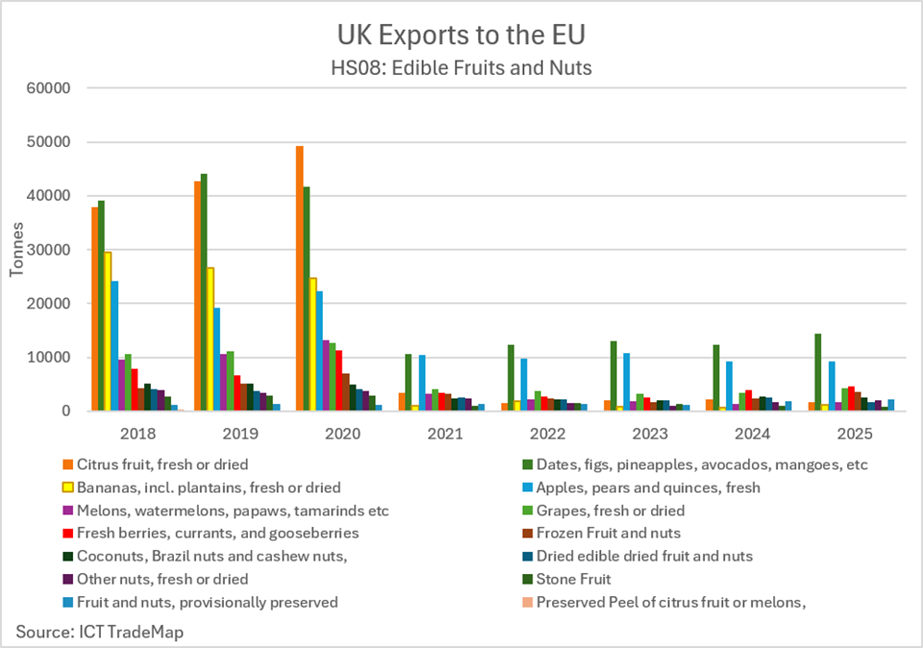
How much will all this cost?
In total, the EU Reset will cost British food manufacturers and farmers between £2.23 and £5.8 billion a year and impose one-off compliance costs of between £2 and £3 billion.
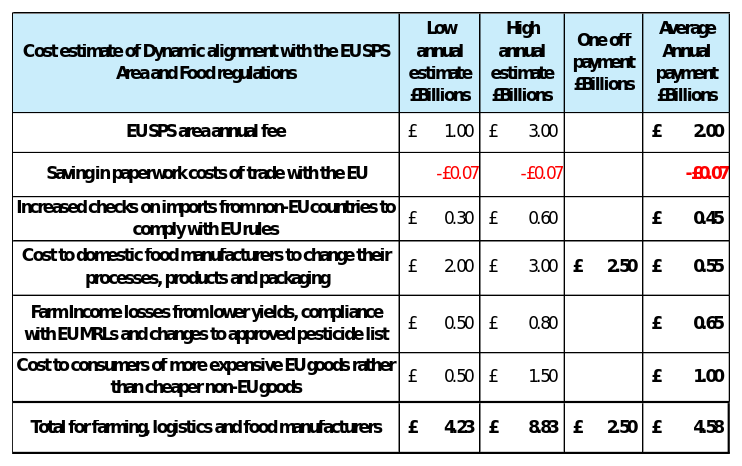
Section V. Internal security and judicial cooperation
This section of the reset is meant to deal with ‘upstream migration’, which includes: migrant smuggling; working on ‘practical solutions’; returns to third countries; and cooperation between the European Migration Network, the European Union Agency for Asylum, Frontex, Europol and its European Migrant Smuggling Centre, and respective United Kingdom authorities. According to the Common Understanding published in May 2025, these EU and UK agencies should work together to prevent irregular Channel crossings.
The House of Commons Library research briefing explains that in 2025, 89% of detected irregular arrivals to the UK arrived by small boat across the Channel, although this accounted for only 40% of 2025 asylum claims.153
With the well-publicised pictures of larger dinghies crossing the Channel laden with immigrants, most people reading this paper will be aware that this section of the Reset has been a dismal failure, even though it did not require the UK to change its laws or pay into the EU budget. It just required cooperation between UK and EU immigration authorities — and a willingness by either area’s immigration authority to want to stop the boats.
Part of this arrangement was the infamous ‘one in, one out’ policy. The original pilot scheme came into force on 6 August 2025 and was due to end on 30 June 2026, but it has now been extended until 1 October 2026. Between the beginning of the programme and 30 June, the UK returned 1,087 people to France, and transferred 1,117 from France to the UK.154 Just to spell that out: the UK received 30 more illegal immigrants than it sent to France, but it also incurred the expense of finding, detaining, and deporting over 1,000 people, only to end up with slightly more than it started with. It is hard to imagine why anyone thought this would solve the problem of illegal immigration to the UK. During the same period, 27,920 people arrived on dinghies, so the ‘one in, one out’ returns policy represents just 4% of these arrivals and has had a very limited deterrent effect, if any. Unsurprisingly, several of the people returned to France later re-entered the UK illegally – but in lorries to avoid UK authorities.
The government has not published the full cost of the ‘one in, one out’ policy, but other Home Office publications show that enforced returns are very expensive. And the ‘one in, one out’ policy would have been mostly enforced returns. The UK-France Agreement on the prevention of dangerous journeys (Treaty Series No 39/2025) has strict selection criteria155: Under the treaty, the UK can only return people who have arrived by small boat, are an adult or an accompanied minor, have had their asylum claim declared inadmissible, but are not considered to be a threat to public order or national security. They must also be returned within 14 days of arrival. So, dangerous criminals, known terrorists, and children cannot be returned to France. The UK must keep them. The 14-day limit also prevents the removal of the 100,000 illegal immigrants already in the UK.
Returning 1,087 people is not without cost, and this programme is not included in the 3-year programmes the UK signed with France under the Sunak Government, which the Starmer Government rolled over (at a higher price). The average cost of an enforced return in 2024 to 2025 was £48,800 according to the Home Office.156 In the 2024/25 financial year, the Home Office spent £420 million on 8,600 enforced returns. The cost covers Home Office staff processing and arranging the removals, holding the person in an Immigration Removal Centre, escorting and transferring the immigrant within the UK and onto the flight, and chartering a plane. These are direct costs only and do not include legal appeals and court cases. Voluntary returns are considerably cheaper, at only £4,300 per person, and while the Home Office managed only 8,600 enforced returns, it managed 13,700 voluntary returns.
Another example of two immigration forces not working to stop illegal immigration is the bilateral UK-France three-year funding package, agreed in April 2026, to run from 2026/7 to 2028/9. This replaces the Sunak Government package of £476 million, meant to fund French Police, coastal surveillance, and disruption of people-smuggling gangs on the French side of the Channel. As this package had clearly not worked, instead of abandoning it, the Starmer Government rolled over the agreement for another 3 years and increased the payments to £662 million: £501 million for a Foundation Fund to strengthen existing controls, policing and enforcement, and surveillance infrastructure on the French coast, and a further £161 million for the Flexible Innovation Fund for new ‘tactics’ — presumably this means new tactics to stop the illegal crossings to the UK.
As the Rt Hon Shabana Mahmood MP stated in her November 2025 policy paper entitled ‘Restoring Order and Control: A statement on the government’s asylum and returns policy’: ‘In 2024, asylum claims in the UK rose by 18 percent, to a record high. Across Europe, meanwhile, claims fell by 13 percent. We have become the destination of choice in Europe, clearly visible to every people smuggler and would-be illegal migrant across the world.’157
The House of Commons Library paper, covers the real cause of the UK’s illegal immigrant problem, which is also one that successive UK governments could have fixed but chose not to: UK government policies have made the UK a more attractive destination than most EU countries with ‘free accommodation, food and pocket money’, a more permissive asylum system with a high acceptance rate, and a ‘black’ economy willing to employ illegal workers — for a very low price.
Besides the UK pull factor, there is also a French push factor. According to the Home Office, although France should provide asylum seekers with accommodation, there is a significant shortage of accommodation, and it isn’t uncommon for asylum seekers in France to live in camps, on the street, and in squats. The House of Commons Library research briefings reiterate this claim: ‘Since 2020, two judgments of the European Court of Human Rights have found that France’s accommodation arrangements have breached asylum seekers’ rights under the European Convention on Human Rights (ECHR).’158 This French ‘significant shortage’ of asylum accommodation is a political choice not to pay to house asylum seekers in hotels and new-build accommodation, unlike successive UK governments. The House of Commons briefing also explains: ‘The French authorities don’t intervene if no one on board [a dinghy] asks for assistance, due to a concern that a forced intervention could heighten the risk of injuries or of people falling into the sea. If only some people want to be rescued, they are helped to disembark, and the remaining people on board are left to continue their journey.’
There is no point in the UK making a formal agreement with the EU on irregular migration as part of the Reset agreement if EU members can: not supply housing to asylum seekers (as in France) or not intervene at border crossings (also in France). The EU obviously does not have the competence to change this, and France has no interest in doing this either.
France has not even closed down the Opal’Exil organisation, a volunteer group operating on the coast south of Calais that provides ‘humanitarian support’ such as food, water, and clothing to people waiting to cross the Channel. This group came to prominence in a recent video made by Chris Philp, the Shadow Home Secretary.159 They were the people dressed in purple vests standing in the shallow water, helping people board a large inflatable ‘mega-dinghy’. They are not the only charities and NGOs facilitating illegal immigrants living in encampments around Calais; Care4Calais, l’Auberge des Migrants, Humans for Rights, and Utopia 56 also provide similar aid (food, water, and clothing) and/or legal advice to immigrants seeking to reach the UK.160 Other solutions to illegal immigration exist. Denmark, for example, has made refugee status temporary, and it only lasts as long as safe harbour is genuinely required. Denmark is removing people who have failed asylum, and asylum claims in Denmark have fallen to a 40-year low.
The Hague Convention
The EU Reset will further embed the Hague Convention on Recognition and Enforcement of Foreign Judgments in Civil or Commercial Matters (“Hague 2019”), which the UK ratified in 2025. The Treaty makes certain business/civil court decisions automatically apply in the UK when granted by EU Courts.
This has always been a system widely open to abuse. The EU itself recognises and is pursuing action against certain of its Member States for having corrupt or unreliable Courts. The Courts of these less stable or, frankly, more corrupt, EU Member States can then be used to hound innocent parties or cripple UK businesses because under Hague 2019, our Courts here will have to recognise those foreign judgments. We will be swapping a system that works, where our Courts have checks and balances in place, for an automated process – which is inherently open to abuse.
Visa Abuse
The Common Understanding agreement between the European Commission and the United Kingdom also committed to exploring closer cooperation to address challenges related to visa policy, such as exchanging analysis on visa abuse by third-country nationals. In light of the recent exposure of the ongoing practice of EU citizens claiming ‘settled status’ and ‘pre-settled status’ in the UK,161 thereby becoming eligible for UK benefits and subsidised university places, it seems strange that we should be coordinating only on ‘visa abuse by third-country nationals’. It is quite clear that the UK’s system is being exploited by EU nationals.
As at the year ending March 2026, 7,953,445 EU nationals had applied for settled status, plus another 83,242 EEA and EFTA nationals and 834,536 non-EEA nationals. The Settled Status Scheme officially closed on 30 June 2021, but 2,824,401 people applied between July 2021 and the end of March 2026. In total, since the scheme was started, a quarter of the 8 million EU nationals applying for settled status are Romanian, and a third of the late applications in Q1 2026 were Romanians. Romanians are by far the largest cohort using this visa scheme — more than the Polish and Bulgarian combined.
Cost of illegal immigration
The largest part of the cost of illegal immigration is the cost of housing and subsistence for immigrants. This is not strictly part of the Reset, but controlling immigration is meant to be, and if immigration remains uncontrolled, the UK’s migrant accommodation costs will remain high.

Conclusion and total Reset cost estimates
The EU Reset is an expensive loss of UK sovereignty for very little in return. The Reset is being sold to the UK population as helping UK companies export their goods to the EU, but the UK exports very few agrifoods covered by the Agrifood SPS agreement or industrial goods covered by the EU’s CBAM agreement. Instead, the SPS Agreement will increase costs for all UK food manufacturers and farmers who will need to comply with EU regulations. The ETS/CBAM Agreement will increase the cost of input materials for the UK’s downstream manufacturers, and increase the carbon taxes paid by UK companies. The Reset’s compliance costs and carbon taxes will apply to all UK businesses, including companies that don’t trade with the EU. The Reset is designed to protect EU producers, not UK consumers. It will force UK importers to buy more expensive EU goods rather than non-EU goods.
The UK’s defence industry sells its equipment worldwide without UK taxpayers buying into a club on their behalf, as the EU’s SAFE program effectively is. The UK’s universities have filled all the spaces vacated by subsidised EU students after Brexit with full fee-paying international students, including 63,000 from the EU; the UK has no need to pay to join the EU’s Youth Mobility scheme or Erasmus+. While the UK-EU cooperation in illegal immigration has been in operation since 2022, despite this, the number of illegal immigrants crossing the Channel has only increased.
All that will come from the EU Reset is a massive bill, and subservience to the EU and the ECJ.
The Table below summarises the costs that are calculated in detail in each chapter. It is incredible to see that the estimated costs amount to £17.6 billion in 2027, increasing to £20.5 billion per annum by the 2030s, with an additional £12 billion in one-off compliance costs. This does not include other potential costs, such as the loss of the UK’s Agtech industry if the government cannot secure a regulatory carve-out.
Our conclusion from this paper and advice to the Government: whatever you do, DON’T press Reset.

References
- Syed Matthew, Apartheid lives on in Britain, yet we turn a blind eye’, The Sunday Times, 29 August 2026 (Link)↩
- Council of the EU, Ukraine support loan: EU countries approve UK participation to help cover Ukraine’s urgent defence needs, 22 July 2026 (Link)↩
- The Council of the European Union, Council Regulation (EU) 2025/1106 of 27 May 2025 establishing the Security Action for Europe (SAFE) through the Reinforcement of the European Defence Industry Instrument, 28 May 2025 (link)↩
- Foreign, Commonwealth & Development Office and Ministry of Defence, Security and defence partnership between the European Union and the United Kingdom of Great Britain and Northern Ireland, 19 May 2025 (link)↩
- Press and information team of the Delegation to UKRAINE, SAFE: Council adopts €150 billion boost for joint procurement on European security and defence, 27 May 2025 (link)↩
- MarketScreener team, BAE SYSTEMS PLC, 28 August 2026 (link)↩
- MarketScreener team, BABCOCK INTERNATIONAL GROUP PLC, 28 August 2026 (link)↩
- MarketScreener team, THALES, 28 August 2026 (link)↩
- MarketScreener team, LEONARDO S.P.A., 28 August 2026 (link)↩
- MBDA UK, MBDA UK Limited Companies Act Section 172(1) Statement, (link)↩
- MarketScreener team, QINETIQ GROUP PLC, 28 August 2026 (link)↩
- Political declaration setting out the framework for the future relationship between the EU and the UK (OJ C 34, 31.1.2020, p.1. This Declaration said that: ‘the Parties agree to consider conditions for entry and stay for purposes such as research, study, training and youth exchanges.’↩
- ‘Mobility’ in the sense of the envisaged agreement implies the residence of a natural person, i.e. a non-temporary stay. Thus, the envisaged agreement does not address matters of travel facilitation, nor does it address the temporary provision of services through the presence of a natural person in the territory of the other Party.↩
- See Article 488 to 491 and the Protocol on Social Security Coordination of the Trade and Cooperation Agreement↩
- UK Government, Employment rights and pay for interns, 28 August 2026 (link)↩
- Politico, UK-EU summit at risk as youth visa talks hit fresh obstacle, 10 June 2026 (link)↩
- UK Department for Education and Higher Education Statistics Agency, High education student statistics UK: 2020 to 2021, 25 January 2022 (link)↩
- HESA, Higher Education Student Statistics: UK, 2024/25 – Where students come from and go to study, 27 January 2026 (link)↩
- Gable Team, Cost of studying in the UK for international students (2026), 4 June 2026 (link)↩
- House of Commons Library, Student Loan Statistics, 15 July 2026 (link)↩
- ONS, Employment in the UK: August 2026, (link)↩
- House of Commons Library, Youth unemployment statistics, 18 August 2026 (link)↩
- Low Pay Commission, The National Minimum Wage in 2026, 1 April 2026, (link)↩
- Eurostat, Minimum wage statistics, 1 July 2026 (link)↩
- Statistics Portal – Luxembourg, Lower migration, low fertility: the demographic slowdown continues, 6 May 2026 (link)↩
- Department for Business, Innovation, Science and Trade and Department for Business & Trade, Plan to Make Work Pay and Employment Rights Act: timeline update, 25 August 2026 (link)↩
- High Flyers, Graduate Market in 2026, (Link)↩
- Eurostat, Euro area unemployment at 6.3%, 30 July 2026 (link)↩
- Department of Business and trade, Analysis to support public consultation on reforms to zero hours and similar contracts, 12 August 2026, (Link)↩
- Home Office, Immigration system statistics data tablets, 27 August 2026 (link)↩
- The National, Fact check: More people leave than arrive on current youth mobility schemes, 5 June 2025 (link)↩
- European Commission, Erasmus+ 2020 in numbers, 2020 (link)↩
- Ibid.↩
- Ibid↩
- European Commission, Erasmus+ 2019 in numbers, 2019 (link)↩
- European Commission, Erasmus+ 2018 in numbers, 2018 (link)↩
- European Commission, Commission proposes new Erasmus+ beyond 2027, 17 July 2025 (link)↩
- European Commission, Data on Erasmus+ in its programme countries, 13 November 2025 (link)↩
- European Commission, Data on Erasmus+ in Türkiye in 2023, 12 October 2024 (link)↩
- European Commission, Key Action 2: Cooperation among organisations and institutions, 28 August 2026 (link)↩
- European Commission, Jean Monnet Actions, 28 August 2026 (link)↩
- CollegeVine, 100 Colleges With Full-Ride Scholarships, 6 June 2025 (link)↩
- UK comparisons – to financial year 2026 – GOV.UK↩
- Low Pay Commission, Minimum wage rates for 2025, 30 October 2024 (link)↩
- Student Finance Calculator, Student Finance Repayment Thresholds Explained, 28 August 2026 (link)↩
- UK Government, Repaying your student loan, 28 August 2026 (link)↩
- Johnson, Ian, The Dutch city where Europe’s electricity grid crunch hits home, Financial Times, 30 August 2026 (Link)↩
- Department for Energy Security and Net Zero, International non-domestic energy prices, 28 May 2026 (link)↩
- Department for Energy Security & Net Zero, Next steps for electricity interconnection in Great Britain, 25 March 2026 (link)↩
- Montel Analytics, UK-EU power trading reset: who wins? 18 June 2026 (link)↩
- S&P Global, EU, UK to open door to recouple electricity trading arrangements, 19 May 2025 (link)↩
- European Union, Directive (EU) 2018/2001 of the European Parliament and of the Council of 11 December 2018 on the promotion of the use of energy from renewable sources, 21 December 2018 (link)↩
- European Union, Directive (EU) 2023/2413 of the European Parliament and of the Council of 18 October 2023 amending Directive (EU) 2018/2001, Regulation (EU) 2018/1999 and Directive 98/70/EC as regards the promotion of energy from renewable sources, and repealing Council Directive (EU) 2015/652, 31 October 2023 (link)↩
- Eurostat, Renewables make up 26% of EU energy use, 23 July 2026 (link)↩
- Eurostat, Main indicators – share of renewable energy, 14 July 2026 (link)↩
- Ibid.↩
- ENTSO-E, Power Statistics, 28 August 2026 (link)↩
- Digest of UK Energy Statistics (DUKES), Chapter 6: Renewable sources of energy, 2026 (link)↩
- The European Court of Justice confirmed in the Hinkley Point C case (2020) that EU State aid rules (Articles 107–109 TFEU) fully apply to the nuclear energy sector.↩
- An agreement on linking the United Kingdom and the Union’s emissions trading systems shall be concluded on the basis of Article 192(1) TFEU. The Union has also exclusive competence to conclude the agreement on linking the United Kingdom and the Union emissions trading systems in accordance with Article 3(2) TFEU↩
- Official Journal of the European Union, COUNCIL DECISION (EU) 2025/2468 of 13 November 2025 authorising the opening of negotiations between the European Union and the United Kingdom of Great Britain and Northern Ireland on a common sanitary and phytosanitary area between the European Union and the United Kingdom in respect of Great Britain and to link the United Kingdom’s and the Union’s greenhouse gas emissions trading systems, 2 December 2025 (link)↩
- Energy Advice Hub, The UK ETS: frequently asked questions, 16 December 2025 (link)↩
- Department for Energy Security & Net Zero, Participating in the UK ETS, 1 July 2026 (link)↩
- Department for Energy Security & Net Zero, UK ETS Allocation Table for operators of installations, 7 August 2026 (link)↩
- European Commission, Climate Action – Free allocation, 1 October 2025 (link)↩
- Trading Economics, EU Carbon Permits, 28 August 2026, (link)↩
- Department for Energy Security and Net Zero, UK ETS Allocation Table for operators of installations, 7 August 2026 (link)↩
- European Environment Agency, EU Emissions Trading System (ETS) data viewer, 15 Sep 2025 (link)↩
- Official Journal of the European Union, Publication of the total number of allowances in circulation in 2025 for the purposes of the Market Stability Reserve under the EU Emissions Trading Scheme (C/2026/2957), 1 June 2026 (link)↩
- European Union, Regulation (EU) 2023/956 of the European Parliament and of the Council of 10 May 2023 establishing a carbon border adjustment mechanism, 17 October 2025 (link)↩
- European Commission, CBAM legislation and guidance, 28 August 2026 (link)↩
- Aluminium Federation, The Aluminium Industry in the UK, 9 September 2024 (link)↩
- Ibid.↩
- International Trade Centre, Trade Map – List of products imported by United Kingdom, 28 August 2026 (link)↩
- International Trade Centre, Trade Map – Existing and potential trade between United Kingdom and European Union (EU 27), 28 August 2026 (link)↩
- Construction Enquirer, UK cement production drops to lowest level since 1950, 2025 (link)↩
- Agriculture and Horticulture Development Board (AHDB), Where does the UK import fertiliser from? Grain market daily, 16 April 2024 (link)↩
- European Union, Regulation (EU) 2023/956 of the European Parliament and of the Council of 10 May 2023 establishing a carbon border adjustment mechanism, 16 May 2025 (link)↩
- International Trade Centre, Trade Map – List of products imported by United Kingdom, 28 August 2026 (link)↩
- Agricultural Industries Confederation, Fertiliser consumption in the UK (Annual Summary), 23 July 2026 (link)↩
- Department for Environment, Food & Rural Affairs, Latest British survey of fertiliser practice report, 16 July 2026 (link)↩
- AgriTrade News, CF to close Inace factory, 9 June 2022 (link)↩
- Chester and District Standard, Former fertiliser land site bought out in Ince, 24 March 2025 (link)↩
- The Grocer, Cake and brownies go vegan to dodge Brexit checks, 11 January 2023 (link)↩
- DEFRA, SPS agreement: preparing your business, 30 July 2026 (link)↩
- International Trade Centre, Trade Map: UK exports of HS 020130, Fresh or Chilled bovine meat, boneless, 2021-2025 (link)↩
- International Trade Centre, Trade Map: UK exports of HS 020230, Frozen meet of bovine animals, 2021-2025 (link)↩
- International Trade Centre, Trade Map: UK exports of HS 070110, Seed Potatoes, 2021-2025 (link)↩
- DEFRA, Food manufacturing, processing and standards: preparing your business, 30 July 2026 (link)↩
- DEFRA, Agriculture in the United Kingdom 2025 – Chapter 14: The food chain, 29 July 2026 (link)↩
- United States Trade Representative, 2026 National Trade Estimate Report on Foreign Trade Barriers of the President of the United States on the Trade Agreements Program (page 206), 2026 (link)↩
- European Commission, Gross national income, 28 August 2026 (link)↩
- Council of the EU, Council greenlights agreements on the EEA and Norwegian Financial Mechanisms for 2021-2018, 25 June 2024 (link)↩
- The Grocer, EU alignment ‘will not cut trade red tape’, claim experts, 8 May 2026 (link)↩
- The text of the statement also included ‘in the long run’ after the £5 billion claim, but the title of the publication did not include this, and most of the journalists repeating the claim did not appear to read beyond the headline. (link)↩
- ONS, UK trade: goods and services publication tables, 113 August 2026, CVM-adjusted price, (LINK)↩
- DEFRA, Logistics, hauliers and trade intermediaries: preparing your business, 30 July 2026 (link)↩
- DEFRA, Genetic Technologies: preparing your business, 30 July 2026 (link)↩
- Grand Chamber, Case C-528/16, Confédération paysanne and Others v Premier ministre and Ministre de l’Agriculture, de l’Agroalimentaire et de la Forêt, 25 July 2018 (link)↩
- European Food Safety Authority, Genetically modified organisms (GMOs) application procedure, 6 May 2026 (link)↩
- European Union, Regulation (EC) No 178/2002 of the European Parliament and of the Council of 28 January 2002 laying down the general principles and requirements of food law, establishing the European Food Safety Authority and laying down procedures in matters of food safety, 1 January 2026 (link)↩
- European Food Safety Authority, Questions and answers on the EFSA practical arrangements, 28 August 2023 (link)↩
- European Parliament, New genomic techniques for plants to boostinnovation in sustainable agriculture, 17 June 2026 (link)↩
- United States Trade Representative, 2026 National Trade Estimate Report on Foreign Trade Barriers of the President of the United States on the Trade Agreements Program (page 183-184), 2026 (link)↩
- Comitology is a term used in the EU for the procedures where the European Commission works with the committees of national experts from member states to implement or adjust EU laws.↩
- DEFRA and Animal and Plant Health Agency, Foot and mouth disease: latest situation, 31 July 2026 (link)↩
- DEFRA, Updated Outbreak Assessment #9: Peste des Petits Ruminants in Europe, 14 April 2026 (link)↩
- DEFRA, Updated Outbreak Assessment #10: Lumpy Skin Disease (LSD) in Europe, 16 April 2026 (link)↩
- DEFRA, Entry risk assessment on the likelihood of incursion of foot and mouth disease virus from the EU to Great Britain, 3 April 2025 (link)↩
- BBC News, Almost 100 tonnes of illegal meat seized at port, 3 February 2025 (link)↩
- Brazil, Argentina, Uruguay, Paraguay, Bolivia, and Venezuela (suspended)↩
- DEFRA, Updated Outbreak Assessment #38: African Swine Fever in Europe, 5 January 2026 (link)↩
- DEFRA, Updated Outbreak Assessment #40: African Swine Fever in Europe, 16 April 2026 (link)↩
- Legislation.gov.uk, The Plant Health (Phytosanitary Conditions) (Amendment) (EU Exit) Regulations 2020 (link)↩
- DEFRA, Xylella fastidiosa, 17 December 2025 (link)↩
- European Commission, Xylella fastidiosa, 28 August 2026 (link)↩
- Legislation.gov.uk, The Plant Health (Phytosanitary Conditions) (Amendment) (EU Exit) Regulations 2020 (link)↩
- DEFRA, UK-EU SPS Agreement – Legislation in scope, 9 March 2026 (link)↩
- United States Trade Representative, 2026 National Trade Estimate Report on Foreign Trade Barriers of the President of the United States on the Trade Agreements Program (page 186), 2026 (link)↩
- European Union, Document 32024L1438, 25 May 2024 (link)↩
- European Union, Document 32006R1924, 30 December 2006 (link)↩
- European Union, Document 32001L0112, 20 December 2001 (link)↩
- Ibid.↩
- Ibid.↩
- European Union, Document 32017R1798, 7 October 2017 (link)↩
- European Union, Document 32006R1925, 30 December 2006 (link)↩
- European Union, Document 32023D1060, 1 June 2023 (link)↩
- Legislation.gov.uk, The Deposit Scheme for Drinks Containers (England and Northern Ireland) Regulations 2025, 23 January 2025 (link)↩
- United States Trade Representative, 2026 National Trade Estimate Report on Foreign Trade Barriers of the President of the United States on the Trade Agreements Program (page 185), 2026 (link)↩
- United States Trade Representative, 2026 National Trade Estimate Report on Foreign Trade Barriers of the President of the United States on the Trade Agreements Program (page 176), 2026 (link)↩
- European Union, Document 32018R0848, 14 June 2018 (link)↩
- European Union, Document 02002R0178-20260101, 1 January 2026 (link)↩
- European Union, Feed Materials Register (link)↩
- European Union, Document 02002R0178-20260101, 1 January 2026 (link)↩
- European Union, Document 02004R0853-20260127, 27 January 2026 (link)↩
- European Union, Document 02023R0915-20251008, 8 October, 2025 (link)↩
- DEFRA, Entry risk assessment on the likelihood of incursion of foot and mouth disease virus from the EU to Great Britain, 3 April 2025 (link)↩
- DEFRA, Horticulture industry: preparing your business, 30 July 2026 (link)↩
- Health and Safety Executive, The GB MRL (Maximum Residue Level) Statutory Register (link)↩
- COLEAD, Yearly review of EU and GB MRL changes in 2025, 12 June 2026 (link)↩
- The UK retained EU pesticide law 1107/2009 and 396/2005.↩
- Pesticide Action Network UK, Divergence of GB and EU pesticide standards, April 2025 (link)↩
- Health and Safety Executive, The GB MRL (Maximum Residue Level) Statutory Register (link)↩
- United States Trade Representative, 2026 National Trade Estimate Report on Foreign Trade Barriers of the President of the United States on the Trade Agreements Program (page 179), 2026 (link)↩
- United States Trade Representative, 2026 National Trade Estimate Report on Foreign Trade Barriers of the President of the United States on the Trade Agreements Program (page 187), 2026 (link)↩
- United States Trade Representative, 2026 National Trade Estimate Report on Foreign Trade Barriers of the President of the United States on the Trade Agreements Program (page 188), 2026 (link)↩
- United States Trade Representative, 2026 National Trade Estimate Report on Foreign Trade Barriers of the President of the United States on the Trade Agreements Program (page 175), 2026 (link)↩
- United States Trade Representative, 2026 National Trade Estimate Report on Foreign Trade Barriers of the President of the United States on the Trade Agreements Program (page 184), 2026 (link)↩
- United States Trade Representative, 2026 National Trade Estimate Report on Foreign Trade Barriers of the President of the United States on the Trade Agreements Program (page 184-185), 2026 (link)↩
- United States Trade Representative, 2026 National Trade Estimate Report on Foreign Trade Barriers of the President of the United States on the Trade Agreements Program (page 182-183), 2026 (link)↩
- Office for National Statistics, UK trade: goods and services publication tables, 13 August 2026 (link)↩
- The UK’s GDP was £3,037 billion in 2025.↩
- Home Office, How many people come to the UK via illegal entry routes? 26 February 2026 (link)↩
- BBC News, ‘One in, one out’ deal returns 4% of migrants, 4 August 2026 (link)↩
- Secretary of State for Foreign, Commonwealth and Development Affairs, Agreement between the Government of the United Kingdom of Great Britain and Northern Ireland and the Government of the French Republic on the Prevention of Dangerous Journey, August 2025 (link)↩
- Home Office, Average cost of an Immigration Enforcement return FY 2024 to 2025, 9 March 2025 (link)↩
- Home Office, Restoring Order and Control: A statement on the government’s asylum and returns policy, 21 November 2025 (link)↩
- House of Commons Library, Unauthorised migration: UK-France border cooperation, 13 May 2026 (link)↩
- Chris Philp MP [@CPhilpOfficial], 2 August 2026, X (link)↩
- Humans for Rights Network, How we do it (link)↩
- Home Office, Immigration system statistics, year ending March 2026, 21 May 2026 (link)↩
About the author and publisher
About the Author
Catherine McBride is an economist specialising in trade. Catherine was a member of the UK’s Trade and Agriculture Commission from 2021 to 2024, scrutinising the UK’s trade agreements with Australia, New Zealand and the CPTPP. She received her OBE for her work explaining economics and trade to both politicians and the public. Before working in trade policy, she was a derivatives trader covering global commodity markets from London. Catherine has written several think tank papers on economics, trade, and taxes; authors her own Substack, Catherine McBride’s Substack; writes for Briefings for Britain, Global Britain, and The Critic; and appears regularly on TV, radio, and podcasts.
About the Publisher
The Great British Business Council was established to enhance public and political understanding of the advantages a thriving business community provides to the UK’s security, standard of living, and wellbeing. It aims to support British firms and small businesses by promoting well-crafted, practical, evidence-based policy reforms that foster enterprise and innovation. It is independent of any political party, as it hopes that all parties will consider adopting the straightforward, practical policy suggestions it proposes.
The GBBC was funded by private donations from concerned citizens who want the UK to thrive economically, as it once did.
If you would like to join us or donate to our cause, please contact us at: [email protected] or follow us on LinkedIn, X, Facebook, YouTube, Instagram, and Bluesky.
Previous reports from the Great British Business Council
Premeditated Industrial Destruction: How the UK destroyed its industry and the path to reverse this


